Introduction:
When planning small bathroom porcelain tile ideas, most people assume space is the problem. In reality, the issue is not square footage—it’s how surfaces are designed, structured, and visually perceived.
Tiles control a significant portion of how a bathroom is visually experienced, influencing continuity, light behavior, and perceived scale. When the wrong tile size, color, or layout is used, the space gets visually fragmented. This fragmentation makes the room feel tighter, shorter, and more confined than it actually is.
On the other hand, when porcelain tiles are used strategically, they can create continuity, reflect light, and guide the eye—making the same bathroom feel significantly larger without changing its dimensions.
If you look at how professionals approach tile selection, they don’t start with design—they start with perception control and material behavior, as explained in this detailed guide on how to choose the right porcelain tile manufacturer, which breaks down material quality, consistency, and selection criteria:
This article will show you exactly how to apply those principles in small bathrooms.
Quick Answer
To make a small bathroom look bigger, use large-format porcelain tiles, light reflective colors, minimal grout contrast, and seamless layouts. These elements reduce visual breaks, improve light distribution, and create a continuous surface that expands perceived space.
Why Porcelain Tiles Make Small Bathrooms Look Bigger
- Reduce grout lines, minimizing visual fragmentation
- Reflect light, increasing brightness and openness
- Create surface continuity, eliminating boundaries
- Support large formats, improving spatial flow
Why Small Bathrooms Feel Smaller Than They Are
A bathroom does not feel small purely because of its dimensions—it feels small because of how the brain processes visual information such as lines, contrast, and continuity.
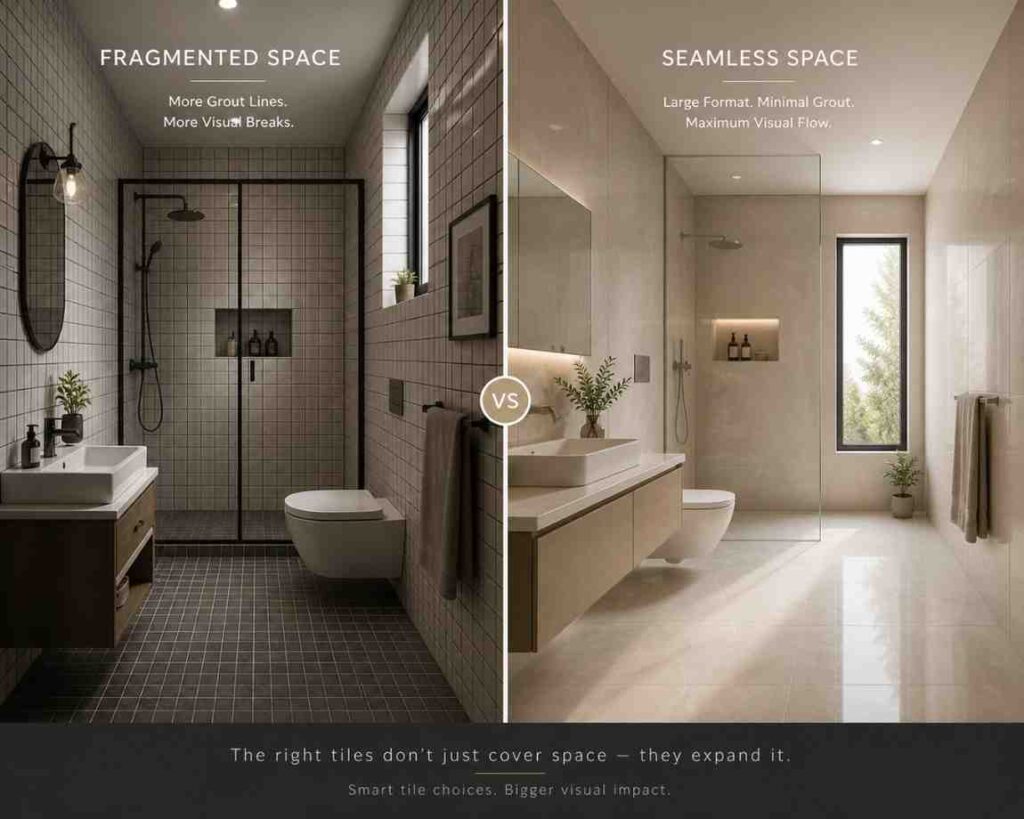
When surfaces are divided into multiple segments, the brain interprets each section independently, which reduces the perceived size of the space. the brain reads them as multiple zones instead of one continuous space. This is why traditional small tiles often make bathrooms look even smaller.
The key psychological triggers that reduce perceived space are:
- Too many grout lines breaking continuity
- Dark surfaces absorbing available light
- High-contrast patterns creating visual noise
- Disconnected floor and wall finishes
From a perception standpoint, the human eye naturally follows continuous lines, brightness, and flow. When these are disrupted, the brain assumes the space is limited.
This is one of the reasons why the This shift is also supported by industry data, as India has become the world’s second-largest tile producer, with strong growth in porcelain segments driven by durability and design flexibility, according to IBEF, as highlighted in industry growth insights —because they align with how people perceive space, not just how they decorate it.
What Makes Porcelain Tiles Ideal for Small Bathrooms
Porcelain tiles are not just another surface option—they are engineered for precision, density, and design consistency.
Porcelain tiles have a water absorption rate of less than 0.5% (ASTM C373 standard), along with high structural density, making them highly resistant to moisture and deformation.
This level of manufacturing precision is supported by large-scale production hubs like Morbi, which contributes up to 80–90% of India’s ceramic exports, highlighting the global reliability of porcelain tile manufacturing according to Government data
What makes porcelain particularly powerful in small bathrooms is its ability to support:
- Larger tile sizes without compromising durability
- Uniform surface patterns that reduce visual clutter
- Multiple finishes (glossy, satin, matte) for light control
7 Porcelain Tile Ideas That Visually Expand Small Bathrooms (Expert-Level, Practical Guide)
Instead of thinking in terms of “tile ideas,” professionals approach small bathrooms through visual control systems. Every surface decision affects how the eye reads scale, light distribution, continuity, and movement.
A small bathroom feels cramped when the eye is forced to stop, reset, and process too many elements. It feels spacious when the eye can move smoothly, continuously, and without resistance.
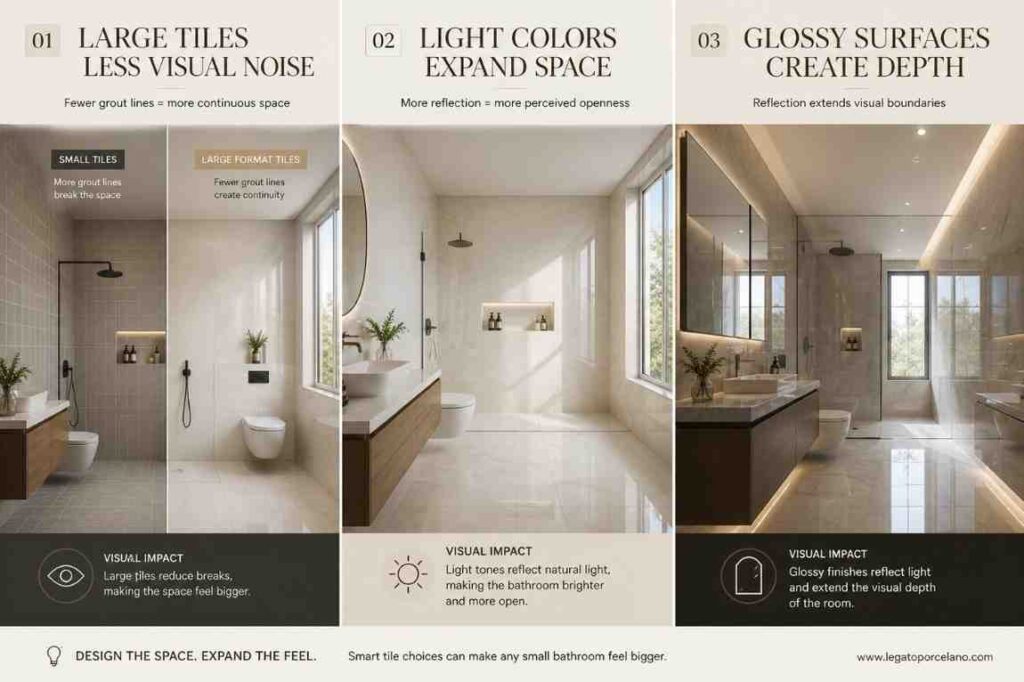
1. Large-format tiles are not a trend—they are a spatial optimization tool.
Smaller tiles increase grout joints per square meter, creating visual segmentation that compresses perceived space, it increases the number of grout joints per square meter, which creates visual segmentation. The brain interprets each segment separately, compressing perceived space.
When you switch to formats like 600×1200 mm or larger, you dramatically reduce these interruptions. The result is a continuous visual field, where surfaces feel broader and more stable.
From an execution standpoint, this only works if installation quality matches the material:
- Substrate must be perfectly level (variation < 2–3 mm)
- Use tile leveling systems to avoid lippage
- Adhesive coverage should be near 100% (especially for large tiles)
If these are ignored, the same large tile can create shadow lines and uneven reflections—making the space feel worse instead of better.
Insight:
You are not choosing larger tiles—you are reducing how frequently the eye has to stop and reprocess the surface.
2. Light Color Tiles Control Luminance and Shadow Behavior
In small bathrooms, color must be treated as a functional layer of light engineering. Light-toned porcelain tiles increase the room’s overall luminance by reflecting both direct and ambient light.
This does two important things:
- Reduces shadow contrast in corners
- Softens visual edges, making boundaries less defined
However, the mistake most people make is using pure white everywhere, which can feel flat and clinical. A more refined approach is tonal layering:
- Walls: high reflectance tones (warm white, ivory, soft beige)
- Floor: slightly deeper tone for visual grounding
- Accents: minimal and low contrast
This creates depth without fragmentation.
Insight:
It’s not about “light vs dark”—it’s about how light travels and distributes across surfaces.
3. Glossy Finishes Extend Space Through Controlled Reflection
Surface finish determines how light behaves after it hits the tile. Glossy porcelain tiles have high specular reflectivity, meaning they reflect light in a directional way that creates subtle visual extension.
In small bathrooms, this effect:
- Reduces edge definition
- Creates depth beyond actual wall planes
- Enhances brightness without adding fixtures
However, uncontrolled use of gloss can create glare or safety issues. That’s why professionals typically balance finishes:
- Walls: glossy or polished for reflection
- Floors: matte or satin (R9–R11 slip resistance)
Also, glossy tiles perform best when paired with clean lighting design. Poor lighting placement can create uneven reflections and visual distortion.
Insight:
Reflection is not decoration—it’s controlled depth creation.
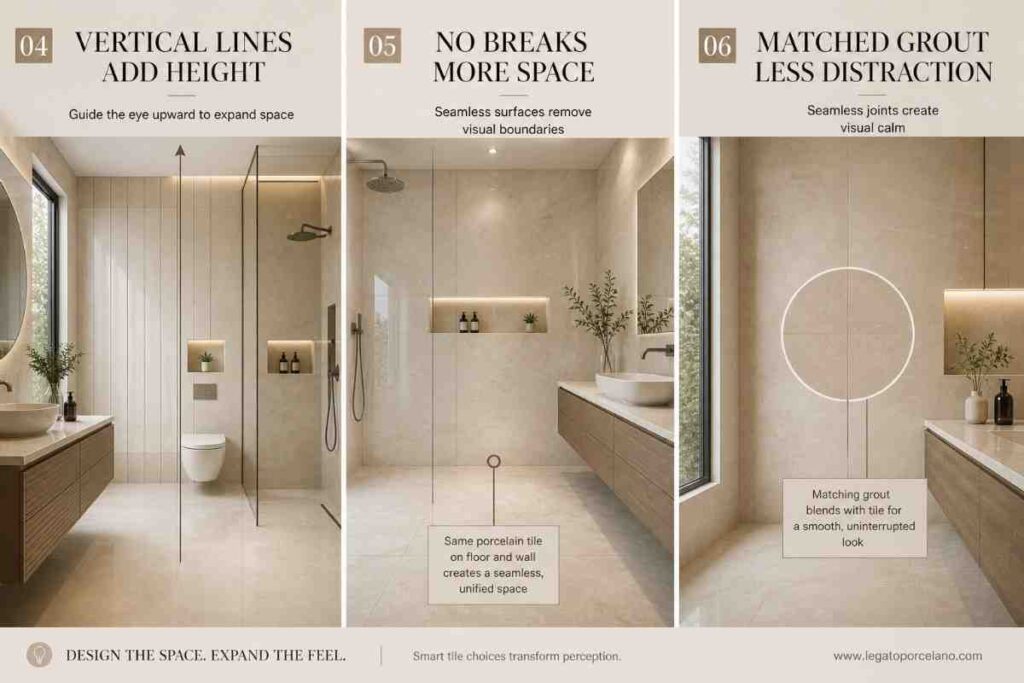
4. Vertical Layouts Reprogram Height Perception
Tile orientation is one of the most underutilized tools in bathroom design. Vertical layouts work because they align with how the brain interprets directional cues.
When grout lines run vertically, they create a continuous upward pathway, guiding the eye from floor to ceiling. This shifts perception from width to height, making the room feel taller.
For this to work effectively:
- Use straight (stacked) layouts, not staggered
- Maintain strict joint alignment
- Avoid mixing orientations within the same wall
This strategy is particularly powerful in:
- Low ceiling bathrooms
- Shower zones where vertical emphasis enhances enclosure height
Insight:
You are not increasing ceiling height—you are training the eye to prioritize vertical movement.
5. Floor-to-Wall Continuity Eliminates Spatial Breakpoints
One of the strongest ways to visually expand a bathroom is to remove the line where the floor meets the wall. When different materials or colors are used, this junction becomes a hard boundary, clearly defining the limits of the space.
By using the same porcelain tile across both surfaces, you eliminate that breakpoint. The eye no longer reads separate planes—it reads a single continuous volume.
Technically, this requires:
- Consistent tile calibration (uniform sizing)
- Accurate alignment of joints across surfaces
- Proper waterproofing transitions
When executed correctly, this approach creates a calm, uninterrupted environment that feels significantly larger than it is.
Insight:
The moment you remove boundaries, you remove perceived limits.
6. Matching Grout Minimizes Micro-Level Visual Noise
Grout is often treated as a secondary detail, but in small bathrooms, it has a disproportionate visual impact. High-contrast grout creates a grid pattern that divides the surface into multiple smaller units.
This increases cognitive load and makes the space feel tighter.
When grout color matches the tile:
- Joints visually recede
- Surfaces appear smoother and more continuous
- The eye flows naturally without interruption
From a technical perspective:
- Use rectified porcelain tiles for tighter joints (2–3 mm)
- Select stain-resistant grout to maintain visual consistency over time
Insight:
At a micro level, grout either supports continuity or destroys it.
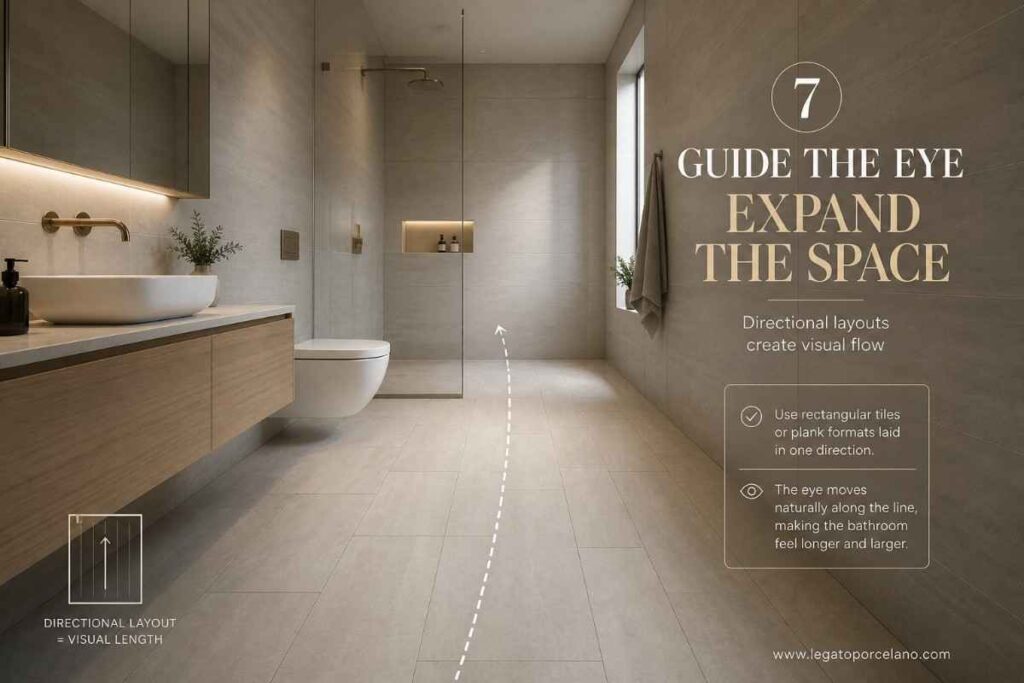
7. Directional Layouts Design Eye Movement
Tile layout is not just placement—it’s movement design. The way tiles are oriented determines how the eye travels through the space.
In small bathrooms, the goal is to extend visual pathways:
- Linear layouts can elongate a narrow bathroom
- Diagonal layouts break rigid geometry and create dynamic depth
However, this approach requires precision. Poor cuts, misalignment, or inconsistent spacing can create visual tension instead of flow.
Directional layouts work best when used selectively—either on floors or feature walls—not everywhere.
Insight:
You are not arranging tiles—you are engineering the path the eye will follow.
“ Most advice says use big tiles and light colors, but real space expansion comes from controlling continuity, luminance, reflectivity, and direction.
When these four elements work together, a bathroom feels larger—without any structural change. “
Tile Layout Science: How Direction Controls Space
Most blogs stop at “tile ideas,” but layout is where real transformation happens.
The direction in which tiles are placed directly affects spatial perception:
- Horizontal layouts make the room feel wider
- Vertical layouts emphasize height
- Diagonal layouts introduce movement and depth
This is not just design—it’s visual psychology in action.
Long-Term Value Comparison of Bathroom Tiles
| Factor | Porcelain | Ceramic | Natural Stone |
|---|---|---|---|
| Initial Cost | Medium–High | Low–Medium | High |
| Maintenance | Very Low | Medium | High |
| Durability | Very High | Medium | Medium |
| Moisture Resistance | Excellent | Moderate | Low |
| Lifespan | 15–25+ years | 8–12 years | 10–15 years |
From a long-term decision perspective, the differences between tile materials become more evident:
- Ceramic tiles may save money upfront but often compromise durability
- Natural stone adds premium appeal but increases maintenance effort
- Porcelain creates a balance between design consistency, structural performance, and long-term visual stability.
A deeper comparison of performance vs cost across materials is explained in this guide on best tiles for flooring.
In small bathrooms, this balance matters more because every imperfection becomes visually amplified.
How to Choose the Right Tiles
Tile selection becomes more predictable when approached as a structured decision system rather than a visual preference. Instead of overthinking designs, focus on a few key decisions that directly impact space perception.
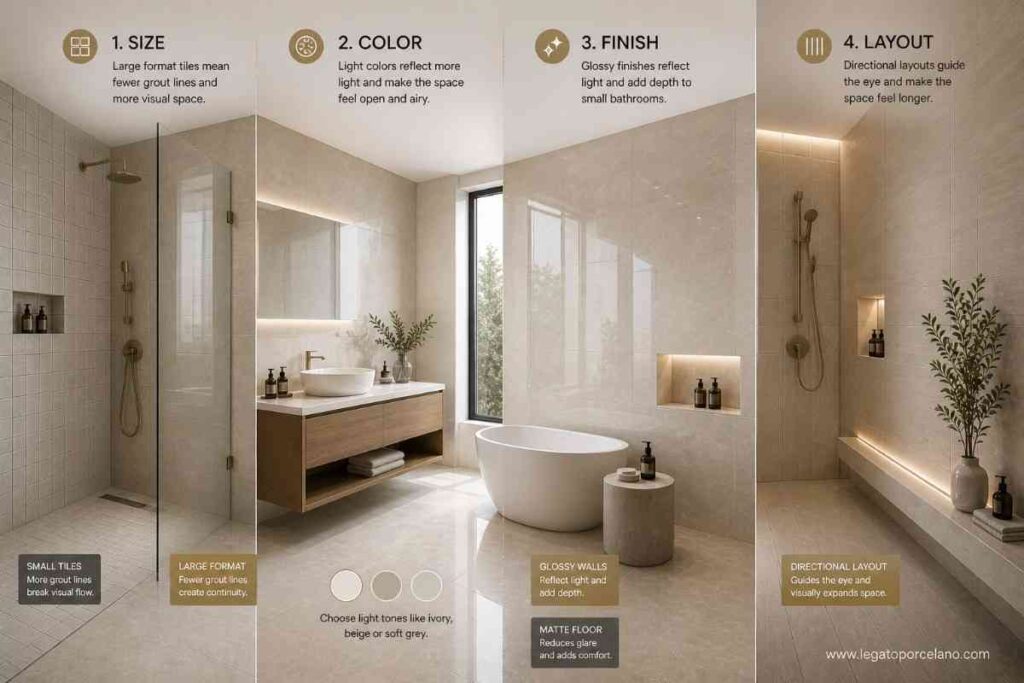
Size: because it defines how fragmented or continuous your bathroom looks. Larger tiles reduce grout lines, which instantly makes the space feel more open.
Color: Light tones help reflect available light, making the bathroom feel brighter and more spacious, while darker tones tend to compress the space visually.
Finish: Glossy or satin surfaces enhance light movement, while matte finishes provide a softer but less expansive effect.
Layout: determines how the eye travels across the room. Vertical layouts increase perceived height, while seamless layouts remove visual boundaries altogether.
If you are evaluating options, reviewing real porcelain tile collections or requesting samples can help you better understand scale, finish, and light interaction before finalizing your selection.
The best tile is not the one that looks premium in a showroom.
It’s the one that controls perception, survives usage, and stays visually stable over time.
Key Trends Shaping Modern Small Bathrooms (2026 & Beyond)
Small bathroom design is no longer driven by decoration—it is driven by surface performance, spatial continuity, and perception control. The materials, layouts, and finishes being used today are directly influenced by how humans perceive scale, light, and continuity.
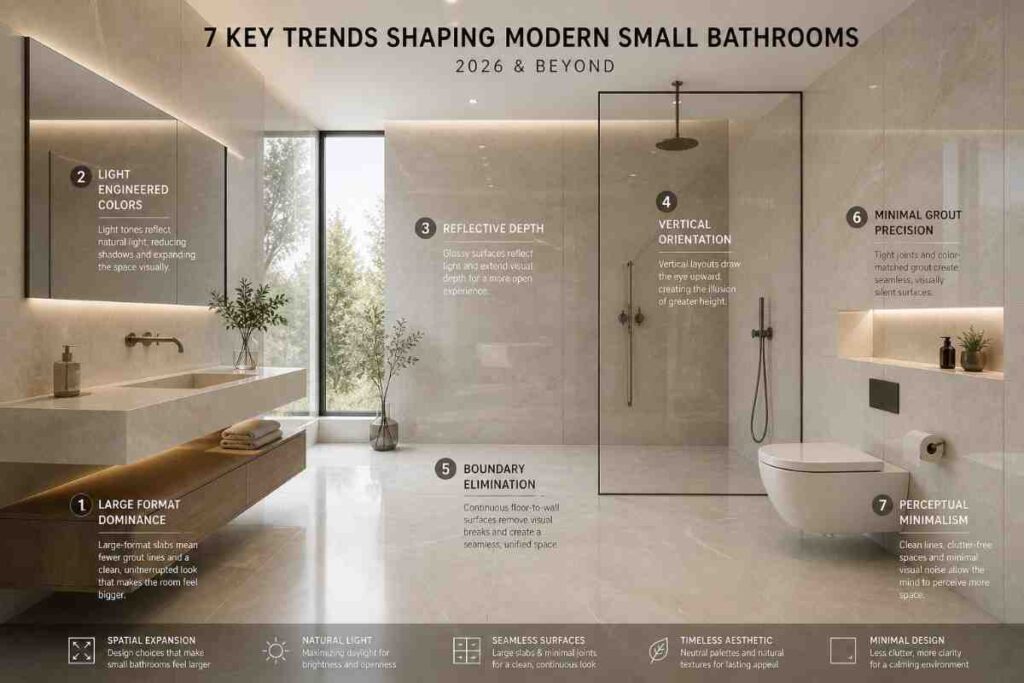
Large-format surfaces are redefining spatial perception
Larger porcelain formats reduce grout-line frequency, directly lowering visual fragmentation in compact spaces.
This improves continuity, allowing the eye to perceive the bathroom as a single uninterrupted plane.
As a result, formats like 600×1200 mm and above are becoming the new baseline in modern specifications.
Boundary elimination is becoming a core design strategy
Using the same tile across floor and walls removes visible transitions between surfaces. This eliminates spatial boundaries, making the room feel volumetrically larger than its actual size.
The approach is now widely adopted in premium residential and hospitality bathroom design.
Color is engineered for light diffusion, not decoration
Neutral tones are selected for their ability to scatter light evenly across surfaces. This reduces shadow contrast, which is a primary factor in making spaces feel smaller.
Soft beige, grey, and stone-inspired palettes are therefore dominating modern tile selections.
Surface finish acts as a light-control layer
Glossy and satin finishes are used to reflect and distribute light across confined spaces. This controlled reflection enhances depth perception without introducing glare or visual fatigue.
Finish selection is now based on lighting conditions, not just aesthetic preference.
Grout lines are minimized to reduce visual noise
High-contrast grout creates grid patterns that visually break the space into smaller units. Matching grout tones with tiles reduces this segmentation and maintains surface continuity.
This technique significantly lowers cognitive load, making the space feel cleaner and larger.
Material performance is driving specification decisions
Porcelain tiles offer water absorption below 0.5%, ensuring durability in wet environments. This makes them resistant to stains, moisture damage, and long-term surface degradation.
As a result, performance reliability is now a key factor in modern bathroom material selection.
Minimalism is evolving into perceptual efficiency
Modern minimalism focuses on reducing visual interruptions rather than removing elements blindly. Every line, contrast, and joint is evaluated based on its impact on spatial clarity.
This creates environments that feel larger because they are easier for the brain to process.
The future of bathroom design is not about adding more—it’s about removing what interrupts space perception.
These trends are not temporary—they reflect a deeper shift toward perception-driven design. Manufacturers like Legato Porcelano are already aligning with this evolution, focusing on surfaces that combine visual continuity with technical performance.
Conclusion
A small bathroom doesn’t need more space—it needs smarter design decisions. The way tiles are selected and applied directly affects how the space is perceived, from light reflection to visual continuity.
The most effective small bathroom porcelain tile ideas focus on reducing visual breaks, improving brightness, and guiding how the eye moves across the room. When size, color, finish, and layout are aligned, even compact bathrooms can feel open and balanced.
Porcelain tiles play a key role because they combine durability with design flexibility, making them ideal for achieving both performance and visual expansion.
In the end, it’s not about adding more elements—it’s about removing what interrupts space.
FAQs
Yes, large-format porcelain tiles reduce grout lines, which minimizes visual fragmentation. This creates a continuous surface, allowing the eye to move freely and making the bathroom appear more spacious.
Light and neutral tones such as beige, soft grey, and warm white are ideal. These colors reflect light effectively, reduce shadow contrast, and help create a brighter, more open visual environment.
Reliable manufacturers focus on precision, consistency, and performance. For example, brands like Legato Porcelano offer large-format porcelain surfaces designed specifically for modern architectural applications and compact spaces.
Glossy porcelain tiles are generally better for small bathrooms because they reflect light and create depth. However, for flooring, a matte or satin finish is recommended to maintain slip resistance while balancing reflection.
Tiles sized 600×1200 mm or larger are highly effective because they reduce grout joints and improve surface continuity. The key is proper installation, as uneven surfaces can negatively affect the visual outcome.
Look for suppliers who provide consistent sizing, certified quality standards, and a wide range of formats and finishes. Established manufacturers such as Legato Porcelano typically offer better reliability for both residential and commercial projects.
