Introduction
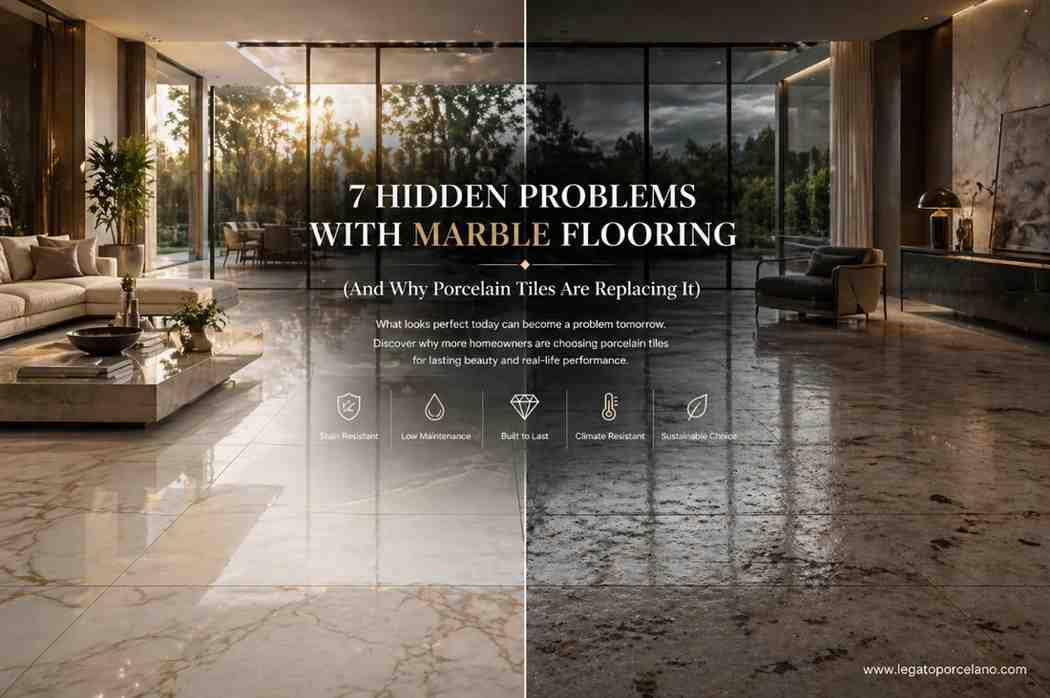
Marble flooring looks stunning on day one But what most homeowners don’t realize is this: the real problems don’t show up immediately—they appear slowly over time.
“The biggest mistake? Most people judge marble in the first 30 days—not after 5 years.”
What starts as a premium design choice can turn into ongoing maintenance, unexpected costs, and visible wear that’s hard to reverse. This is why many modern homeowners are rethinking marble—and exploring smarter alternatives like porcelain tiles that align better with real-life usage.
According to industry insights from IBEF, India has become one of the largest producers of ceramic and porcelain tiles globally, driven by advancements in manufacturing technology and growing demand for high-performance materials.
This shift is not just about production scale—it reflects a broader change in how modern flooring is evaluated: not just by appearance, but by durability, maintenance, and long-term usability.
This evolution has introduced a new perspective:
Is marble still the best choice—or are modern alternatives better suited for today’s living?
Increasingly, homeowners are exploring porcelain tiles as an alternative to marble flooring, especially when balancing design with practicality. In this guide, we break down marble vs porcelain tiles based on real-world usage, not just showroom appeal.
Why Marble Flooring Requires a Deeper Evaluation
Marble is a natural material—and that’s where its complexity begins. Its organic structure makes every surface unique, but also more sensitive to everyday conditions like moisture, dust, and wear.
The biggest mistake is judging marble at installation, not after years of use.
Flooring is a long-term decision. It affects:
- maintenance effort
- Long-term visual consistency
- Cost of upkeep over years
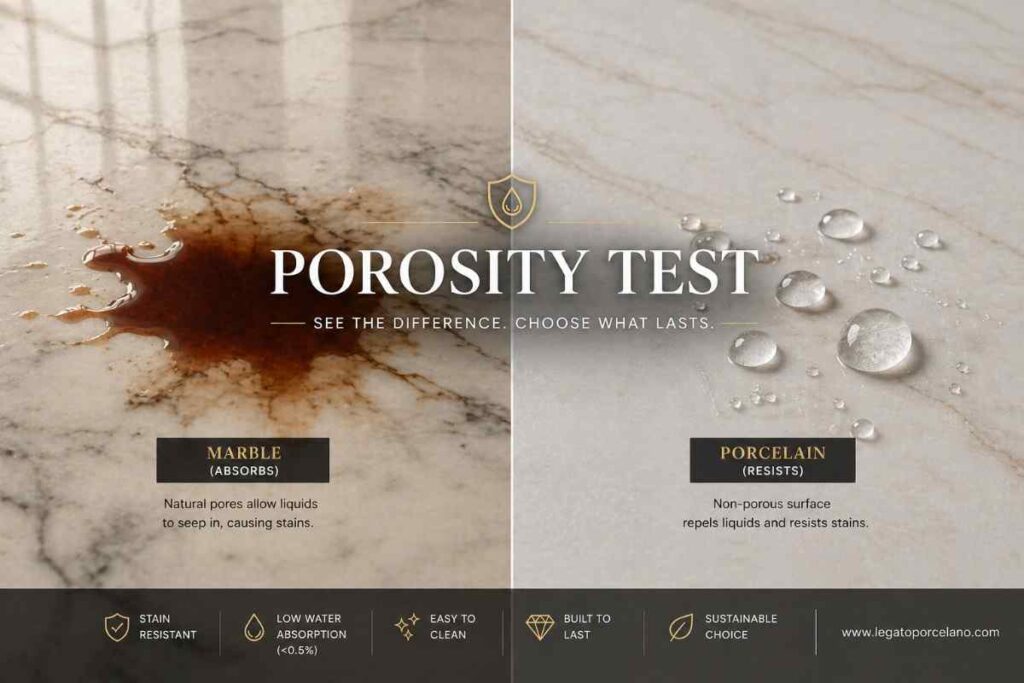
From a technical perspective, marble contains natural micro-pores that allow liquids to seep in—making sealing essential.
Porcelain, by contrast, is engineered at high temperatures (above 1200°C), into a dense, vitrified surface with water absorption typically below 0.5%, making it far more resistant to stains, moisture, and long-term damage.
7 Overlooked Factors That Impact Long-Term Living
1. Appearance vs Long-Term Performance
Marble delivers unmatched visual depth on day one, but maintaining that finish over time requires effort. Its surface is naturally reactive, which means it can gradually lose its polish when exposed to daily wear.
Small scratches, mild etching from spills, and general dullness are common after prolonged use. These changes are not always immediate—but they accumulate.
Porcelain, being engineered, is designed for visual stability. Its surface layer is resistant to common household interactions, allowing it to retain its appearance with far less intervention. This difference becomes more evident in high-traffic spaces where consistency matters.
Industry Insight:
Engineered porcelain surfaces are manufactured with near-zero porosity, making them inherently resistant to these issues—without relying on chemical treatments.
2. Maintenance Reality
One of the biggest gaps in decision-making is underestimating maintenance. Marble flooring is not difficult to maintain—but it is demanding.
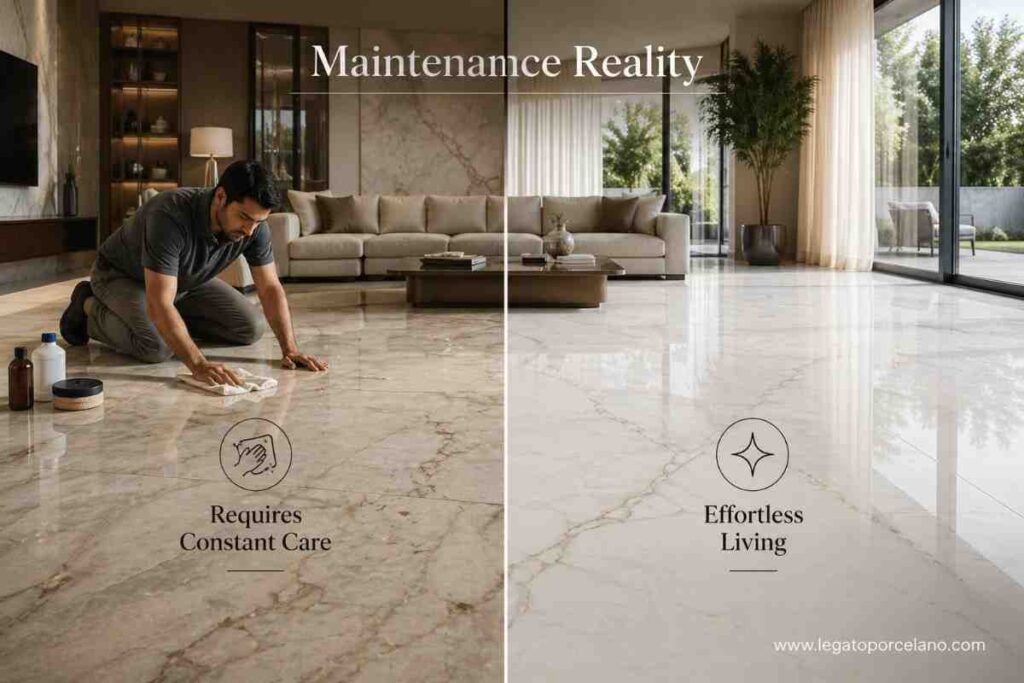
It typically involves:
- Careful selection of cleaning products
- Periodic sealing to prevent absorption
- Polishing to restore shine
Even minor neglect can impact its surface condition.
Porcelain tiles simplify this entirely. They are non-porous and chemically stable, which means they don’t require sealing or specialized care. For homeowners managing busy routines, this reduction in effort often becomes a deciding factor over time.
3. Climate Sensitivity
climate introduces a layer of complexity that many buyers don’t fully account for. Marble, due to its porous nature, can respond to environmental conditions in subtle but important ways.
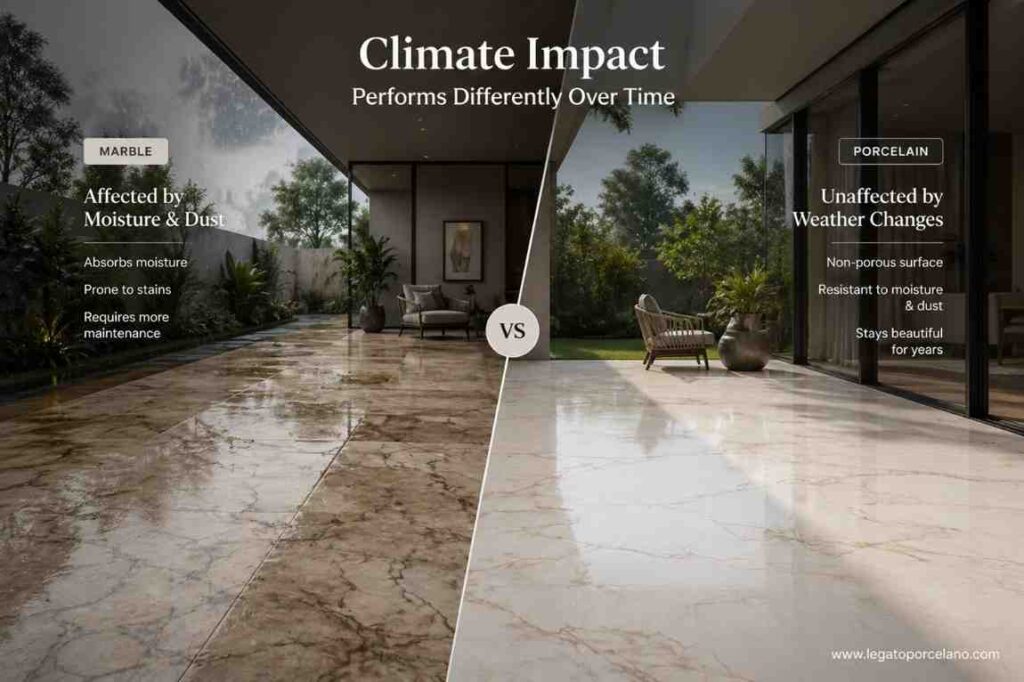
In humid regions, it may absorb moisture. In dusty environments, it may require more frequent cleaning to maintain its finish. Over time, these factors influence both appearance and durability.
Porcelain tiles are far more stable in comparison. Their extremely low water absorption rate (0.5% or less) allows them to perform consistently across different climates, making them suitable for both indoor and semi-outdoor applications.
4. Lifecycle Cost vs Initial Cost
Marble is often perceived as a long-term investment, but the actual cost extends beyond the initial purchase. Over time, maintenance and restoration contribute significantly to the total expense.
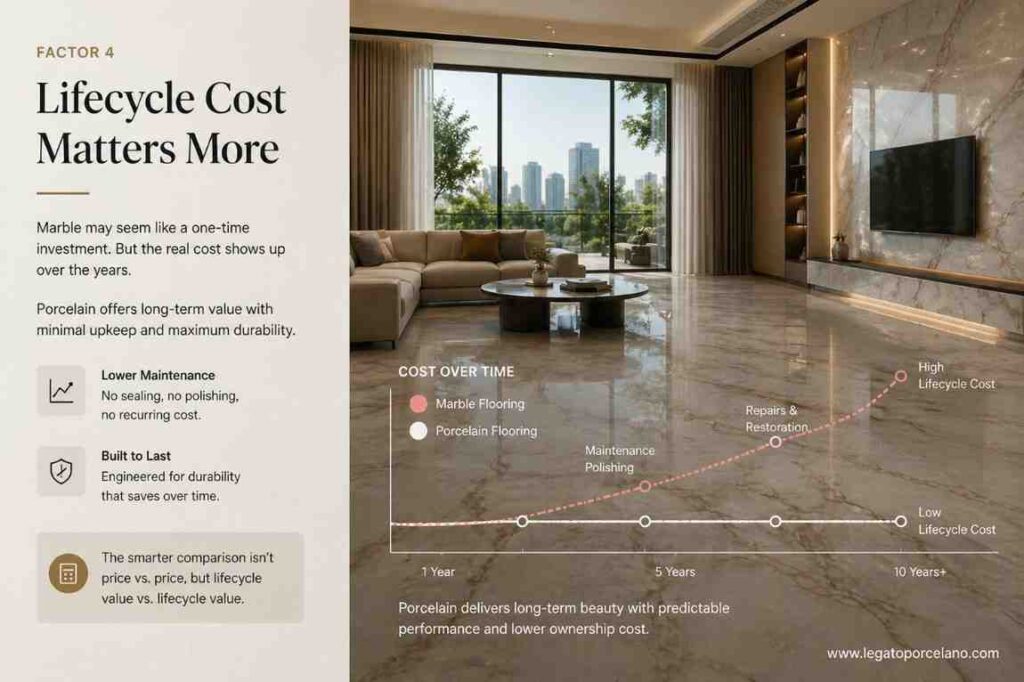
These ongoing factors include:
- Polishing and refinishing
- Repairs for stains or surface damage
- Professional maintenance services
Porcelain tiles, by contrast, are more predictable in terms of lifecycle cost. Since they require minimal upkeep, the long-term financial impact is easier to manage.
For those evaluating flooring from a cost-efficiency perspective, it’s useful to explore how modern materials are being used in large-scale porcelain applications, where durability and consistency become critical
“ The smarter comparison is not price vs price, but lifecycle value vs lifecycle value. “
5. Finish & Slip Risk
Surface finish is not just an aesthetic decision—it directly affects usability. Polished marble can appear highly refined, but it may also become slippery under certain conditions, particularly when wet.
This makes it less suitable for spaces like bathrooms, kitchens, or entryways where safety is a concern.
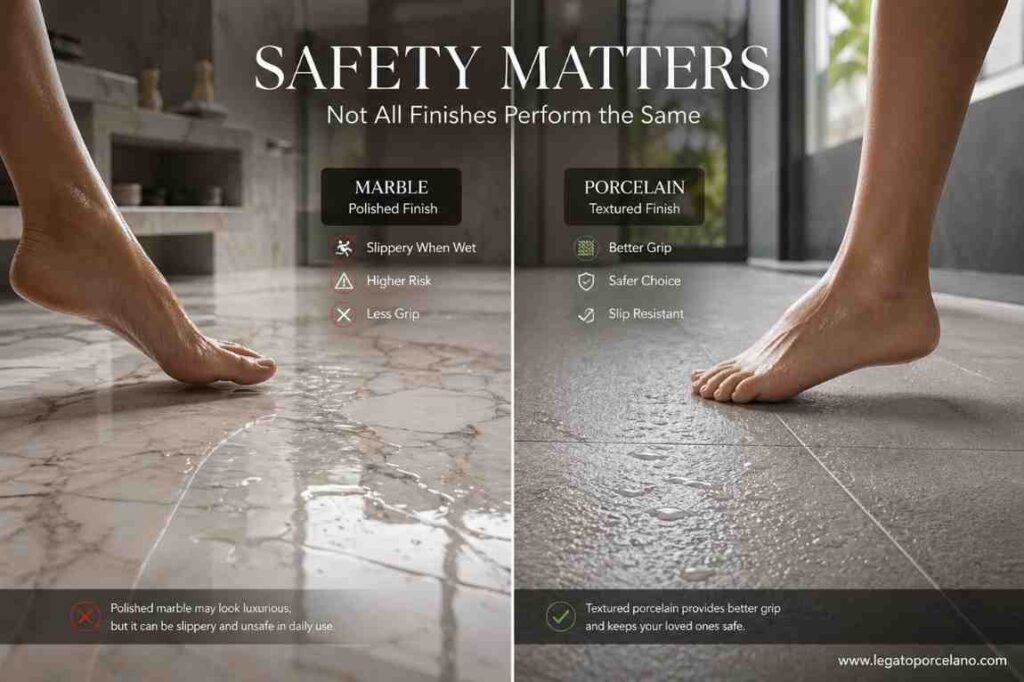
Porcelain tiles offer greater flexibility in this regard. Different finishes—including matte and textured options—allow users to choose a balance between design and functionality without compromising safety.
Surface safety is often measured using slip resistance ratings such as the coefficient of friction (COF). Many porcelain tiles are manufactured with finishes that meet higher slip resistance standards, making them suitable for wet and high-risk areas without compromising design.
“Real performance isn’t tested in showrooms— it’s tested in everyday life.”
6. Installation Precision
Marble installation is highly dependent on craftsmanship. Each slab varies slightly in thickness and structure, requiring careful alignment and skilled handling.
This increases both installation time and dependency on experienced labor.
Porcelain tiles are manufactured with precision. Rectified edges and uniform dimensions allow for cleaner installation, tighter joints, and a more consistent finish. This not only improves aesthetics but also reduces complexity during execution.
7. Limited Exploration of Modern Alternatives
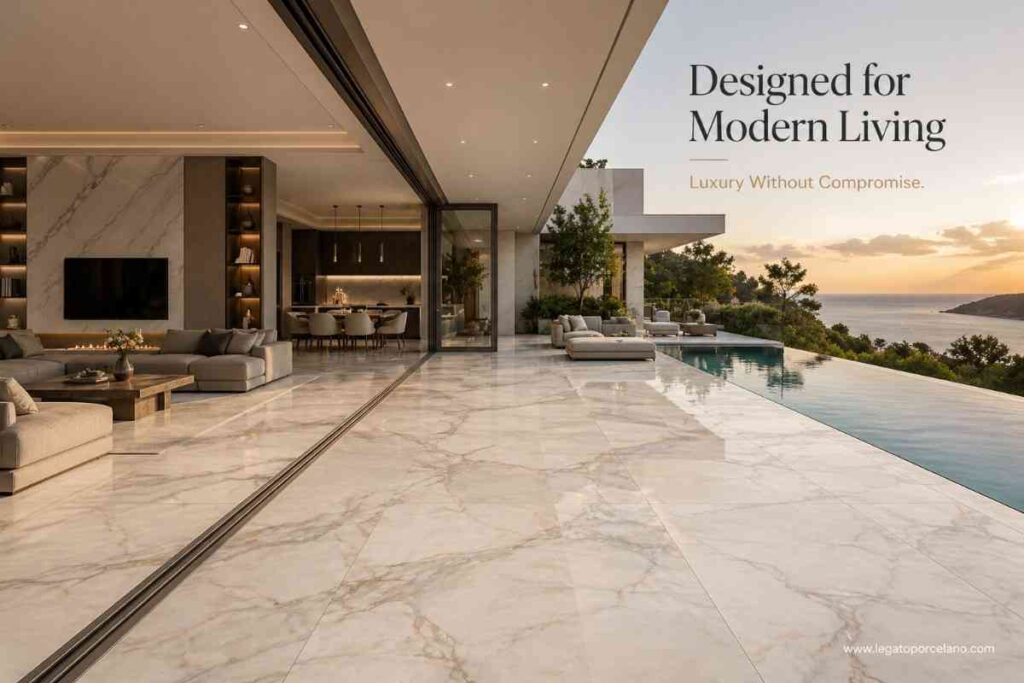
Perhaps the most overlooked factor is not exploring alternatives deeply enough. Many buyers compare marble only with basic tile options, missing the evolution that has taken place in surface technology.
Modern porcelain surfaces—especially marble-look variants—have advanced significantly in recent years.
They replicate natural textures and patterns with remarkable accuracy while offering improved durability. To understand how these materials fit into broader flooring choices, it helps to look at current design and material trends shaping the industry
Clients choose marble for beauty but stay with porcelain for peace of mind
Marble vs Porcelain Tiles — A Modern Perspective
When comparing marble vs porcelain tiles, the differences go far beyond appearance. From durability and maintenance to long-term cost, each material performs very differently in real-life conditions.
| Factors | Marble | Porcelain Tiles |
|---|---|---|
| Composition | Natural calcium carbonate stone | Engineered vitrified ceramic |
| Water Absorption | High (porous) | ≤0.5% (non-porous) |
| Mohs Hardness | 3–5 | Higher engineered hardness |
| Maintenance | Requires sealing & polishing | Minimal maintenance |
| Chemical Resistance | Sensitive to acids | Highly resistant |
| Dimensional Consistency | Natural variation | Factory precision |
| Lifecycle Cost | Increases over time | More predictable |
When viewed through a long-term lens, the difference becomes clear. Marble delivers natural beauty, but requires ongoing care to maintain it. Porcelain tiles offer a more predictable experience—combining durability, low maintenance, and consistent performance for everyday living.
“A good flooring choice should still feel right after years—not just on day one.”
Why More Homeowners Are Choosing Porcelain Today
The growing preference for porcelain tiles is not just a passing trend—it reflects a clear shift in how modern flooring is evaluated.
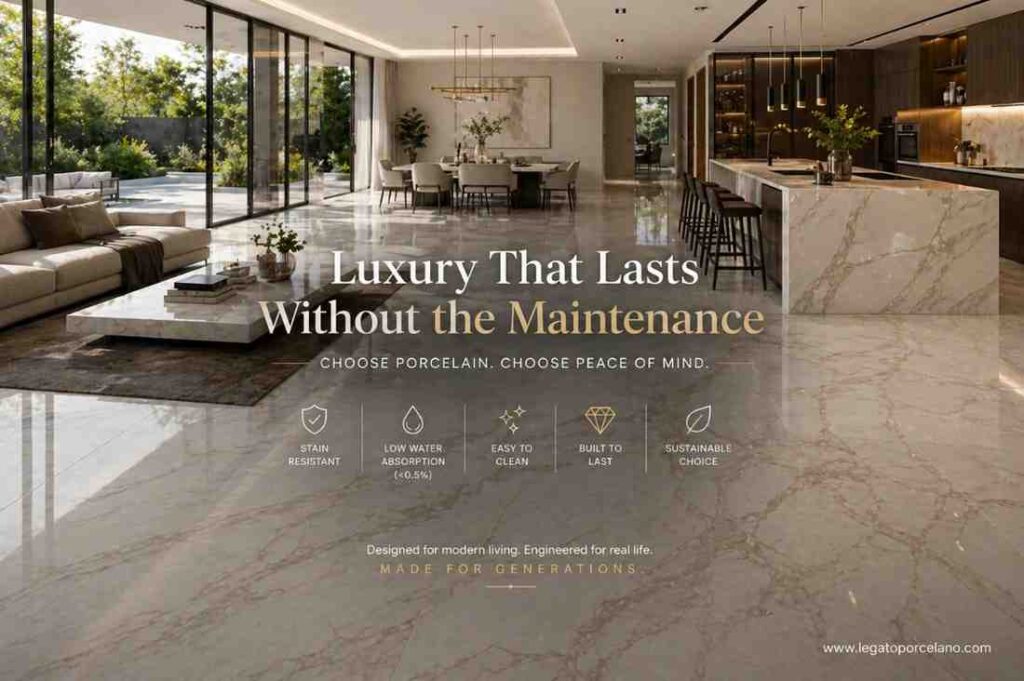
Today, homeowners are prioritizing durability, ease of maintenance, and long-term performance alongside aesthetics. This is where porcelain tiles have gained strong momentum, especially in markets like India where environmental conditions and daily usage demand more from flooring materials.
India’s Morbi region, in Gujarat, has become a global center for advanced tile manufacturing. According to official Government data, Morbi contributes 80–90% of India’s ceramic and porcelain tile exports, supplying high-quality materials to international markets
This growth reflects not just scale, but rapid advancement in porcelain technology, surface design, and manufacturing precision.
As a result, more homeowners are choosing porcelain because it offers:
- Strong resistance to scratches, stains, and daily wear
- Minimal maintenance without the need for sealing or polishing
- Consistent appearance across large spaces
- Flexibility in finishes suitable for different areas
In addition, modern porcelain tiles can closely replicate the look of natural materials like marble, allowing homeowners to achieve a premium aesthetic without the same level of upkeep.
Manufacturers such as Legato Porcelano, based in Morbi, are contributing to this shift by developing large-format porcelain surfaces designed for contemporary architectural needs.
Ultimately, the decision is becoming less about tradition and more about performance—and porcelain tiles align naturally with how modern homes are built and used today.
For most modern households, the shift toward porcelain is not just about design—it’s about reducing effort, risk, and long-term uncertainty.
Making the Right Choice for Your Space
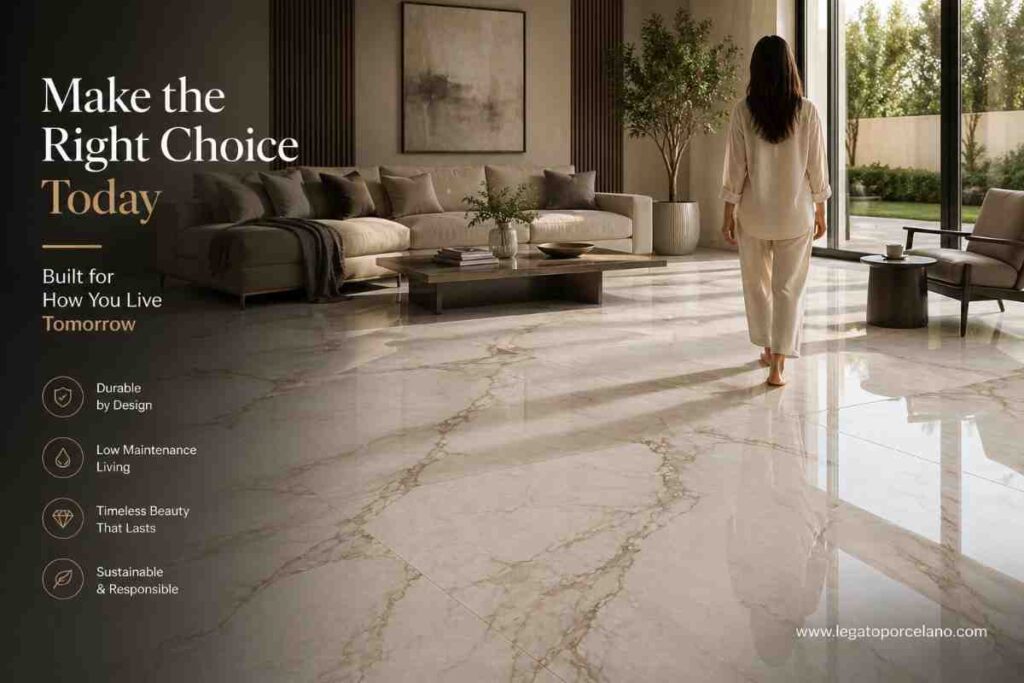
There is no universally correct choice between marble and porcelain. The decision depends on how the space will be used and what priorities matter most.
If the goal is to achieve a naturally unique, heritage-style aesthetic, marble remains a compelling option. However, if the focus is on long-term convenience, durability, and consistent performance, porcelain offers a strong alternative.
The key is not to choose based on perception—but to align the material with real-life usage.
“Good design looks beautiful. Smart design stays beautiful.
Conclusion
When evaluating marble vs porcelain tiles, the right choice depends on how you prioritize beauty, performance, and long-term practicality.
Marble offers a timeless, natural aesthetic that has defined luxury spaces for generations. However, it requires ongoing care, attention, and maintenance to preserve its original finish. Over time, factors like wear, moisture, and usage can impact its appearance and increase overall upkeep.
Porcelain tiles, in contrast, are engineered for modern living. They deliver consistent performance, high durability, and minimal maintenance—making them better suited for today’s fast-paced lifestyles and varied environmental conditions.
Ultimately, the decision between marble vs porcelain tiles should not be based solely on first impressions, but on how the material performs over years of daily use. A well-informed choice ensures that your flooring not only looks good on day one, but continues to perform effortlessly for years to come.
FAQs
Marble offers natural beauty, but porcelain tiles provide better durability, lower maintenance, and more consistent long-term performance.
Yes, porcelain tiles perform well in Indian climates due to low water absorption, heat resistance, and minimal maintenance needs.
Yes, premium porcelain surfaces from brands like Legato Porcelano offer marble-like aesthetics with enhanced durability for luxury spaces.
Modern porcelain tiles can closely replicate marble patterns using advanced digital printing, offering a similar aesthetic with better practicality.
Porcelain tiles are easier to maintain since they don’t require sealing or polishing and resist stains more effectively than marble.
You can explore modern collections from manufacturers like Legato Porcelano, known for large-format and design-focused porcelain surfaces.
