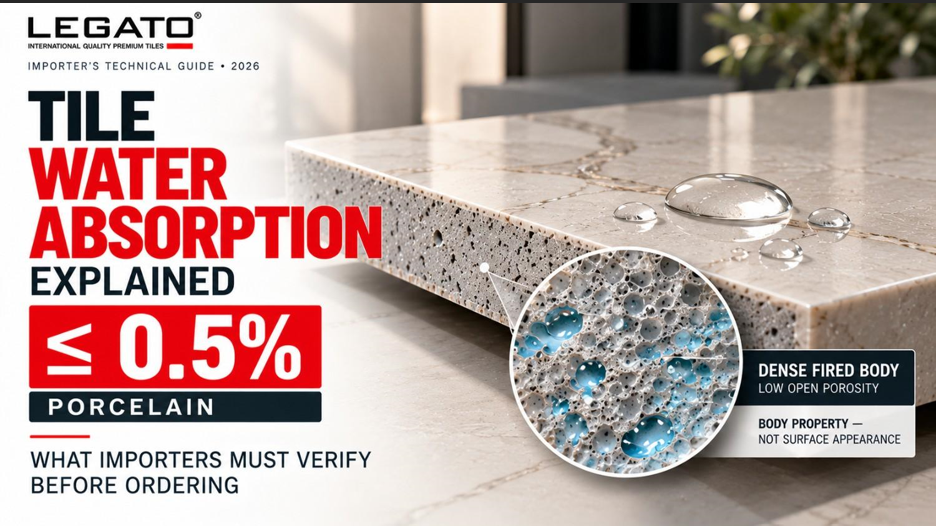
Quick answer: Tile water absorption measures how much water a fired ceramic tile body absorbs under a defined laboratory test, expressed as a percentage of dry mass. Porcelain tile water absorption is generally 0.5% or less where the applicable product framework defines the product as porcelain. However, water absorption is only one part of product selection. For exterior, wet or freeze-thaw applications, buyers should also verify frost resistance, slip performance, structural requirements and the manufacturer’s declared area of use. Use current test documentation for the exact product rather than relying on appearance or marketing terminology.
Buyers generally associate porcelain with a denser, lower-absorption body than many non-porcelain ceramic tiles. For porcelain tile water absorption, what matters in procurement is the measured result and the applicable product classification rather than appearance or terminology alone.
What Is Tile Water Absorption and What Does It Measure?
Water absorption indicates how much water the fired ceramic body takes up under the specified test conditions. It provides useful information about the accessible porosity of the fired tile body and can help indicate its degree of maturation. Lower absorption generally indicates a denser body, but it should not be used as a substitute for separate tests of frost resistance, staining, slip performance or mechanical strength.
A tile water absorption test should be interpreted according to the applicable standard and procedure. The ISO 10545-3 water absorption test determines water absorption and related properties of ceramic tiles, while ASTM C373 tile testing covers water absorption and associated properties using procedures applicable to specified ceramic product types. Water absorption is calculated from the difference between dry and saturated mass.
Water Absorption (%) = [(Wet Weight − Dry Weight) / Dry Weight] × 100
Example:
If a dry tile weighs 1,000 g and its saturated weight is 1,004 g, the water absorption is 0.4%.
Water absorption is primarily a property of the fired tile body rather than a judgement based on surface appearance. A glazed porcelain tile can still have a low-absorption porcelain body, while visually similar glazed products can have different body classifications. For this reason, buyers should verify the measured absorption value rather than infer it from the glaze or surface finish.
Why Does the Tile Water Absorption Test Method Matter When Comparing Reports?
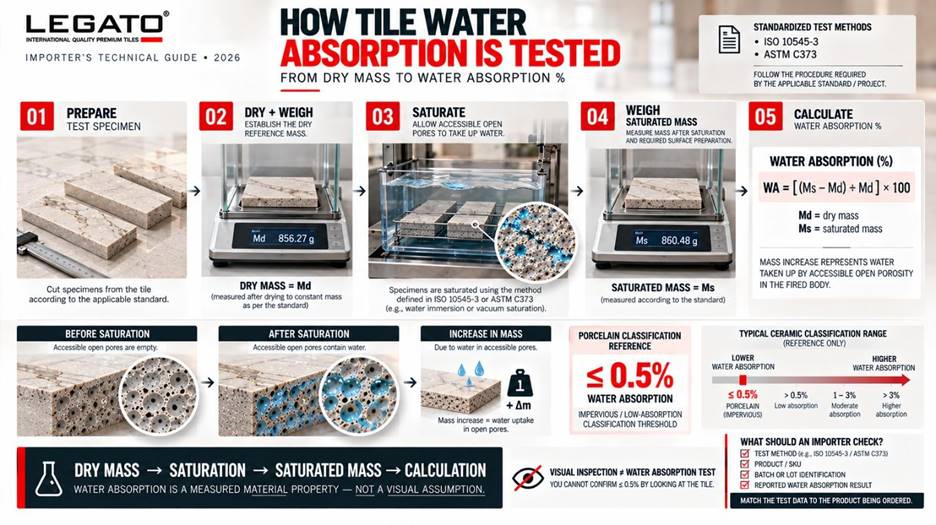
Water-absorption results should be interpreted together with the test standard, test method and edition used.
Different test procedures and saturation methods can influence the reported result, so buyers should confirm that reports were produced using comparable standards and procedures before comparing numerical values directly.
The ISO 10545-3 water absorption test specifies the determination of water absorption and related properties for ceramic tiles. ASTM C373 also covers water-absorption testing, with the applicable procedure depending on the ceramic product type.
For imported porcelain tile, buyers should therefore check:
- the test standard and edition;
- the applicable saturation or preparation method;
- the exact product or SKU tested;
- the reported water-absorption value; and
- whether the report applies to the product currently being ordered.
When two suppliers report slightly different absorption values, first confirm that the results were generated under comparable standards and procedures before treating the numerical difference as a difference in product quality.
How Does Tile Water Absorption Classification Work?
Water-absorption testing and tile water absorption classification are related but separate. ISO 10545-3 provides the test method, while ISO 13006 establishes ceramic-tile classification groups within the ISO framework. In the U.S., ANSI A137.1 classifies ceramic tile using water-absorption results determined under ASTM C373. Because the ranges are not identical, buyers should treat the ISO and ANSI systems as separate classification frameworks.
The following table compares classification ranges; it should not be read as stating that ISO and ANSI categories are direct equivalents.
| Water Absorption | ISO 13006 Group* | ANSI A137.1 Classification | Buyer Interpretation |
|---|---|---|---|
| E ≤ 0.5% | BIa | Impervious | Very low-absorption ceramic tile; porcelain classification depends on the applicable product standard and definition |
| 0.5% < E ≤ 3% | BIb | Vitreous | Low-absorption ceramic tile |
| 3% < E ≤ 6% | BIIa | Semi-vitreous | Medium-low absorption |
| 6% < E ≤ 7% | BIIb | Semi-vitreous | Medium-high absorption |
| 7% < E ≤ 10% | BIIb | Non-vitreous | Higher absorption; ISO and ANSI categories differ in this range |
| E > 10% | BIII | Non-vitreous | Higher-absorption ceramic tile |
Note: *The ISO “B” groups shown above apply to dry-pressed ceramic tiles. ISO and ANSI classification ranges are not exact equivalents, particularly above 6% absorption.
How Water Absorption Influences Product Selection
Does Low Water Absorption Guarantee Frost Resistance?
Freeze-thaw exposure: A low porcelain tile water absorption rate may reduce the amount of water available within the tile body to freeze and expand, but low absorption alone does not prove frost resistance. Buyers evaluating with the manufacturer’s declared exterior suitability and project-specific requirements.
Does Low Water Absorption Guarantee Stain Resistance?
Staining and maintenance: Low body absorption limits water uptake into the ceramic body, but it should not be treated as a complete measure of stain resistance or hygiene performance. Surface finish, glaze, grout, chemical exposure and cleaning procedures can also affect maintenance performance. Where stain resistance is critical, review the applicable product test data separately.
Does Water Absorption Determine Dimensional Performance?
Dimensional performance: Water absorption should not be used as a substitute for dimensional or movement-related testing. Warpage, moisture expansion, thermal movement, substrate conditions and installation quality are separate factors that should be evaluated according to the product and project requirements.
What Controls Tile Water Absorption During Manufacturing?
Actual measured water absorption can vary between ceramic bodies and production runs because it depends on composition, forming and firing conditions. Products sold as porcelain should still meet the applicable ≤0.5% absorption definition where that classification is claimed.
Particle-size distribution and body composition: Final porosity depends on the combined effects of raw-material composition, particle-size distribution, granulation, forming conditions and firing. Finer grinding alone should not be treated as proof of lower water absorption; the finished product should be verified through measured technical data.
Pressing and forming conditions: Compaction during forming influences the green-body structure before firing and can affect the final porosity of the tile. The resulting water absorption should be verified from the technical data for the exact finished product rather than inferred from press tonnage or tile size alone.
Firing temperature and vitrification: During firing, porcelain bodies undergo vitrification, which reduces open porosity and contributes to the dense, low-absorption structure associated with porcelain tile. Inconsistent firing conditions can affect the final absorption result even when the raw-material formulation is similar.
The practical implication for importers: Two suppliers can use similar-sounding body descriptions and still report different absorption results because the final result reflects the combined effects of body composition, forming and firing conditions. Buyers should therefore rely on measured product data rather than marketing terminology, particularly on repeat or technically critical orders.
Buyer note: Water absorption is established by the fired body and should therefore be verified before procurement. Installation quality remains important, but it does not replace the need for an appropriate tile classification for the intended application.
What Should Importers Check in Tile Water Absorption Test Documentation?
For importers, test results should be reviewed in the context of the product and production documentation supplied for the order.
Laboratory reports are based on tested samples rather than every individual tile in a shipment. For large, repeat or technically critical orders, buyers should confirm whether the available test documentation represents the current product and production conditions. Where the project specification requires additional assurance, representative sampling or independent verification may also be considered before shipment.
A surface glaze does not replace verification of the tile body’s water-absorption classification. A glazed porcelain tile can still have a porcelain body with water absorption of 0.5% or less. Cut edges and drilled areas expose the tile body, so buyers should evaluate the actual porcelain tile water absorption result and the manufacturer’s application guidance rather than assuming suitability from labels such as “glazed,” “unglazed” or “full-body” alone.
Absorption Does Not Equal Slip Resistance or Breaking Strength
A common buyer mistake is assuming that a low-absorption tile is automatically suitable for any exterior floor. Water absorption, slip performance and mechanical strength describe different product characteristics and should be evaluated separately where relevant to the application. Where these characteristics are important, buyers should review documentation against the applicable test standard. Examples may include ISO 10545-12 or ASTM C1026 for frost resistance, ISO 10545-4 for breaking strength, ANSI A326.3 where DCOF slip-performance evaluation is applicable, and ISO 10545-7 for surface-abrasion resistance of glazed floor tiles.
Why Should Importers Verify Current Product Documentation?
A technical data sheet is useful only when it accurately represents the product being supplied. For repeat or long-running product lines, buyers should confirm that the available documentation remains applicable to the current product and production conditions, particularly where the project has strict technical requirements.
For technically critical orders, confirm the product identification, relevant production information and applicable test documentation before shipment. Independent verification may also be appropriate where required by the buyer, project specification or destination market.
A Practical Selection Framework
| Application | Water-Absorption / Classification Check | Additional Performance Verification |
|---|---|---|
| Exterior or freeze-thaw applications | Confirm the classification required by the applicable framework—for example, the relevant ISO group or ANSI water-absorption classification—and verify the declared absorption result | Frost resistance: ISO 10545-12 or ASTM C1026; manufacturer-declared exterior suitability; installation requirements |
| Pool decks and wet walking areas | Confirm product classification required by the specification | Verify applicable slip-performance data, drainage conditions, surface finish and manufacturer area-of-use guidance |
| Commercial kitchens and food-service areas | Confirm the specified product classification | Verify slip, stain, chemical-resistance and cleaning requirements |
| Commercial interior floors | Match absorption/classification to the project specification | Verify abrasion, breaking strength, dimensions and applicable slip performance |
The appropriate tile water absorption classification and acceptance requirement depend on the applicable product framework and intended application; exterior, wet and freeze-thaw uses also require separate performance checks.
For import orders spanning multiple end uses in one shipment, buyers should review absorption data by relevant SKU or product specification rather than assuming that one blanket requirement applies to every product in the order.
Do not use water absorption as the only acceptance criterion for an application. The exact requirements should come from the project specification, applicable standards and manufacturer documentation.
Frequently Asked Questions (FAQ’s)
Where the product is specified and classified as porcelain, buyers should generally confirm a water-absorption result of 0.5% or less under the applicable product framework. For freeze-thaw, pool or façade use, also verify the product’s applicable frost, exterior and project-specific performance requirements.
No. Low water absorption is relevant to porcelain classification, but freeze-thaw suitability should be verified separately using applicable frost-resistance data, such as ISO 10545-12 or ASTM C1026, together with the manufacturer’s declared area of use.
Large format alone does not create a different water-absorption classification. For large-format porcelain slabs, buyers should verify the declared absorption result and ensure that specimen preparation and testing follow the applicable test standard for the exact product.
Buyers should request water absorption reports, testing standards, production dates, and batch traceability records. Legato Porcelano’s export team works with importers to provide technical documentation that helps verify product suitability before containers are dispatched.
Porcelain tile is generally associated with water absorption of 0.5% or less under the applicable product framework. Buyers should verify the declared value using the applicable test method and current technical documentation for the exact product.
Requesting lot-specific test reports and verifying technical documentation before shipment helps reduce procurement risk. Legato Porcelano supports buyers with production-linked quality documentation, allowing specifications to be reviewed against the actual manufacturing batch rather than relying solely on catalogue data.
Buyers should request water absorption reports, testing standards, production dates, and batch traceability records. Legato Porcelano’s export team works with importers to provide technical documentation that helps verify product suitability before containers are dispatched.
ISO 10545-3 provides a method for measuring ceramic-tile water absorption, while ISO 13006 provides ceramic-tile definitions and classification groups. In simple terms, ISO 10545-3 tests the property, while ISO 13006 uses properties such as water absorption within the classification framework.
Key Takeaway
A tile water absorption classification should be supported by the applicable test result and product framework, but it does not independently establish suitability for exterior, wet or freeze-thaw applications. Buyers should verify the absorption value together with the other performance requirements relevant to the project.
Conclusion
Tile water absorption is an important specification to verify before importing ceramic tile, particularly where porcelain classification, exterior exposure or freeze-thaw conditions are relevant. Buyers should match the declared porcelain tile water absorption value to the exact product and intended application, then review other requirements such as frost resistance, slip performance, breaking strength and dimensional accuracy separately.
For projects using large-format porcelain slabs, review the applicable technical data for the selected product before finalising the order.
