Brand: Legato Porcelano
Category: Commercial Office Flooring
Reading Time: ~7 Minutes
Quick Answer
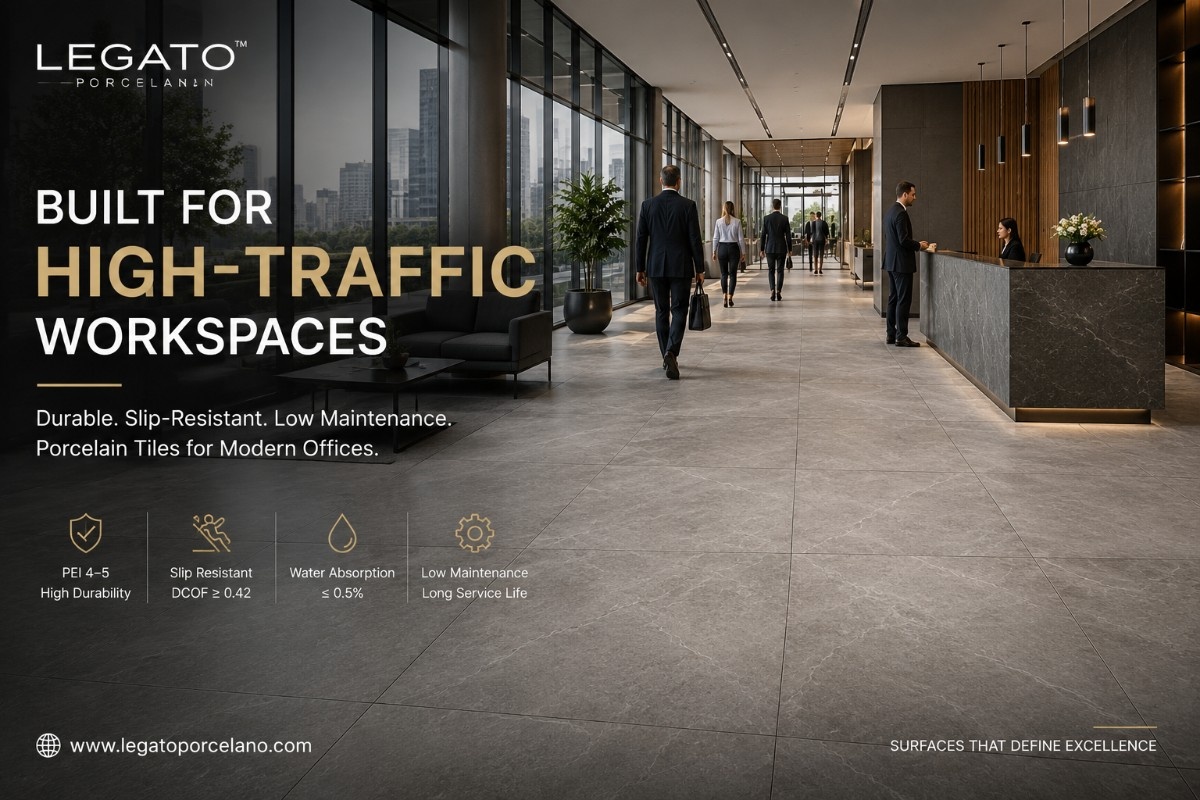
Porcelain tiles are ideal for high-traffic office spaces because they offer exceptional durability, low water absorption, strong stain resistance, long service life, and minimal maintenance. Commercial-grade porcelain tiles with PEI 4–5 ratings and ANSI-compliant slip resistance perform reliably in office lobbies, corridors, conference rooms, and workspaces where constant foot traffic and rolling loads are common.
PEI 4–5 porcelain tiles are typically recommended for modern office environments with continuous daily traffic.
Why Office Flooring Matters More Than Most Businesses Realize
In modern offices, flooring is more than a design decision. It directly affects durability, maintenance costs, workplace safety, and the overall appearance of the workspace.
A busy commercial office experiences continuous movement every day:
- employees walking across corridors
- visitors entering reception areas
- office chairs rolling repeatedly
- equipment carts and cleaning machines moving across surfaces
Many flooring materials begin showing visible wear within a few years under these conditions. Scratches, stains, fading, edge damage, and maintenance problems quickly reduce the professional appearance of the workplace.
This is why architects, facility managers, and commercial interior designers increasingly prefer porcelain tiles for office flooring. Properly specified porcelain tiles combine long-term durability with modern aesthetics, making them one of the most reliable flooring solutions for commercial environments.
What Makes Porcelain Tiles Suitable for Commercial Offices?
Porcelain tiles are manufactured using refined clay and minerals fired at extremely high temperatures. This process creates a dense and highly durable surface capable of handling commercial traffic conditions.
One of the most important technical standards for porcelain tiles is water absorption.
Water Absorption<0.5%
According to ASTM C373 standards, a tile qualifies as porcelain only when its water absorption rate is 0.5% or lower. This low absorption rate makes porcelain highly resistant to:
- moisture penetration
- stains
- surface damage
- chemical exposure
For commercial offices, this matters because entrances, breakrooms, and circulation zones experience regular exposure to dirt, moisture, and cleaning chemicals.
Unlike softer flooring materials, porcelain maintains its structural stability and appearance for many years even in demanding environments.
“Commercial flooring performance is defined by durability, safety, and long-term maintenance efficiency — not appearance alone.”
Commercial Specification
| Requirement | Recommended Standard |
|---|---|
| Water Absorption | ≤0.5% |
| PEI Rating | PEI 4–5 |
| Slip Resistance | DCOF ≥0.42 |
| Best Finish | Matte or Textured |
| Recommended Tile Type | GVT / PGVT |
| Ideal Application | Offices, Lobbies, Corridors |
Understanding PEI Ratings for Office Flooring
The Tile Council of North America (TCNA) enforces this through the Porcelain Tile Certification Agency (PTCA), which independently tests and certifies products submitted by manufacturers. The PEI rating is one of the most important factors when selecting porcelain tiles for commercial spaces.
PEI (Porcelain Enamel Institute) ratings measure how resistant a tile surface is to visible wear caused by foot traffic. Higher PEI ratings indicate better durability for demanding environments.
Recommended PEI Ratings for Commercial Offices
| Office Area | Recommended PEI |
|---|---|
| Main Lobby | PEI 5 |
| Corridors | PEI 4–5 |
| Open Workspaces | PEI 4 |
| Conference Rooms | PEI 4 |
| Breakrooms | PEI 4 |
| Private Offices | PEI 3–4 |
For most office projects, PEI 4 or PEI 5 porcelain tiles provide the best balance between durability and long-term appearance retention.
Lower PEI-rated tiles may look visually attractive initially but can develop surface wear under continuous commercial traffic.
Why Slip Resistance Is Critical in Office Environments
Safety is a major consideration in commercial flooring specifications.
Office entrances, pantry areas, and washroom approaches are vulnerable to moisture exposure, increasing the risk of slips and falls.
Modern commercial porcelain tiles are tested for Dynamic Coefficient of Friction (DCOF), which measures slip resistance under wet conditions.
ANSI A326.3 recommends a minimum DCOF value of 0.42 for interior wet areas.
For office environments, matte and textured porcelain finishes generally provide better grip compared to highly polished surfaces.
Recommended Areas for Textured or Matte Tiles
- office entrances
- reception zones
- pantry areas
- breakrooms
- washroom approaches
- high-traffic corridors
Slip-resistant porcelain tiles not only improve workplace safety but also reduce long-term liability risks for commercial properties.
Porcelain Tiles vs Other Office Flooring Options
Commercial offices use many different flooring materials, but each comes with limitations.
Comparison of Common Office Flooring Materials
| Flooring Type | Lifespan | Maintenance | Water Resistance | Commercial Durability |
|---|---|---|---|---|
| Porcelain Tile | 50+ years | Low | Excellent | Excellent |
| Carpet Tile | 7–12 years | High | Poor | Moderate |
| LVT Flooring | 10–20 years | Moderate | Good | Moderate |
| Natural Stone | 20+ years | High | Moderate | Good |
| Laminate Flooring | 10–15 years | Moderate | Poor | Moderate |
“The cheapest flooring option during installation often becomes the most expensive over the building lifecycle.”
Why Porcelain Performs Better Long-Term
Porcelain tiles offer several advantages over alternative flooring systems:
- resistant to scratches and stains
- suitable for rolling office chairs
- easy to clean
- resistant to moisture
- no regular sealing required
- maintains appearance over time
- compatible with modern commercial interiors
While materials like carpet and vinyl may have lower initial costs, they typically require earlier replacement and higher maintenance over the building lifecycle.
Best Porcelain Tile Specifications by Office Zone
Different office zones require different flooring characteristics. Using one specification across every area often leads to compromises in performance or design.
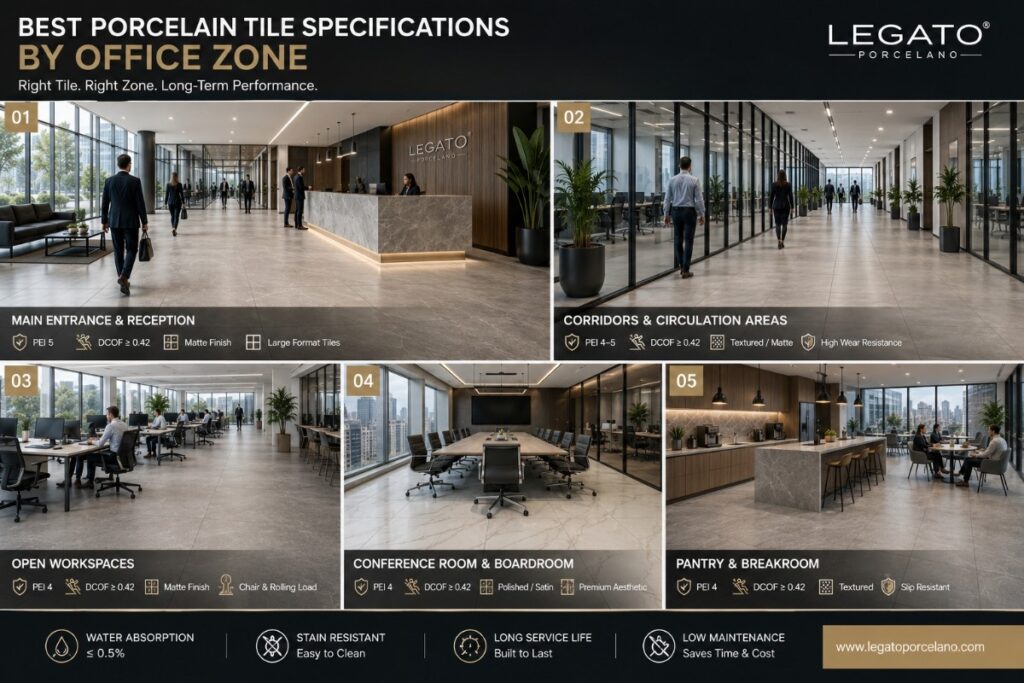
1. Main Entrance & Reception
Traffic Level: Very High
Recommended Finish: Matte or Textured
Recommended PEI: PEI 5
Entrance areas experience the highest concentration of dirt, moisture, and foot traffic. Large-format matte porcelain tiles work best because they reduce visible grout lines and improve visual continuity.
Stone-look and concrete-look GVT tiles are especially popular for modern reception areas.
2. Corridors & Circulation Areas
Traffic Level: High
Recommended Finish: Matte
Recommended PEI: PEI 4–5
Corridors experience continuous movement throughout the day. Durable porcelain tiles help maintain a clean and professional appearance even after years of heavy usage.
Neutral tones such as grey, beige, greige, and warm stone shades work well in corporate environments.
3. Open Office Workspaces
Traffic Level: Moderate to High
Recommended Finish: Matte
Recommended PEI: PEI 4
Open-plan offices benefit from porcelain flooring because it withstands office chair movement and constant occupancy without visible deterioration.
Warm neutral shades create a balanced and comfortable visual environment while complementing modern furniture systems.
4. Conference Rooms & Boardrooms
Traffic Level: Moderate
Recommended Finish: Satin Matte or Lapato
Recommended PEI: PEI 4
Conference rooms require a more refined aesthetic while still maintaining commercial durability.
Marble-look porcelain tiles and subtle stone textures are widely used in executive meeting spaces because they create a premium professional appearance without the maintenance demands of natural marble.
5. Pantry & Breakroom Areas
Traffic Level: Moderate to High
Exposure: Moisture & Food Spills
Recommended Finish: Matte or Textured
Breakrooms require flooring that resists:
- stains
- moisture
- cleaning chemicals
- daily cleaning cycles
Textured GVT tiles provide better grip and easier maintenance in these areas.
Common Commercial Flooring Mistakes
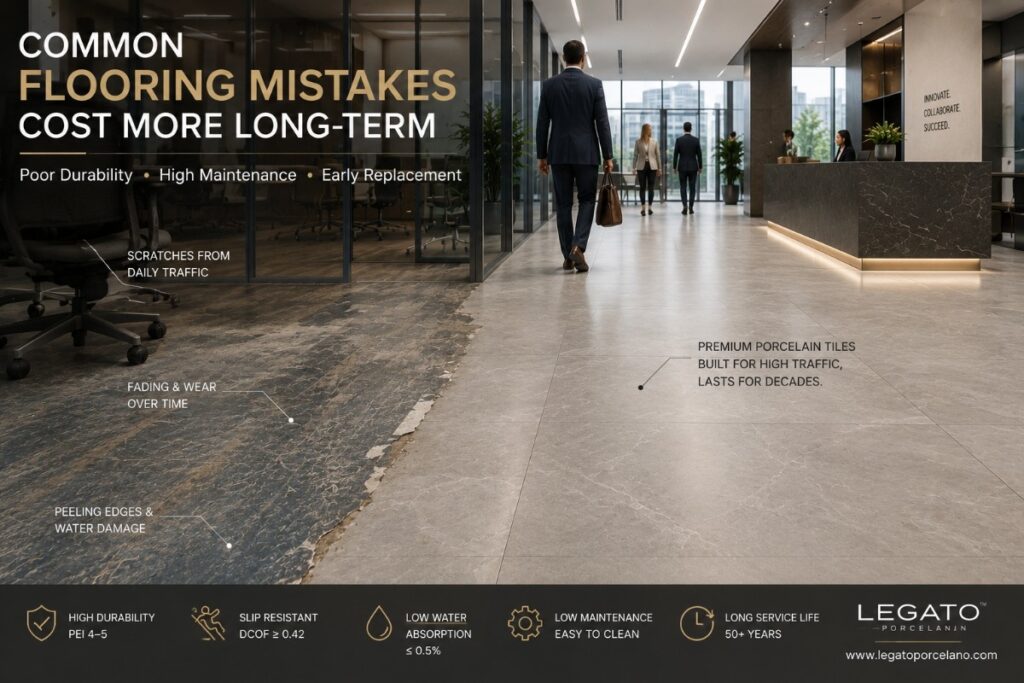
1. Prioritizing Design Over Performance
A visually attractive tile may still fail commercially if it lacks the required PEI rating or slip resistance. Always verify technical specifications before finalizing design selections.
2. Ignoring Slip Resistance Standards
Many projects select polished surfaces without checking DCOF values for wet-risk areas.This creates long-term safety and liability concerns.
3. Choosing Low-Durability Materials for High-Traffic Zones
Using residential-grade flooring in commercial spaces often results in:
- premature wear
- staining
- replacement costs
- maintenance issues
Commercial offices require commercial-grade specifications.
4. Underestimating Maintenance Costs
- sealing
- polishing
- waxing
- deep extraction cleaning
Porcelain tiles simplify maintenance because they only require routine cleaning with standard pH-neutral products.
Long-Term Value of Porcelain Office Flooring
The true value of commercial flooring is measured over decades, not just during installation. Porcelain tiles provide strong long-term returns because they combine:
- durability
- low maintenance
- visual longevity
- commercial-grade performance
Many commercial flooring materials require multiple replacement cycles within 20–30 years. Properly installed porcelain flooring can remain functional and visually appealing far longer with minimal maintenance intervention.
This makes porcelain especially valuable for:
- corporate offices
- business parks
- commercial towers
- coworking spaces
- institutional environments
For facility managers and developers, fewer replacement cycles also mean:
- lower disruption
- lower labor costs
- reduced operational downtime
- better lifecycle economics
Why GVT & PGVT Tiles Are Popular in Modern Offices
Modern office interiors increasingly use GVT (Glazed Vitrified Tiles) and PGVT (Polished Glazed Vitrified Tiles) because they combine durability with premium aesthetics.
Popular commercial office designs include:
- concrete-look porcelain
- marble-look porcelain
- stone-look finishes
- large-format neutral tiles
- industrial-inspired matte textures
These styles help create modern workspaces that feel professional, clean, and visually timeless.
Premium porcelain collections also allow businesses to maintain design consistency across:
- lobbies
- workspaces
- conference rooms
- corridors
- reception areas
Conclusion
Porcelain tiles have become one of the most trusted flooring solutions for high-traffic office spaces because they combine commercial durability, workplace safety, low maintenance, and modern aesthetics in a single material.
When specified correctly with the right PEI rating, slip resistance, and finish, porcelain tiles deliver long-term performance across entrances, corridors, workspaces, and client-facing areas.
For architects, designers, and facility managers looking for reliable commercial flooring, porcelain offers a balance of functionality and premium appearance that few materials can match.
Explore premium commercial porcelain collections from Legato Porcelano for modern office flooring solutions designed for long-term performance and contemporary workspace aesthetics.
FAQs
Porcelain tiles offer exceptional durability, stain resistance, and low maintenance, making them perfect for busy office environments with constant foot traffic.
PEI 4 and PEI 5 tiles are recommended for commercial offices because they can handle continuous movement, rolling chairs, and heavy daily usage.
Yes, matte and textured porcelain tiles provide better slip resistance and help improve workplace safety in entrances, corridors, and pantry areas.
Yes, premium porcelain surfaces from Legato Porcelano require minimal upkeep, reducing repair, replacement, and cleaning expenses over time.
Porcelain tiles last significantly longer, resist scratches and moisture better, and require less maintenance compared to carpet or vinyl flooring.
Legato Porcelano offers premium GVT and PGVT collections designed for durability, modern aesthetics, and long-term commercial performance.
