Quick answer:
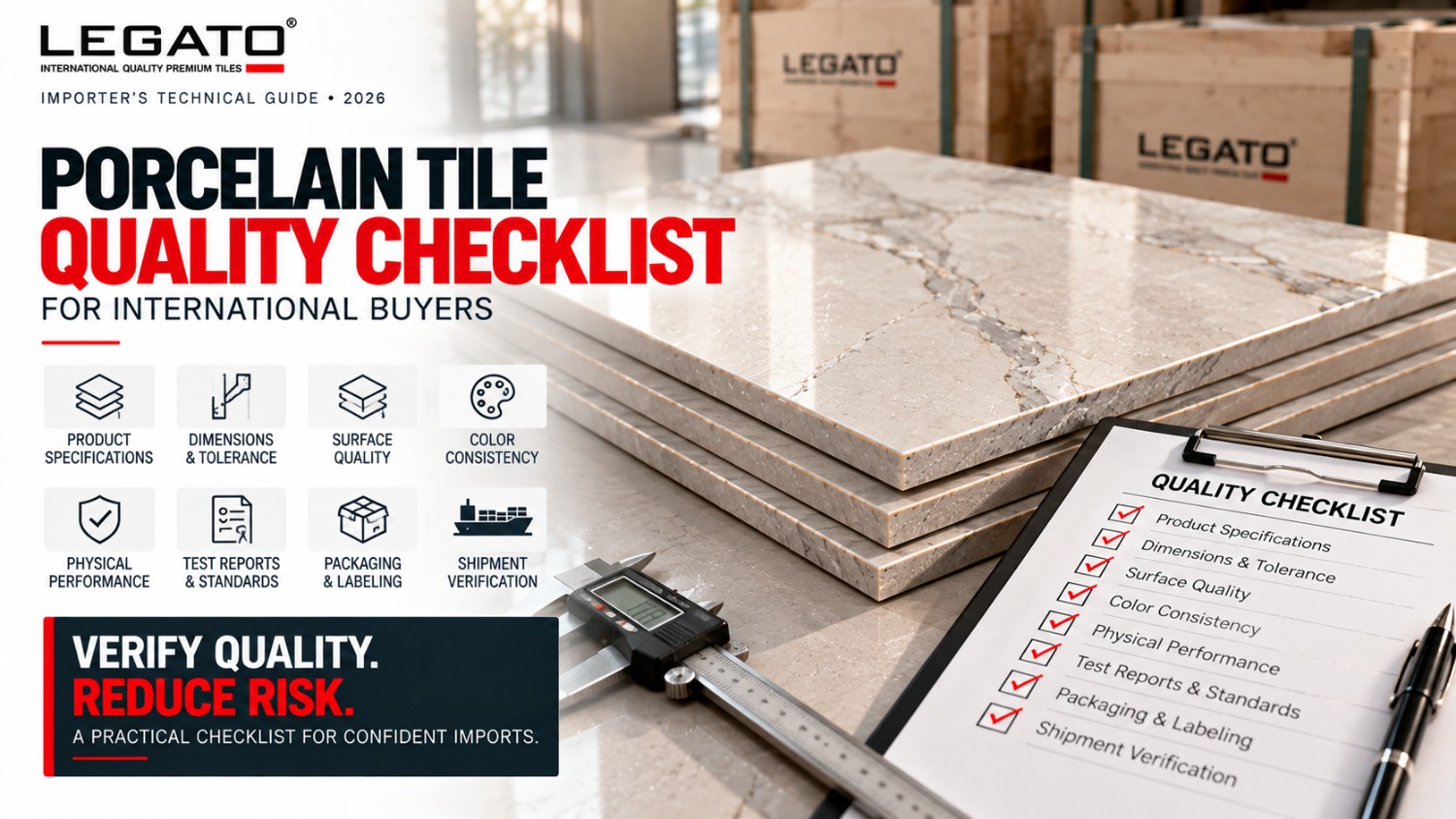
A porcelain tile quality checklist should begin with a documented porcelain tile quality inspection covering product identification, classification, water absorption, dimensional characteristics, abrasion performance appropriate to the surface type, breaking strength, slip-performance data, shade and batch consistency, and relevant destination-market documentation. Porcelain tile is generally classified by water absorption of 0.5% or less, while other acceptance criteria depend on the product type, surface, thickness, intended application and applicable product standard. Buyers should request current technical data and relevant test evidence for the exact product rather than relying only on catalogue claims or appearance.
Visual appearance is only one part of porcelain tile evaluation. Two products may look similar in a showroom while differing in water absorption, dimensional characteristics, abrasion performance, mechanical properties, slip characteristics or other tested properties. This porcelain tile quality checklist therefore combines visual review with technical evidence rather than treating appearance as proof of performance. This porcelain tile buying guide focuses on the checks and documentation international buyers can review before confirming an order or shipment.
Why Porcelain Tile Quality Inspection Cannot Rely on Appearance Alone
A porcelain tile quality inspection should combine visual checks with relevant product data and test evidence. Surface appearance can help assess shade, finish and visible defects, but it cannot by itself confirm water absorption, dimensional conformity, abrasion performance, mechanical properties or other technical characteristics.
An effective porcelain tile quality checklist therefore separates visual observations from laboratory-tested properties and applicable product requirements.
Which Porcelain Tile Quality Standards Should International Buyers Check?
Porcelain tile quality standards depend on the product, destination market, intended application and specification framework. Buyers should distinguish between product standards, laboratory test methods, classification systems, installation requirements and project-specific specifications rather than treating them as interchangeable.
Under the ISO framework, ISO 13006 establishes definitions, classifications, characteristics and marking requirements for ceramic tiles, while the ISO 10545 series contains test methods for individual product characteristics. ISO 13006 remains the current published edition framework while a revision is under development.
The porcelain tile quality checklist below therefore evaluates individual properties and evidence within their applicable technical context instead of reducing tile quality to one universal score.
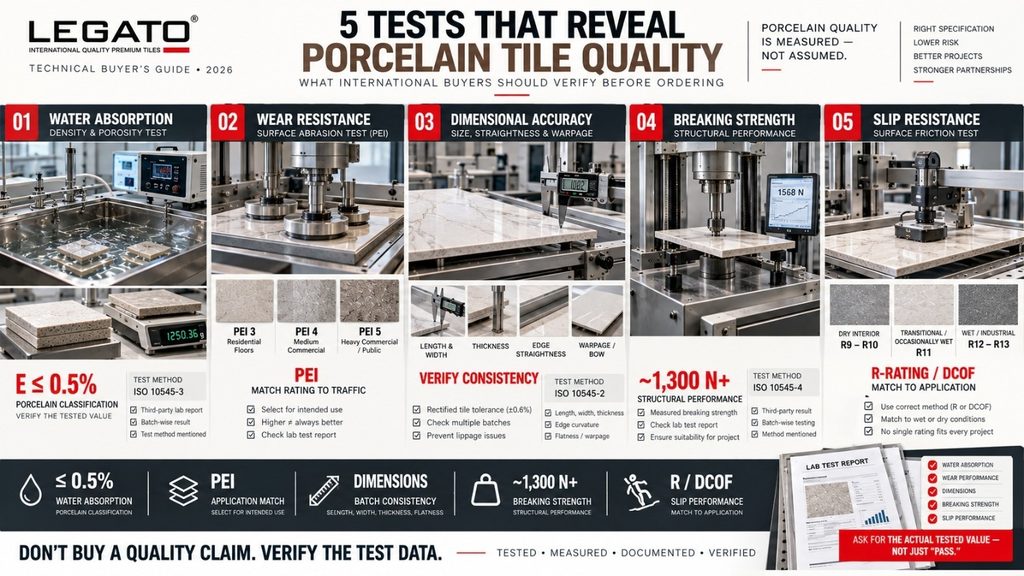
1. Water Absorption (E ≤ 0.5%)
Water absorption is one of the key properties used to confirm porcelain classification. Porcelain tile is generally associated with water absorption of 0.5% or less, but the result should be evaluated within the product-standard framework applicable to the product, destination market and project.
Under the ISO framework, ISO 10545-3 provides the test method for determining water absorption, apparent porosity, apparent relative density and bulk density, while ISO 13006 establishes ceramic-tile classification and product requirements. These different functions should not be confused when reviewing porcelain tile quality standards.
What to request: Current technical documentation showing the tested value, applicable test method and sufficient product identification to connect the result with the product being ordered. Where independent or project-specific verification is required, request the appropriate laboratory evidence.
Red flag: Technical documents that do not clearly identify the tested product, relevant test method or reported result, or that cannot reasonably be linked to the material being supplied.
Buyer note: Water absorption cannot be reliably confirmed through visual appearance alone. Verify the declared value using applicable technical documentation or test evidence as part of the porcelain tile quality inspection.
2. Abrasion Performance: Glazed and Unglazed Porcelain
Abrasion performance should be evaluated according to the product surface and intended application. Glazed and unglazed porcelain floor tiles are evaluated using different abrasion methods, so buyers should identify the surface type before interpreting the test result.
Under the ISO framework, ISO 10545-7 covers resistance to surface abrasion for glazed floor tiles, while ISO 10545-6 covers resistance to deep abrasion for unglazed floor tiles.
| Surface Type | Performance to Verify | Relevant ISO Test Method | Buyer Check |
|---|---|---|---|
| Glazed porcelain floor tile | Surface abrasion performance | ISO 10545-7 | Confirm the tested classification and compare it with the intended traffic and application |
| Unglazed porcelain floor tile | Deep abrasion resistance | ISO 10545-6 | Confirm the tested result against the applicable product and project requirements |
Buyer mistake to avoid: Treating an abrasion class or test result as a universal measure of overall tile quality. Appropriate abrasion performance depends on the surface type, traffic conditions, application and applicable specification.
Abrasion evidence is therefore one part of a porcelain tile quality standards review rather than a substitute for dimensional, mechanical, slip or water-absorption checks.
3. Dimensional Tolerance (Especially on Rectified Tiles)
For rectified and large-format porcelain, dimensional consistency directly affects joint alignment, lippage control and installation quality. Buyers should review length, width, thickness, edge straightness, rectangularity and surface flatness against the applicable product specification and manufacturer documentation rather than applying one universal tolerance to every tile.
How to verify before shipment: For porcelain tile quality inspection, use representative samples from the actual production lot or shipment rather than relying only on a hand-picked showroom reference. Where multiple batches, pallets or production lots are involved, sampling should reflect the relevant parts of the shipment.
Measure surface flatness, including bow and edge curvature, because excessive variation can contribute to lippage and installation difficulties.
4. Breaking Strength and Modulus of Rupture
Breaking strength and modulus of rupture help indicate how a tile performs under mechanical loading. Under the ISO framework, ISO 10545-4 provides the test method for determining modulus of rupture and breaking strength. The result should then be interpreted against the applicable product requirement and intended application rather than treated as an independent guarantee of suitability.
Buyers should review the tested value in the product’s technical documentation and compare it with the requirements for the tile type, thickness and intended application. Large-format slabs used in façades, raised floors or other engineered systems may require additional project-specific structural evaluation.
Why this matters for international shipments: Export orders may pass through multiple loading, unloading, handling and storage stages. Buyers should therefore review packaging, edge protection, palletization and shipment condition alongside the product’s technical performance.
Inspection note: Visual appearance alone cannot confirm structural or dimensional compliance. Review product test data and shipment condition together before accepting the order.
5. Frost Resistance and Slip Resistance
Frost and slip performance are application-specific properties that deserve separate verification, particularly for exterior, wet or high-risk flooring environments.
Low water absorption can support frost performance, but it should not be used as the only evidence of suitability. For ISO-based specifications, ISO 10545-12 provides the test method for determining frost resistance of ceramic tiles intended for freezing conditions in the presence of water.
For exterior installations exposed to freeze-thaw conditions, request documented frost-resistance information for the exact product and confirm that it matches the intended application.
Slip performance should be evaluated according to the intended environment, expected contaminants, footwear conditions and maintenance requirements. In North American specifications, ANSI A326.3 provides the current DCOF test method and product-use classifications for hard-surface flooring. A single DCOF value should not be treated as proof that a surface is suitable for every application.
| Test / Classification Framework | What It Evaluates | Typical Specification Context |
|---|---|---|
| DIN EN 16165 Annex B + German R9–R13 classification context | Shod-foot ramp performance | German workplace/commercial contexts where the R classification is specified |
| DIN EN 16165 Annex A + German A–B–C classification context | Wet-barefoot ramp performance | Wet barefoot environments where the classification is specified |
| ANSI A326.3 | DCOF testing and product-use classification | North American hard-surface flooring specifications |
These systems use different test methods and classification approaches and should not be treated as direct equivalents. Buyers reviewing porcelain tile quality standards should confirm which method and classification system the destination market, project specification or relevant authority requires.
Slip-performance requirements should be selected according to the intended environment, expected contaminants, footwear or barefoot conditions, maintenance regime and applicable project requirements.
6. Batch Consistency in Porcelain Tile Quality Control
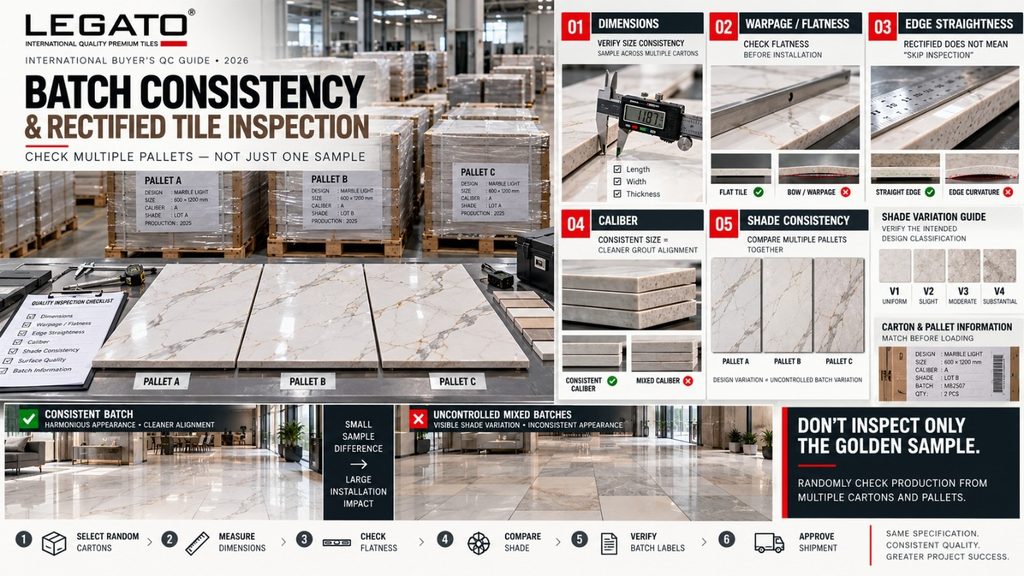
Porcelain tile quality control should include batch identification and visual-consistency checks where shade, calibre or production variation can affect a continuous installation. Natural stone-look, marble-look and other intentionally varied products may contain planned visual differences, so buyers should distinguish intended design variation from unintended batch inconsistency.
Shade-variation classifications such as V1–V4 may appear in product documentation, but buyers should confirm the classification framework used by the manufacturer rather than assuming that one visual-variation system applies universally.
What to ask for: Request the declared shade-variation grade and relevant production batch or calibre information, especially where visual consistency across large installation areas is important. Where more than one batch is involved, review representative samples before installation.
7. Documentation to Review Before Shipment or Final Acceptance
A documented porcelain tile quality control process should allow the buyer to compare the supplied product with the agreed technical, commercial and destination-market requirements before shipment or final acceptance.
Relevant laboratory test reports or technical evidence for water absorption, abrasion performance, dimensional characteristics, breaking strength and slip performance, as applicable to the product and destination market.
Product data sheet with dimensional tolerances and shade variation grade.
Country of origin and HS code for customs clearance.
Packing list with carton/pallet breakdown.
Applicable destination-market compliance documentation, declarations or marking requirements, where required for the product and intended use.
Required documentation should be agreed before shipment rather than assumed after dispatch. A supplier should be able to identify which technical, shipment and destination-market documents are available for the exact product and order.
Manufacturers such as Legato Porcelano provide this documentation as standard practice for porcelain tiles exporter transactions — a reasonable baseline to expect from any supplier handling international shipments, not a premium add-on.
Buyer note: Documentation review belongs in a porcelain tile quality checklist because even a technically acceptable product can create procurement problems if product identification, batch information or required shipment documentation is incomplete.
Porcelain Tile Inspection Checklist: Buyer Verification Summary
This porcelain tile inspection checklist summarizes the main properties and evidence buyers should review. It should be adapted to the exact product, project and destination-market requirements rather than treated as one universal acceptance specification.
This porcelain tile quality checklist keeps the focus on documented evidence rather than appearance alone.
| Property | What to Verify | Verification |
|---|---|---|
| Water absorption | ≤0.5% for porcelain classification; confirm applicable product classification | Current technical data / relevant test report |
| Abrasion resistance | Match surface type, traffic and intended application | Product technical data / applicable test result |
| Dimensional characteristics | Match applicable product specification | Representative production or shipment sampling |
| Breaking strength / modulus of rupture | Match tile type, thickness and intended application | Technical test report |
| Frost performance | Confirm suitability where freeze-thaw exposure applies | Product technical documentation / relevant test evidence |
| Slip performance | Match environment and intended use | Applicable classification / test result |
| Shade and batch consistency | Match specified visual variation and project requirements | Product data and batch/calibre information |
Common Porcelain Tile Quality Control Mistakes Buyers Should Avoid
- Treating a marketing brochure as a substitute for relevant technical evidence.
- Ordering by photo or sample without confirming it matches the production batch.
- Ignoring the applicable abrasion performance when selecting floor tiles for traffic-intensive applications.
- Skipping slip-resistance verification for wet or outdoor applications.
- Assuming the word “porcelain” in marketing material is sufficient evidence of the applicable product classification instead of verifying the tested water-absorption result and applicable product standard.
Frequently Asked Questions (FAQs)
Start by confirming the exact product identification, applicable classification and declared water-absorption result. Then review dimensional characteristics, abrasion performance, mechanical data, slip performance, shade and batch information according to the product and intended application.
Visual similarity does not establish identical technical performance. Products that look similar may have different tested water absorption, abrasion performance, dimensional characteristics, mechanical properties or slip-performance data, which is why technical documentation should be reviewed separately from appearance
Large continuous installations can make shade, calibre and batch differences more visible. Review the declared shade variation and relevant production information before full-quantity dispatch.
Slip suitability depends on the intended environment, expected contaminants, footwear or barefoot conditions and applicable project requirements. Confirm the appropriate performance classification before selecting flooring for areas exposed to slip risk.
Use representative samples from the actual production lot or shipment rather than relying only on a showroom piece. Where multiple batches, pallets or production lots are involved, sampling should reflect those different parts of the shipment. Evaluate the relevant dimensional characteristics using the applicable inspection method and agreed acceptance criteria.
Large-format tiles and panels may require additional inspection and handling considerations because dimensions, thickness, surface flatness, edge condition, packaging and installation requirements can become more consequential at larger sizes. The relevant checks should follow the exact product classification, technical specification and intended application.
Importers should request complete documentation before payment, including laboratory test reports, product data sheets, tolerance specifications, and batch information. Legato Porcelano follows this documentation-first approach because most quality disputes originate from assumptions rather than verified technical data.
Reliable exporters provide consistent technical documentation, transparent testing records, and production traceability. Legato Porcelano’s export team supports buyers with batch-specific quality information, helping procurement teams evaluate products on verified performance rather than catalogue claims alone.
Key Takeaway
A porcelain tile quality checklist should not reduce product quality to one test result, appearance grade or marketing claim. International buyers should evaluate the exact product through the relevant classification, test evidence, dimensional and mechanical characteristics, application requirements, production information and order documentation.
Conclusion
A porcelain tile quality checklist turns product evaluation from a mainly visual judgement into a documented procurement process. Water absorption, abrasion performance, dimensional characteristics, mechanical performance, frost and slip characteristics, batch consistency and documentation should be evaluated against the exact product, intended application and applicable destination-market requirements.
Used as part of a broader porcelain tile buying guide, these checks help importers, architects, contractors and procurement teams define what should be verified before shipment rather than resolving avoidable specification questions after delivery.
When evaluating suppliers for an upcoming order, the large-format porcelain slabs technical data sheets are a useful reference point for what a complete documentation package should look like.
