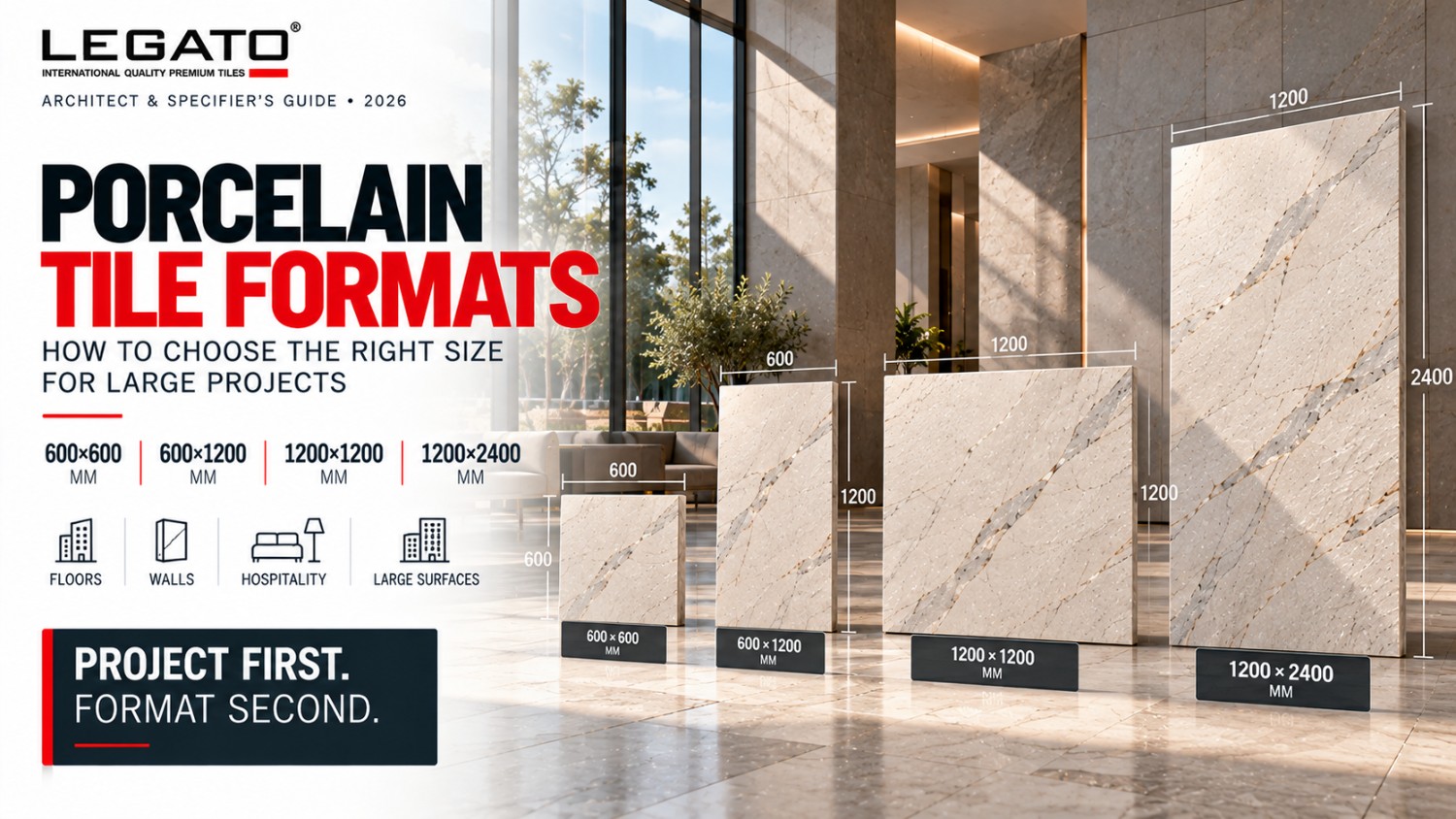
Quick answer: The right porcelain tile format for large projects depends on the application, substrate condition, installer capability, layout geometry and site logistics. Large format porcelain tiles can reduce joint density in open areas, but larger products may require tighter substrate tolerances, specialised handling and more careful cut planning. Format and thickness should be evaluated separately and confirmed against the product specification, installation system and applicable project requirements.
Larger porcelain tile sizes can reduce grout-joint density, but size alone does not determine whether a format is suitable for a large project. When choosing porcelain tile size, project teams should also consider substrate condition, installation capability, layout, handling requirements, project timeline and budget.
This porcelain tile size guide treats selection of a porcelain tile format for large projects as a technical and procurement decision rather than a size-chart exercise. Where North American requirements are discussed, relevant ANSI product and installation standards are referenced. For international projects, product classification, testing requirements, local installation standards and project-specific specifications should also be reviewed.
Why Do Porcelain Tile Formats Matter on Large Projects?
In a small installation, the consequences of a format mismatch may remain relatively contained. Across a large public floor area, hotel corridor or logistics facility, the same mismatch can multiply through additional cutting, labour, handling, waste and preparation requirements.
Large projects amplify several variables that may be easier to manage on smaller installations:
Multiple installation crews working in parallel, which means format, handling and installation procedures should be coordinated consistently across teams.
Staged delivery and storage, where large panels may require purpose-designed crates, racks, A-frames or other manufacturer-approved support systems that differ from conventional tile cartons.
Substrate variability across a large floor plate, where changes in elevation, local irregularities and transitions may occur across different installation zones and should be assessed before format selection.
Long-term maintenance, because reducing joint density can change the amount of grout that requires cleaning, inspection and maintenance over the service life of the installation.
What Factors Should Determine Porcelain Tile Sizes on Large Projects?
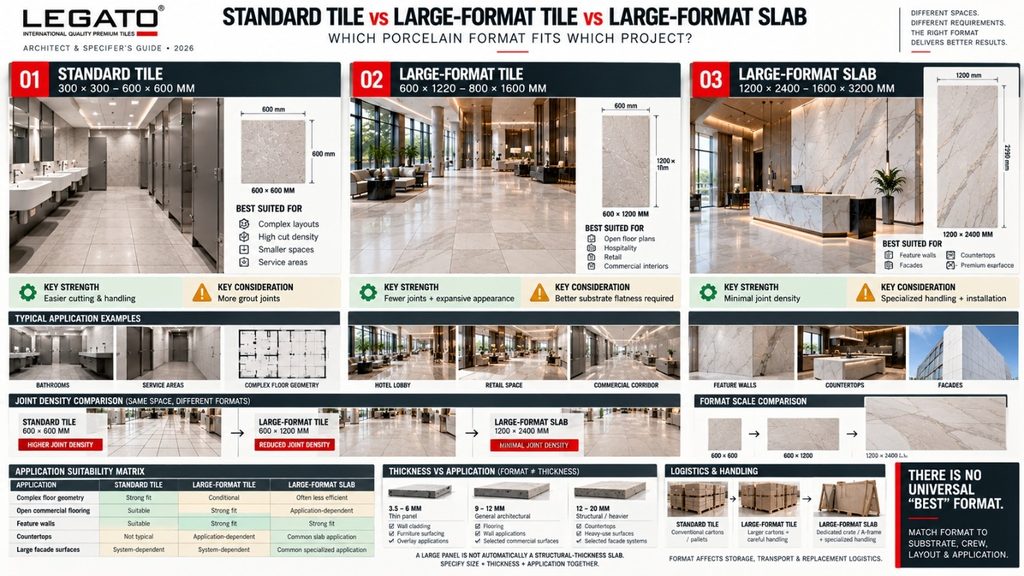
How Does Substrate Flatness Affect Tile Format?
As tile dimensions increase, substrate flatness becomes increasingly important for controlling lippage and supporting proper mortar contact. Under ANSI A108.02, for tiles with at least one edge 15 in. (381 mm) or longer, the substrate should generally have no more than 1/8 in. variation in 10 ft (3 mm in 3 m) and no more than 1/16 in. variation in 24 in. (2 mm in 610 mm), measured from the high points in the surface. Confirm the applicable project specification and current standard requirements before installation.
If the substrate does not meet the required flatness tolerance, additional preparation may be necessary. Proceeding without adequate correction can increase the risk of lippage, inadequate mortar contact and installation-related defects.
Specifier takeaway: Verify the actual substrate flatness before finalising the selected porcelain tile sizes or formats, particularly on renovation and retrofit projects. If the surface falls outside the required tolerance, additional preparation or levelling may be necessary, affecting cost, programme and installation planning.
Which Product and Installation Standards Apply?
ANSI A137.3 establishes product requirements for gauged porcelain tile and gauged porcelain tile panels/slabs. ANSI A108.19 provides requirements and procedures for interior installation, while ANSI A108.20 covers exterior installation of these products.
Project teams should confirm the current edition of the applicable standard and verify that its scope matches the selected product, installation system and application.
Specifier takeaway: When defining a porcelain tile format for large projects, confirm the applicable product classification and installation framework before approving the product. Format, thickness and technical performance should be reviewed within the relevant product and installation requirements rather than inferred from nominal size alone.
How Does Layout Geometry Affect Format Selection?
Large format porcelain tiles can be efficient in open, rectilinear spaces where the selected module aligns well with the project layout.
Layouts with frequent columns, curved boundaries, service penetrations or other interruptions can increase cutting complexity and material waste when very large formats are used. Evaluate the tile module against the actual plan rather than assuming that a larger format will automatically improve installation efficiency.
Specifier takeaway: For large or layout-sensitive projects, consider a project-specific cut-yield review using the actual plan. Include columns, fixtures, penetrations, perimeter conditions and directional layout requirements rather than relying on a universal waste allowance.
How Does Installer Capability Affect Format Choice?
Installations using large format porcelain tiles require careful control of substrate flatness, lippage, layout pattern and mortar coverage. For rectangular tile, large offsets can increase visible lippage, while adequate mortar coverage is essential for proper support.
Follow the applicable installation standard, manufacturer instructions and installation-system requirements for the selected tile or panel. For North American projects, relevant ANSI requirements may form part of that framework.
How Should Movement Joints Be Coordinated With Large Floor Areas?
Movement joints should be coordinated with tile format and layout rather than treated as an afterthought. Existing structural and movement joints must be respected, while perimeter and field movement provisions should follow the applicable installation standard, exposure conditions, substrate and project requirements. Movement-joint spacing should not be based on a universal rule without considering the actual installation conditions.
How Do Porcelain Tile Formats Compare for Large Projects?
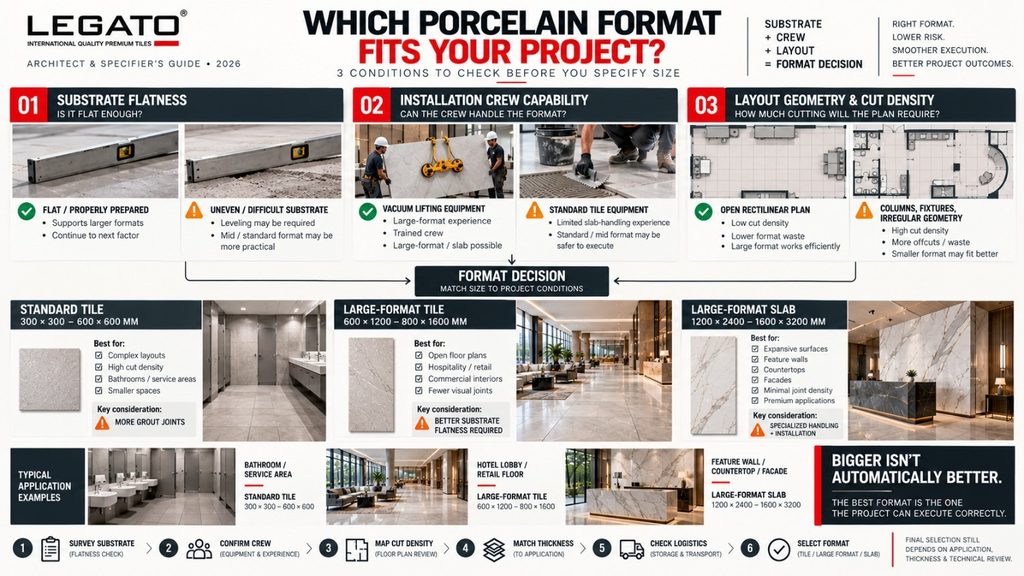
Porcelain tile sizes should be compared by product classification, dimensions, layout compatibility, handling requirements and installation conditions rather than size alone. Different porcelain tile formats may fall under different product definitions, so buyers should confirm the applicable standard for the exact product. When evaluating a porcelain tile format for large projects, classification should not be inferred from nominal size alone.
| Product / Format Category | Size / Classification | Common Project Contexts | Key Consideration |
|---|---|---|---|
| Smaller-Format Porcelain Tile | Porcelain tile that does not meet the ANSI A108.T large-format threshold; confirm the exact dimensions and applicable product standard | Smaller rooms, service areas and layouts with frequent cuts, corners or interruptions | Can be easier to handle in complex layouts, but generally creates more joints across large surfaces |
| Large-Format Porcelain Tile | Under ANSI A108.T terminology, ANSI A137.1 tile with a facial dimension greater than 23 in. (584 mm) | Open floors, corridors, retail, hospitality and other large surfaces | Requires appropriate substrate flatness, layout planning, handling and installer capability |
| Gauged Porcelain Tile Panel / Slab | Under ANSI A137.3, a gauged porcelain tile panel/slab has a facial area of 1 m² or greater; confirm the exact product classification and technical specification | Large walls, feature areas, selected flooring, countertops and suitable façade applications | Requires product-specific handling, cutting, installation and technical verification |
Important note: Different porcelain tile formats should not be treated as consecutive size categories within one classification system. Large-format porcelain tile and gauged porcelain tile panels/slabs may fall under different product definitions and standards, so classification should be confirmed from the applicable product standard and technical documentation.
For example, an 800 × 1600 mm product has a facial area of 1.28 m², but its applicable classification should still be confirmed from the manufacturer’s technical documentation rather than inferred from dimensions alone.
Does Porcelain Tile Thickness Determine Application Suitability?
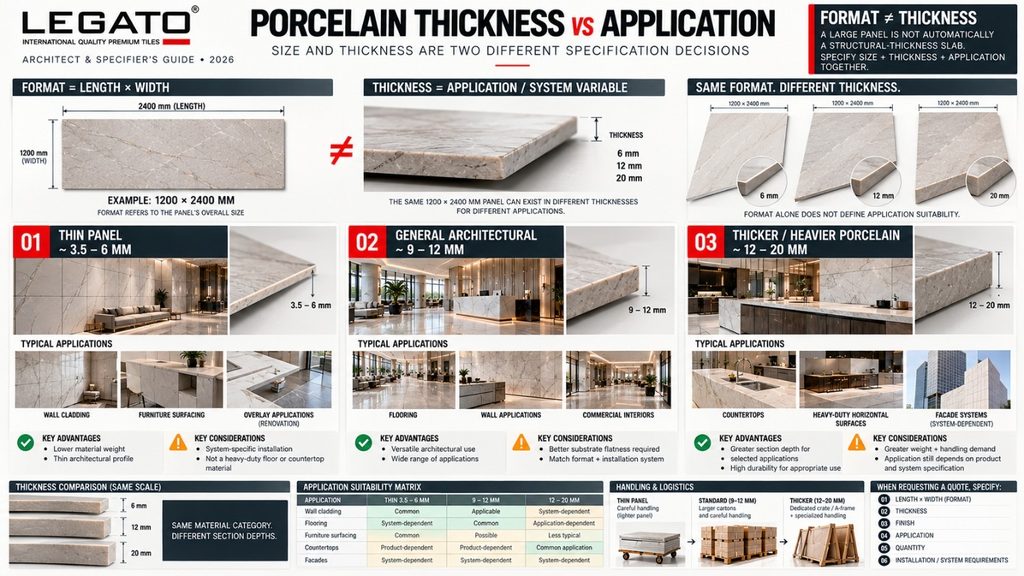
Format and thickness are often discussed together but decided separately. Porcelain panel thickness should not be used by itself to determine application suitability. Gauged porcelain products are manufactured in different thicknesses and performance classifications, and permitted uses depend on the product’s tested properties, intended application, installation system and manufacturer documentation.
ANSI A137.3 establishes performance requirements for gauged porcelain products across defined thickness categories. Suitability still depends on the exact product, intended application, tested performance and applicable installation or system requirements. Where thickness-specific requirements are material to the specification, confirm them against the current applicable edition and product documentation.
For porcelain products outside these specific gauged thickness categories, suitability should be confirmed using the product’s technical data, tested performance, intended application and project specification. Thickness alone should not determine product suitability.
This distinction matters most on two application types that get conflated in early-stage briefs:
For ventilated façade systems, panel dimensions, thickness, fixing method, support system, wind actions, building height and engineering requirements must be considered as part of the complete façade design. Follow the selected façade-system specification, structural design requirements and applicable local standards rather than selecting the panel on size alone.
For countertops and other demanding horizontal applications, thickness, support conditions, edge design, cut-outs, installation system and expected loads should be evaluated together rather than selecting the product by surface dimensions alone.
Specification note: Treat thickness as one part of the complete system selection. Application, product strength, support conditions, fixing or bonding system and expected loads should be assessed together.
Porcelain Tile Size Guide: How Should Project Teams Choose a Porcelain Tile Format for Large Projects?
When choosing porcelain tile size, use this sequence to compare porcelain tile sizes and confirm whether the selected format works with the project conditions:
Survey the substrate — get actual flatness data, not assumed condition, especially on renovations.
Confirm crew capability — verify that the installation team has appropriate training, handling equipment and cutting capability for the selected product, format and installation system.
Map the floor plan for cut density — estimate waste from columns, fixtures, and irregular geometry.
Match thickness to application: wall cladding, flooring, countertops and façade systems can have different support, load and installation requirements regardless of surface size.
Confirm logistics: large format porcelain tiles and other large-format products may require specialised crates, racks, A-frames or other manufacturer-approved handling and storage systems. Check site access, doorways, elevators, storage areas and staging conditions before delivery.
Reconcile with budget and timeline — Large-format products may require additional substrate preparation, handling equipment, trained labour and installation time depending on the format, site conditions and local market.
Skipping substrate verification can create significant installation risk on renovation projects because existing conditions may differ from the assumptions made during design.
Should One Tile Format Be Used Across the Entire Project?
In a hotel project, an open lobby may suit a larger porcelain format, while service corridors, smaller rooms and areas with frequent penetrations may benefit from more manageable tile sizes.
The final selection should still consider substrate condition, layout, installer capability, handling requirements and product specifications.
What Are the Most Common Porcelain Tile Format Specification Mistakes?
Specifying large-format material before confirming substrate flatness can lead to unplanned preparation work, cost changes, programme delays and installation adjustments.
Assuming one format suits every zone of a mixed-use project. A hotel, for instance, may reasonably use large-format slabs in the lobby and smaller-format porcelain tile in back-of-house areas, matching format to function rather than applying one specification building-wide.
Overlooking replacement logistics. Replacement planning can be more complex for large-format material where matching size, shade, batch or finish is important. Consider spare-material strategy, storage and future handling requirements during procurement.
Shade & Batch Control: Shade variation and production-batch consistency should be checked separately. Review the manufacturer’s declared shade variation and confirm batch or calibre consistency before full-quantity delivery, especially for large continuous areas.
Under-specifying edge finishing for slab applications. Edge condition and surface finish should be specified separately. Rectified edges affect dimensional consistency and joint planning, while polished, lappato, matte and textured finishes relate primarily to the tile surface.
Frequently Asked Questions (FAQs)
There is no universal best porcelain tile size. The appropriate choice depends on substrate condition, installation capability, project geometry, maintenance requirements and lifecycle considerations rather than size alone.
Large-format slabs can be a strong option for open layouts, feature walls, lobbies and expansive surfaces where fewer joints support the design intent. Their suitability should still be evaluated against substrate condition, layout geometry, handling requirements, installer capability and the exact product specification.
Substrate condition is one important source of risk in large-format renovation work. Flatness, stability, preparation, mortar coverage, movement accommodation and installation workmanship should all be evaluated before attributing a failure to the porcelain product itself.
Installer capability should be evaluated together with format selection. A product that requires handling equipment, cutting methods or installation procedures beyond the contracted team’s capability can introduce breakage, schedule and workmanship risks
Not always. Many projects may use large-format porcelain in public-facing areas while selecting smaller formats for service zones, back-of-house spaces, and complex layouts with high cutting requirements.
Layout geometry can significantly affect cutting, waste and installation efficiency. Open, rectilinear spaces may accommodate larger modules efficiently, while columns, penetrations and irregular boundaries can increase cutting complexity and may justify evaluating alternative formats.
The most effective approach is validating substrate flatness, installer capability, logistics constraints, and application requirements before finalizing specifications. Legato Porcelano frequently advises project teams to evaluate these factors early, when adjustments remain inexpensive and straightforward.
Beyond product range and pricing, specifiers should review technical support, production consistency, format availability, and project-specific guidance. Legato Porcelano’s technical team assists architects and procurement professionals with format selection, thickness recommendations, and application-specific requirements for large-scale projects.
Key Takeaway
A useful porcelain tile size guide should make clear that the best porcelain tile format for large projects is not automatically the largest available size. Selection should balance substrate condition, layout geometry, installer capability, handling, logistics, thickness and application requirements for the exact project.
Conclusion
Choosing a porcelain tile format for large projects is both a design and technical decision. The selected format should be coordinated with substrate condition, application requirements, installer capability, layout geometry, handling, logistics and lifecycle considerations.
Early verification can reduce the risk of avoidable substrate preparation, material waste, handling problems and specification changes during installation.
Working with a porcelain tile manufacturer can also help project teams review available formats, thicknesses and relevant technical documentation before procurement.
Planning a large-format porcelain project? Share your required format, application, quantity, destination market and project specifications with Legato Porcelano to discuss suitable product options and available technical documentation before procurement.
