
Quick Answer
1600×3200 mm is the closest thing to an industry-standard slab size for premium countertop work, because it covers most kitchen islands in a single piece. 12 mm remains the default thickness for countertops — thinner slabs (6–6.5 mm) are cladding-only unless bonded to a rigid substrate, and thicker (20 mm+) is reserved for heavy commercial or outdoor use. The sourcing decision that actually determines whether a shipment succeeds isn’t size or color — it’s whether the destination market’s fabricators have diamond/CNC equipment and vacuum-lift handling rated for the slab ordered.
Porcelain slabs have become one of the fastest-growing categories in kitchen countertop material, and for importers, the appeal is straightforward: large sizes that reduce seams, high resistance to heat and scratching, and a manufacturing process that allows consistent supply at scale. But sourcing decisions in this category go well beyond picking a color and finish. Slab size, thickness, edge-bonding technique, and fabrication compatibility all affect landed cost, breakage risk, and how well a shipment performs once it reaches a fabricator’s shop. This guide covers what an importer needs to know before placing an order, from a manufacturing perspective.
What Makes Porcelain Different From Other Countertop Materials?
Porcelain slabs are made by compacting fine clay, feldspar, and mineral pigments under extremely high pressure and firing them at temperatures typically above 1,200°C. This produces a dense, low-porosity material that resists heat, UV exposure, scratching, and staining better than natural stone or resin-based surfaces like quartz. Because the body is fired rather than cured with resin, porcelain also does not contain the polymer content that makes quartz vulnerable to heat marks and sun fading.
For importers evaluating category positioning, the practical distinction is this: quartz competes on cost and ease of fabrication, natural stone competes on unique veining and prestige, and porcelain competes on performance and slab size. Buyers who prioritize outdoor kitchens, induction cooktops, or minimal-seam islands are the core audience for porcelain.
What Slab Sizes Should Importers Stock or Offer?
Slab size is the single biggest differentiator between porcelain and other countertop materials, and it directly affects how few seams a kitchen island or run of countertop needs.
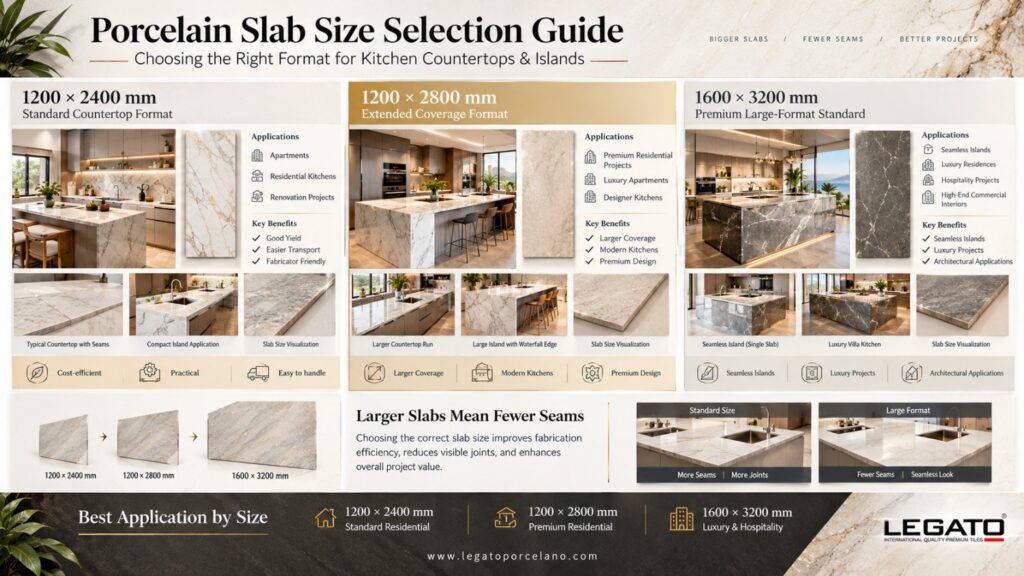
Common large-format sizes in the current market include:
| Size (mm) | Approx. Size (inches) | Typical Use |
|---|---|---|
| 1200 x 2400 mm | 47″ x 94″ | Standard-size runs, mid-size islands |
| 1200 x 2800 mm | 47″ x 110″ | Extended runs, vertical feature panels |
| 1600 x 3200 mm | 63″ x 126″ | Seamless islands, large countertop runs |
The 1600 x 3200 mm format has become the closest thing to an industry standard for premium countertop projects because it covers most kitchen islands in a single piece. Smaller formats remain relevant for markets where fabrication shops have limited handling equipment, or where freight costs favor smaller, lighter crates.
Importers should confirm with any manufacturer whether quoted sizes are nominal (as pressed) or rectified (trimmed to exact, calibrated dimensions), since usable slab area after trimming can be smaller than the nominal size suggests — this affects yield calculations for fabricators and, ultimately, the price competitiveness of the imported slab.
What Thickness Is Right for Kitchen Countertops?
Thickness is where buying decisions often go wrong, because the “right” thickness depends entirely on application, not just aesthetic preference.
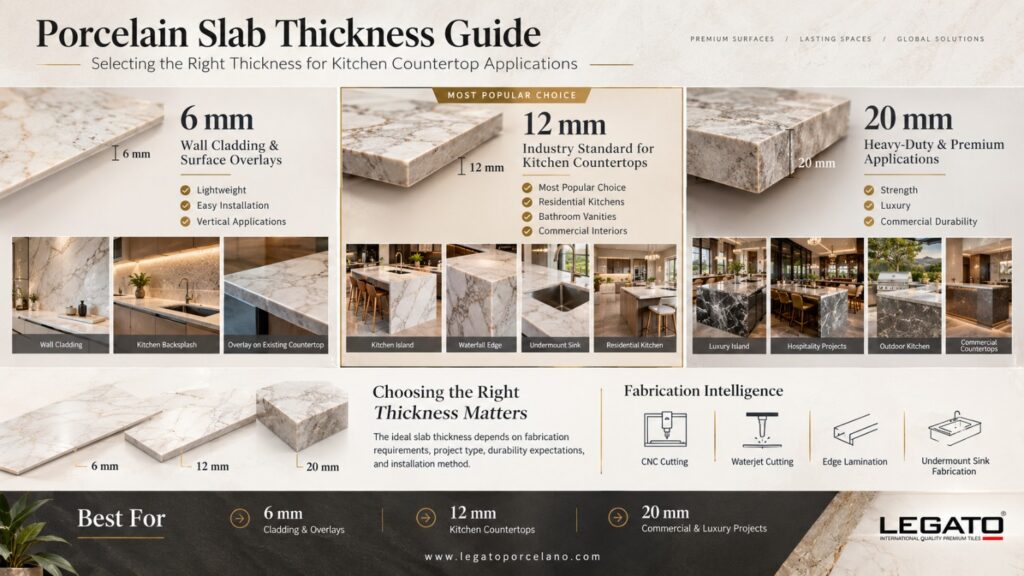
- 6 mm to 6.5 mm — Too thin for a standalone kitchen countertop under normal use; typically reserved for wall cladding, vertical panels, or bonded overlays on an existing substrate.
- 12 mm — The most common thickness for kitchen and bathroom countertops. It balances weight, impact resistance, and workability for standard fabrication equipment, and it’s the default spec across most manufacturers’ countertop-oriented product lines.
- 20 mm and above — Used where a heavier, more substantial edge profile is wanted without lamination, or for high-traffic commercial and outdoor kitchen applications that see more impact and thermal cycling.
Importers should confirm whether quoted slab sizes are nominal, calibrated, or rectified — size tolerance definitions covered under ANSI A137.1 — since trimming can reduce usable slab area and affect fabrication yield and landed price competitiveness. Separately, thickness-based strength and grading criteria for gauged porcelain slabs are addressed under ANSI A137.3, which classifies products by declared nominal thickness (for example, 5.0–6.5 mm and 20 mm+ categories)
Because permitted applications differ by thickness and by manufacturer, importers should always request the manufacturer’s documented application classification for a given SKU rather than assuming a thickness is countertop-rated because a competitor uses it that way. A 6 mm slab from one line may be cladding-only, while a 6 mm slab from another may carry a countertop rating when installed over a rigid substrate — the difference lies in the specific product’s engineering and backing, not the number alone.
Fiberglass Backing and Structural Reinforcement
Most 12 mm porcelain slabs sold into the countertop market are reinforced with a fiberglass mesh laminated to the back of the slab during production. This backing does two things: it reduces the risk of cracking during transport and installation, and it holds the slab together if a hairline crack does form, preventing it from propagating into a full break. For importers, this is a meaningful quality checkpoint — ask suppliers directly whether mesh backing is standard on their countertop-rated products, and get this confirmed in writing on the technical data sheet, not just in sales conversation.
Finish Options and How They Affect Buyer Perception
Finish is a major driver of retail positioning, and importers should understand the practical trade-offs behind each option, not just the visual difference:
- Polished — High gloss, marble-like appearance; shows fingerprints and light scratching more readily than matte finishes.
- Matte / Natural — Low reflectivity, closer to honed natural stone; forgiving of daily wear and fingerprints, currently the most requested finish for kitchen work.
- Honed — A soft, satin surface between matte and polished; common on marble-look designs.
- Leathered / Textured — Subtle surface texture that hides fingerprints and light abrasion well, often used for a more tactile, natural-stone effect.
Book-matched slab pairs — where two adjacent slabs are cut and finished so their pattern mirrors across a seam — are increasingly requested for premium kitchen islands. If a manufacturer offers book-matching, this is worth highlighting to design-focused buyers, since it directly addresses one of the main aesthetic complaints about large-format installations: visible pattern mismatch at seams.
What Should Importers Ask Fabricators to Confirm Before Ordering?
Because porcelain fabrication differs from quartz or granite, a shipment that arrives without matching fabrication support can sit unused. Before committing to volume, importers should confirm the following with their target market’s fabricators:
- Do they have diamond-tipped or CNC cutting equipment rated for porcelain? Standard stone-cutting blades wear down quickly on porcelain’s dense body.
- Do they have slab lifting and handling equipment for the specific size ordered? A 1600 x 3200 mm slab requires vacuum lifters and a two-person minimum handling protocol; fabricators without this equipment risk breakage that gets attributed to the material rather than handling.
- Are they equipped for mitred or laminated edge profiles? Thin 12 mm slabs are often edge-laminated to create the appearance of a thicker, more substantial edge — a technique that requires specific fabrication skill.
- Do they have experience with undermount sink cutouts in porcelain? Cutout corners are a common failure point if radius and reinforcement aren’t handled correctly.
A shipment paired with an unprepared fabrication base creates returns, damage claims, and reputational risk that has nothing to do with the material’s actual quality — this is a sourcing risk worth managing proactively, not an afterthought.
Packaging and Freight Considerations for Large-Format Slabs
Large-format porcelain slabs are typically shipped vertically in A-frame crates, which protect against the flexing that causes cracks when slabs are laid flat or stacked horizontally. Importers should verify:
- Crate design suits the specific slab thickness and size ordered — thinner slabs need tighter, better-cushioned crating.
- Corner protection and edge padding are included, since corners are the most common breakage point during transit.
- The manufacturer provides a documented claims process for in-transit breakage, including what percentage of breakage (if any) is considered normal and pre-accounted for in freight insurance.
Container loading density also affects landed cost per slab — larger formats mean fewer slabs per container, which changes the cost math compared to importing smaller porcelain tiles or quartz slabs of similar total area.
Kitchen Countertop FAQ’s for Importers
The 1600×3200 mm format is widely preferred because it covers most kitchen islands and long countertop runs with minimal seams, creating a cleaner and more premium finished appearance.
12 mm remains the industry standard for most residential countertops because it balances durability, weight, fabrication efficiency, and installation practicality without significantly increasing handling costs.
Many buyers focus on design and price while overlooking fabrication requirements. If local fabricators lack suitable equipment, installation challenges and product damage can quickly erode profitability.
Not necessarily. Larger slabs reduce seams and enhance aesthetics, but they also increase freight costs, handling complexity, and installation requirements. Market demand should guide size selection.
Porcelain requires specialized cutting tools, CNC equipment, and experienced fabricators. Confirming fabrication capability before purchasing helps prevent breakage, delays, and customer complaints after delivery.
Container utilization, slab dimensions, packaging quality, freight rates, and breakage protection often influence landed cost more than small differences in factory pricing.
Importers should prioritize suppliers with reinforced A-frame crating, edge protection, and proven export packaging standards. Legato Porcelano uses export-focused packaging systems designed specifically for large-format porcelain slab transportation.
Beyond pricing, buyers should assess consistency, technical support, reinforcement standards, packaging quality, and export experience. Legato Porcelano’s team helps importers evaluate slab specifications and application suitability before ordering.
Conclusion
Porcelain slabs offer importers a genuine performance and design advantage in the kitchen countertop category, but the sourcing decision is more technical than it looks from a catalog page. Size and thickness need to match the target market’s fabrication capability, backing and reinforcement specs should be confirmed in writing, and freight and crating need to account for the specific risks of large, thin-format material. Importers who verify these details upfront — rather than after a damaged shipment or an unhappy fabricator — are the ones who build a durable position in this category.
If you’re evaluating suppliers for a porcelain slab import program, Legato Porcelano’s porcelain slab exporter team can walk through size, thickness, and reinforcement specifications for specific market requirements.
