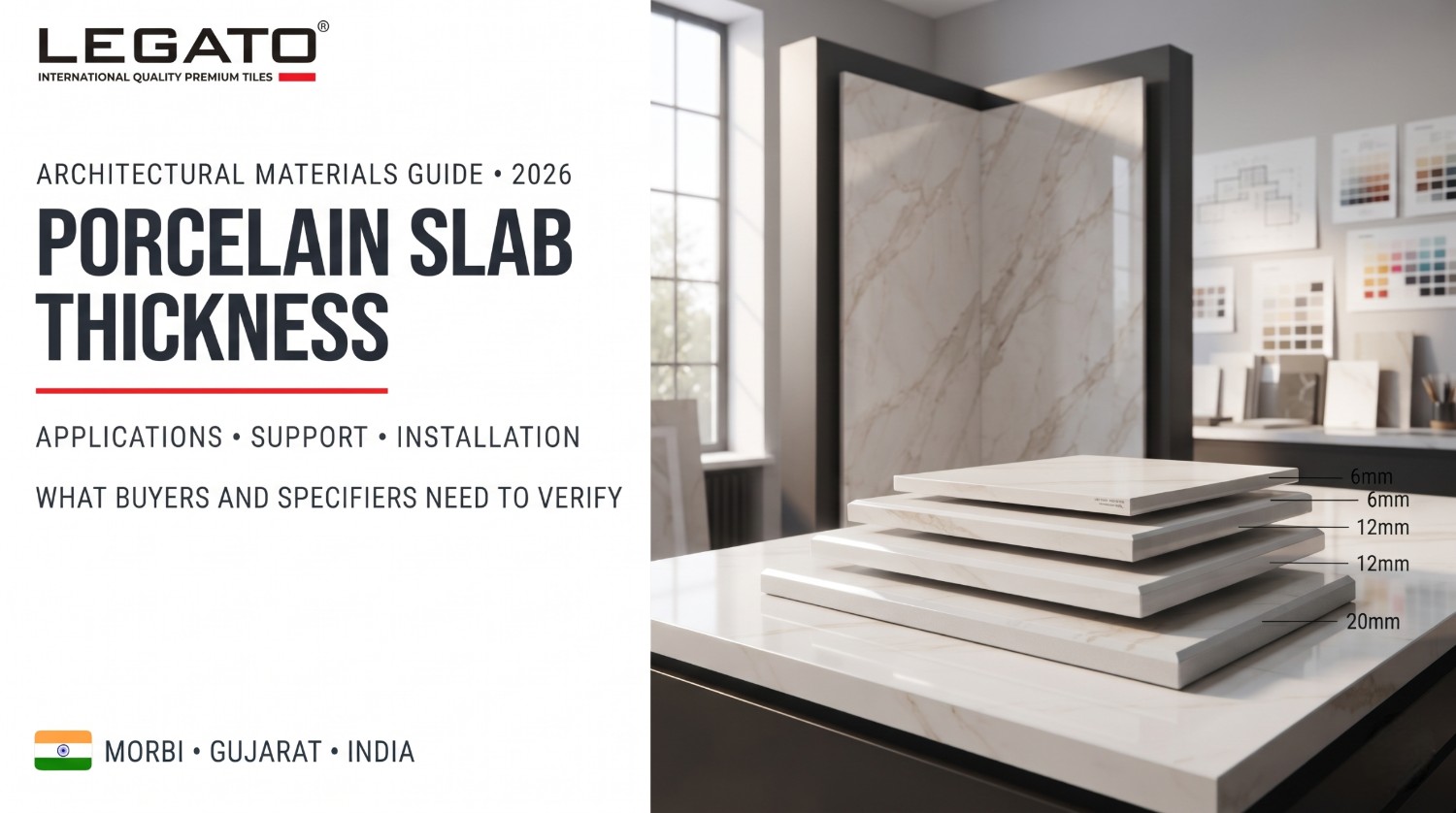
Porcelain slab thickness affects more than appearance: it influences handling weight, fabrication, support requirements and the installation system that may be appropriate. The right choice depends on the product, its dimensions, intended use, edge details, substrate or fixing system and project requirements—not simply on a rule that thin slabs belong on walls and thick slabs belong everywhere else. This guide explains how to evaluate porcelain slab applications and what importers, architects, fabricators and project teams should verify before specifying a product.
Quick answer: Select thickness according to the manufacturer’s documented permitted applications, tested performance, support conditions and installation instructions. Thickness is one important specification, but it does not independently prove that a slab is suitable for a particular floor, countertop, façade or outdoor installation.
What thickness options mean in practice
Porcelain slabs are available in different thicknesses, but the available ranges vary by Porcelain tiles manufacturer and product family. For example products from approximately 2.2 mm to 20.5 mm and maps selected products to applications such as flooring, vertical cladding, kitchen worktops and furnishings. Its guidance also emphasizes verifying suitability for the project and applicable requirements.
That variation is important: a thickness chart is a useful starting point, not a universal specification.
| Nominal thickness | Potential applications | Essential checks |
|---|---|---|
| 6 mm | Wall cladding, backsplashes and selected furnishing applications | Product approval, bonding or fixing method, handling and substrate |
| 8–9 mm | Selected wall and floor applications, depending on product | Intended use, format, performance data and installation requirements |
| 12 mm | Selected worktops, interior surfaces and other approved applications | Support, spans, cut-outs, edge details and fabrication instructions |
| 20 mm | Selected exterior, paving and heavier-duty applications | Product rating, load conditions, support system and environmental exposure |
These are indicative categories, not universal approvals. Actual permissible applications can differ across product lines, even at the same nominal thickness.
How porcelain slab thickness affects performance
A useful porcelain slab thickness decision starts with the complete application rather than treating millimetres as a standalone measure of strength.
Thickness can influence stiffness, weight, fabrication requirements and the loads transferred to the supporting structure. But final performance also depends on the material’s properties, slab dimensions, unsupported span, edge processing, cut-outs, support continuity, impact conditions, fixing method and installation quality.
Two products with identical nominal thicknesses may have different permitted uses. A slab that performs well as bonded wall cladding is not automatically suitable for an unsupported worktop or a mechanically fixed exterior façade.
1. Vertical cladding and backsplashes
6 mm porcelain slabs are often used in selected vertical applications because a thinner panel can reduce dead load compared with a thicker product of equivalent area and similar density.
However, reduced weight does not eliminate installation risks. Large panels require appropriate handling, a compatible substrate, a specified adhesive or mechanical fixing system, and installation procedures appropriate to their size and location.
For exterior façades, the design must also account for the support system, wind actions, building geometry, fixing details and applicable local requirements. A thickness recommendation alone is not a façade specification.
2. Flooring and commercial spaces
Floor applications require a different assessment from vertical cladding because the product and installed assembly must withstand expected foot traffic and other applicable loads.
For residential and commercial flooring, evaluate:
- Declared product characteristics and application suitability.
- Breaking strength or other relevant tested performance.
- Surface abrasion and slip performance appropriate to the space.
- Substrate condition and flatness.
- Adhesive coverage, joints and installation system.
- Expected loads, impact conditions and maintenance requirements.
6 mm porcelain slabs should not automatically be ruled out for every floor, nor should any thicker slab be automatically approved. The precise product, format and installation system determine whether a proposed use is appropriate.
3. Countertops and work surfaces
Choosing a porcelain slab for countertops requires particular attention to support and fabrication. The finished worktop may contain sink openings, hob cut-outs, internal corners, edge profiles and overhangs, each of which affects how loads travel through the slab.
12 mm porcelain slabs are offered for worktop applications in some product ranges, while other products and designs may require different thicknesses or reinforcement. Neither option is universally correct.
Before approval, check the manufacturer’s countertop design guide, cabinet support layout, permitted span and overhang, cut-out reinforcement, edge details and fabricator requirements.
A countertop specified for one support configuration should not be assumed suitable for another simply because the material and thickness are unchanged.
4. Outdoor paving and heavy-duty applications
20 mm porcelain slabs may be appropriate for outdoor paving or selected demanding applications when the product is specifically designed and rated for that use.
The installed system matters just as much as the nominal thickness. A slab installed on a prepared, supported base behaves differently from a slab installed on pedestals or another support arrangement.
Confirm the permitted loading, support spacing, drainage, freeze-thaw suitability where relevant, surface slip performance, environmental exposure and local requirements. Do not assume that every 20 mm product is suitable for vehicles, every pedestal system or every external location.
5. Furniture, shelving and decorative surfaces
Thinner products may be appropriate for furniture facings, decorative panels and selected shelving applications when the product is designed for the intended use and adequately supported.
For horizontal surfaces, the unsupported span, support arrangement, cut-outs and expected loads still matter. A product’s suitability for vertical cabinet cladding does not establish its suitability for a shelf carrying a heavy load.
What matters besides thickness?
When comparing porcelain slab thickness, evaluate the following factors together rather than choosing a product from a thickness chart alone.
| Factor | Why it matters |
|---|---|
| Product properties | Relevant mechanical and physical characteristics help establish suitability. |
| Dimensions and format | Larger panels can introduce additional handling, support and installation demands. |
| Span and support | Unsupported areas, overhangs and uneven support can affect stress and deflection. |
| Cut-outs and edges | Openings, internal corners and edge treatments may create vulnerable areas. |
| Substrate and fixing | The slab must be compatible with the specified adhesive, restraint or support system. |
| Surface performance | Slip and abrasion requirements depend on the intended environment. |
| Exposure and local rules | Outdoor, façade and other demanding applications may require additional verification. |
| Fabrication capability | Cutting, drilling and handling methods must suit the product and design. |
Thickness alone should never substitute for the relevant technical data and installation instructions.
How standards fit into the decision
ISO 10545-2:2018 specifies methods for determining ceramic tile dimensions and surface quality, including thickness. ISO 13006:2018 addresses ceramic-tile definitions, classification, characteristics and marking.
These documents should not be interpreted as providing one universal thickness recommendation for every installation. Buyers and specifiers should identify the applicable product classification, current requirements, declared performance and application-specific guidance for the relevant market.
For structural façade systems, unusual spans or demanding countertop designs, involve the responsible designer, installer or qualified technical specialist rather than relying solely on a general online guide.
A practical checklist for buyers and project teams
Before approving a product, request and review:
- Exact product identification: collection, finish, nominal thickness, dimensions and relevant product code.
- Technical data: applicable declared characteristics, test evidence and tolerances.
- Permitted applications: written porcelain slab exporter guidance for the intended location and installation type.
- Installation instructions: approved fixing or bonding system, substrate conditions, joint requirements and support details.
- Fabrication requirements: handling, cut-outs, edge treatment and any product-specific restrictions.
- Logistics information: actual slab weight, dimensions, packaging and handling requirements.
- Project approval: confirmation that the product and installation system satisfy the design, exposure and local requirements.
For importers, also verify the exact product specification before finalizing a commercial order. Product availability, packing details, lead times and commercial terms should be confirmed with the supplier rather than inferred from a generic catalogue or industry norm.
FAQs
No. Thickness can affect stiffness and mechanical performance, but actual suitability also depends on the product’s material properties, dimensions, support, span, fabrication details and installation system.
That depends on the specified product, panel dimensions, substrate, adhesive or fixing system, building conditions and whether the installation is internal or external. Follow the manufacturer’s application guidance and applicable requirements.
Some thin products may be approved for floor use under specified conditions, while others are intended for different applications. Verify the product’s permitted use, test data, format and installation instructions before specifying it.
Some manufacturers offer 12 mm products specifically for worktops. Suitability depends on the individual product, cabinet support, spans, overhangs, cut-outs, edges and fabrication instructions.
No. Outdoor suitability depends on the product rating, installation system, support, load conditions, slip performance, exposure and local requirements. A nominal 20 mm thickness is not universal approval.
For otherwise comparable products, greater thickness generally increases material weight per unit area. Actual weight varies by product and construction, so use the manufacturer’s declared figures for handling equipment, structural checks and shipping calculations.
Request the exact product code, dimensions, nominal thickness, technical data, permitted applications, installation instructions, slab weight and packing details. Legato Porcelano’s export guidance can help buyers begin verifying product specifications for their intended project.
Start with the intended application, then verify product approval, support conditions, fabrication needs and installation requirements. Legato Porcelano’s team can clarify product-specific details, but final selection must meet project and local requirements.
Conclusion:
The right porcelain slab thickness is the one supported by the product’s technical evidence, permitted application, design conditions and installation system. Thin, intermediate and thicker products can serve different purposes, but those purposes are manufacturer- and project-dependent.
For every specification, verify the actual product, its support conditions, fabrication details and installation requirements before approval. This approach is more reliable than applying a universal rule based only on thickness.
For product range and international supply enquiries, consult Legato Porcelano’s export information and confirm the exact product specification and permitted application directly with the company’s team.
