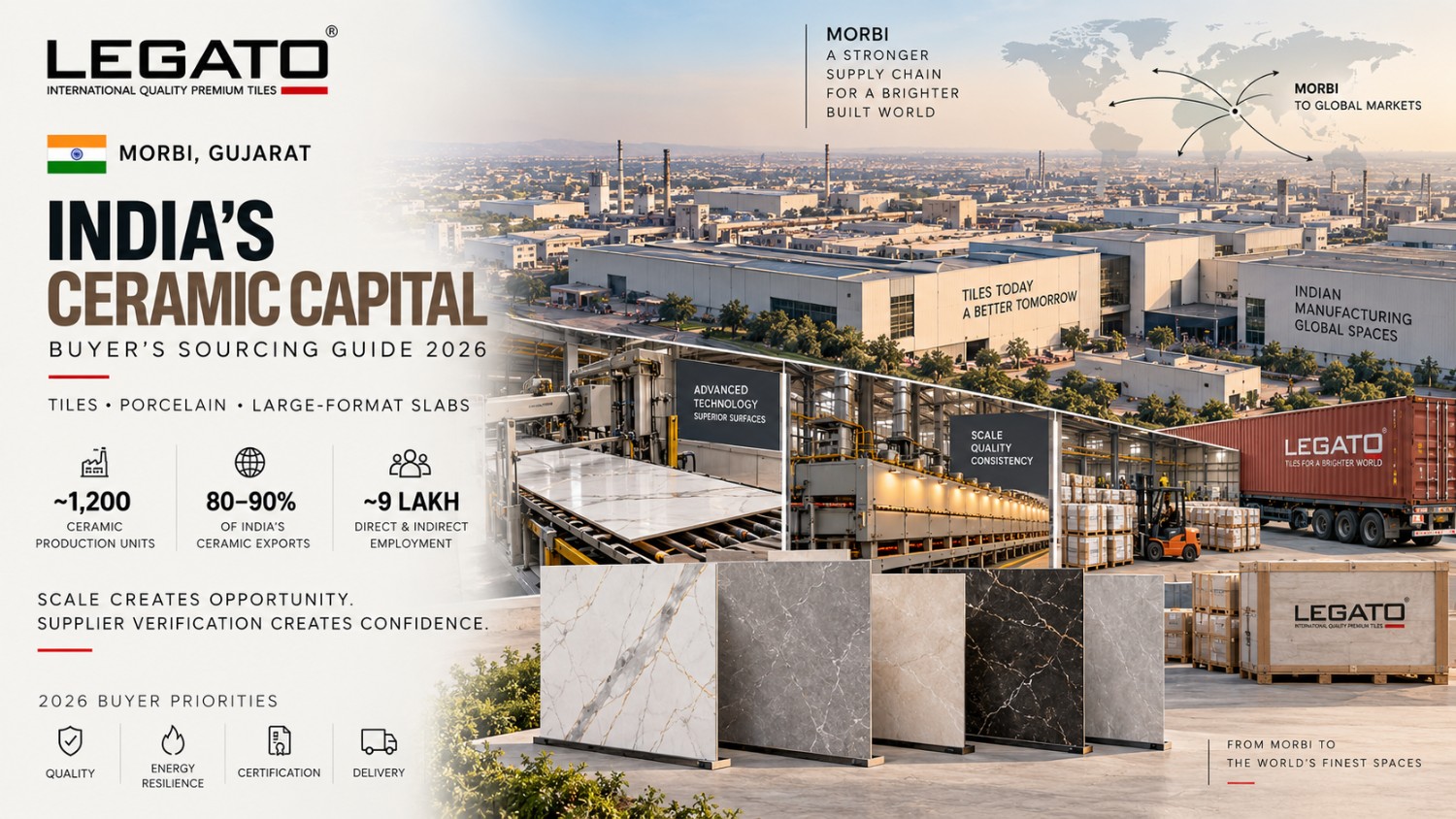
If you’ve bought porcelain tiles anywhere in the world in the last decade, there’s a good chance they came from one district in western India.
Morbi, Gujarat produces 80–90% of India’s ceramic exports — a concentration few industries anywhere achieve in a single geography. That’s the appeal for buyers: strong pricing, deep product range, and manufacturers who compete daily on quality and speed.
But 2026 also exposed the downside of that concentration. A regional energy shock shut down hundreds of Morbi factories within weeks and cut the district’s exports by roughly 70% in a single quarter.
This guide covers both sides: why Morbi built its dominant position, and what buyers need to check before placing an order today.
Quick answer: Morbi is India’s ceramic capital because a 30-kilometer industrial cluster of roughly 1,200 factories, employing about 9 lakh people, produces the large majority of the country’s ceramic exports (~Rs 15,000 crore in FY2024–25). It’s the world’s second-largest ceramic production cluster after China’s Foshan region. For buyers, that means strong pricing and variety — but also a supply chain concentrated enough that one regional disruption, like the 2026 gas crisis, can hit many suppliers at once.
Sourced from: Gujarat government data, IBEF (India’s Ministry of Commerce–backed trade body), ICRA (credit rating agency), Ceramic World Web/Acimac, the Morbi Ceramic Association’s own published research, and 2026 crisis reporting from BBC, ThePrint, and Vibes of India. Full source list at the end.
Key takeaways
- Morbi produces 80–90% of India’s ceramic exports, from roughly 1,200 factories in one cluster.
- The advantage is structural — shared suppliers, machinery, labor — not one company’s output.
- Quality varies a lot between factories in the same cluster. The region’s name isn’t a quality guarantee.
- The 2026 Iran–Israel conflict disrupted gas imports through the Strait of Hormuz, cutting Morbi’s exports ~70% year-on-year in Q1 FY2026–27.
- Before ordering, verify a factory’s fuel source, export certifications, and contract terms — not just its price.
1. How Morbi Became India’s Ceramic Capital

Morbi’s ceramic story didn’t start with tiles. The district’s industrial identity began with pottery, then wall clocks — both built on locally available clay and skilled artisan labor.
The shift to glazed and roof tiles took hold in the 1970s–80s. From there, the cluster compounded on itself:
- One factory’s success attracted suppliers, mold makers, and glaze/frit producers.
- That drew kiln technicians, packaging units, and freight forwarders.
- Each new business made it cheaper and faster for the next factory to start up nearby.
Fifty years later, that compounding effect — not any single company or government scheme — is the real explanation for Morbi’s dominance. It’s an entire supply ecosystem packed into a roughly 30-kilometer radius. Outside China’s Foshan cluster, few regions in the world have matched this density.
2. Morbi by the Numbers
| Metric | Approximate figure |
|---|---|
| Share of India’s ceramic exports | 80–90% |
| Ceramic production units in Morbi | ~1,200 |
| Annual production volume | ~60 lakh tonnes |
| Direct and indirect employment | ~9 lakh people |
| Morbi ceramic exports, FY2024–25 | ~Rs 15,000 crore |
Source: Gujarat government estimates, via PTI.
National context, for scale:
- IBEF puts India’s overall ceramic tile industry at roughly Rs 62,000 crore in FY2024, with domestic demand still the larger revenue share.
- ICRA notes India became the world’s largest tile exporter by volume in CY2023, helped by lower production costs than Spain and Portugal — though it flagged US anti-dumping duties as a headwind for FY2025 exports.
- The Morbi Ceramic Association’s own research points to the district’s cost-effective gas pricing and export-oriented logistics as the structural reasons the cluster formed where it did — the same dependency that made 2026’s gas disruption so damaging.
Three independent sources — a national trade body, a credit rating agency, and the industry’s own association — all point to the same conclusion: Morbi isn’t just a locally proud claim. It’s the documented production base behind India’s position as a top-three global ceramic tile exporter.
3. What This Scale Means for Buyers
Pricing is structurally competitive, not promotional. Clay, feldspar, and silica are sourced domestically, and hundreds of factories compete for the same export orders. Factory-gate pricing typically undercuts European producers, even after freight.
Large-format Porcelain and slab capacity is real, and growing. More Morbi manufacturers now produce large-format porcelain slabs — commonly 600×1200 mm and 1200×2400 mm — using continuous press lines and digital printing comparable to established Italian and Spanish producers. That matters for architects specifying fewer, larger joints on facades, flooring, and countertops.
One region covers categories that usually need several countries. Glazed vitrified tiles, full-body porcelain, GVT/PGVT, large-format slabs, and sanitaryware are all realistically sourceable through Morbi supplier relationships.
But density cuts both ways on quality. The barrier to opening a small ceramic unit in Morbi is lower than in more consolidated markets. The cluster ranges from export-grade manufacturers with in-house testing labs to small units serving mainly the domestic market. The region’s name is not a quality guarantee — the individual factory is.
4. The 2026 Supply Disruption: What Changed, and Why It Matters Now
This is the part a generic “why is Morbi the ceramic capital” answer won’t tell you — and it’s the most relevant thing if you’re sourcing in the second half of 2026.
What happened:
- Morbi’s kilns run overwhelmingly on propane and piped natural gas.
- Early 2026: the escalating Iran–Israel conflict disrupted shipping through the Strait of Hormuz, a route carrying a significant share of India’s LPG and gas imports.
- As supply tightened, the government prioritized gas for households, healthcare, and agriculture over industrial users.
- Most Morbi factories shut down for nearly a month, affecting roughly 400,000 workers linked to the sector.
What the trade data shows:
- Morbi’s ceramic exports fell from ~$616.78 million (April–June 2025) to ~$184.19 million (April–June 2026) — a ~70% decline, year-on-year, same quarter.
- Exports to Iraq fell ~98%; Oman ~94%; Saudi Arabia ~93%; UAE ~87%.
- The US and Russia also saw sharp drops over the same period.
The response: By early 2026, Gujarat had committed more than Rs 115 crore in industrial incentives to over 2,200 beneficiaries, alongside stated plans for technology upgrades, automation, renewable energy, and logistics support.
What this means if you’re placing an order today:
- Ask about fuel sources and backup plans. Lead times now depend on energy availability, not just factory workload.
- Add a fuel-cost clause to fixed-price contracts. A contract signed before a fuel spike can push a manufacturer into a loss-making position — raising the risk of delayed shipment or cut corners. Negotiate this up front.
- Spread orders across two or three verified suppliers. A single-factory dependency is riskier in a cluster where one regional shock can hit hundreds of units at once.
- Favor manufacturers with diversified energy sourcing or stronger balance sheets. They tend to absorb shocks with less delivery disruption — worth asking about directly.
5. How to Vet a Morbi Manufacturer: A Buyer’s Checklist
Given how much factory size and quality vary across the cluster, a structured evaluation beats chasing the lowest quote.

| Check this | Because |
|---|---|
| Export track record and destination markets | Factories already shipping to your region know your market’s standards and packaging norms |
| In-house or third-party testing (ISO 13006, water absorption, PEI rating) | Confirms the product meets your spec, not just visual inspection |
| Kiln fuel source and backup plan | Directly affects delivery reliability post-2026 |
| Sample-before-bulk-order policy | Lets you verify shade consistency and caliber before full containers |
| Container loading standards and packaging | Reduces breakage risk on long sea freight, especially for large-format slabs |
| Minimum order quantity vs. production slot availability | Confirms the factory can realistically hit your timeline |
| Clarity on Incoterms and documentation | Avoids disputes over risk and cost at each shipping stage |
The simplest tell: a manufacturer that answers these questions specifically, without hedging, is usually the safer long-term partner — even if their quote isn’t the lowest one you receive.
6. Morbi vs. Other Global Sourcing Hubs
| Factor | Morbi, India | Spain | China |
|---|---|---|---|
| 2025 industry scale | ~Rs 15,000 crore in exports (district-level) | €4.83bn total sales; €3.48bn exports (ASCER) | Largest global producer by volume |
| Factory-gate pricing | Lowest among major producers | Higher, premium positioning | Competitive, similar range to Morbi |
| Large-format slab capability | Growing year over year | Long-established, design-led | Well-established, high volume |
| Design and glaze technology | Increasingly comparable, imported machinery | Regarded as a design leader | Strong on volume and standardization |
| Lead time to major ports | Moderate; depends on Mundra/Kandla congestion | Shorter for European buyers | Comparable for most Asian/Western markets |
| Recent supply reliability | Disrupted in 2026 by regional energy shock | Comparatively stable | Comparatively stable |
Source: Spain figures: ASCER (Spanish Ceramic Tile Manufacturers’ Association), 2025 provisional data.
None of these hubs is a universal “best.” The right one depends on your budget, spec requirements, and appetite for supply-chain risk in a given year.
FAQs
Morbi offers one of the world’s largest concentrations of ceramic manufacturers, providing buyers access to competitive pricing, extensive product variety, and multiple supplier options within a single sourcing region.
No. Manufacturing capabilities vary significantly across the cluster. Buyers should evaluate export experience, testing standards, certifications, packaging quality, and production consistency rather than relying on location alone.
Morbi manufacturers produce formats ranging from 600×600 mm floor tiles to large-format porcelain slabs exceeding 1200×2400 mm, supporting residential, commercial, façade, and countertop applications.
The disruption highlighted the importance of supplier diversification, production transparency, and contingency planning. Buyers relying on a single manufacturer faced greater risk than those with multiple qualified supply partners.
Importers should verify production capacity, energy sourcing, testing procedures, packaging standards, and lead times before placing large orders. Factory audits and sample evaluations provide additional confidence.
In many cases, yes. Lower manufacturing costs, local raw material availability, and cluster-scale competition often allow Morbi suppliers to remain cost-competitive compared with many European producers.
Reliable exporters provide clear documentation, consistent product quality, transparent communication, and proven export experience. Legato Porcelano supports international buyers with technical documentation, product samples, and export-focused manufacturing processes developed for global markets.
Beyond pricing, buyers should assess quality consistency, production reliability, packaging standards, and export capabilities. Legato Porcelano’s team works with distributors to review specifications, production requirements, and shipment planning before orders are finalized.
Conclusion
Morbi earned its position as India’s ceramic capital through decades of compounding industrial density, not a single company or campaign. That scale still hands international buyers a real advantage in price and product range.
But 2026 was a reminder that concentration cuts both ways: when energy supply to the cluster tightened, the effect showed up in export data within a single quarter. Buyers who understand both sides of that picture — and who evaluate individual manufacturers rather than the region as a whole — are the ones sourcing reliably from Morbi going forward.
Legato Porcelano manufactures porcelain tiles and large-format porcelain slabs from the Morbi cluster for international markets, and works directly with importers and distributors evaluating suppliers in the region. If you’re comparing options as a porcelain tiles exporter, our team can walk you through current lead times and specifications for your project.
