Australian construction has moved decisively toward larger tile formats. Sydney and Melbourne apartment towers want fewer grout lines. Brisbane and Gold Coast high-rises want continuous surfaces. Australia’s renovation market wants the same look at home. Large-format porcelain tiles now sit at the centre of that shift.
Large-format porcelain tiles measure at least 600 mm on one edge. Rectified edges keep the grout joints thin and create one continuous surface. Australia has almost no domestic porcelain manufacturing. Importers supply nearly the whole market — mainly from China, Spain, Italy, and India.
Legato Porcelano manufactures large-format porcelain tiles and slabs in Morbi, Gujarat, and exports them worldwide, including to Australia. This guide draws on that manufacturing and export experience.
This guide covers the sizes and designs Australian projects want most. It also covers the finishes that suit local conditions, the compliance rules that matter, and what to check before you sign with a supplier.
Quick Summary
This guide covers:
- Why large-format porcelain demand keeps growing in Australia.
- Which sizes Australian projects specify most, and where each fits best.
- Which porcelain tile designs lead the Australian market right now.
- Which finishes suit Australia’s climate and application types.
- How to pick the right size for your project, not just a photo.
- What AS ISO 13006 and AS 4586 require, and why they matter here.
- What to verify before you sign a contract, plus export logistics basics.
Why Large-Format Porcelain Tiles Are Growing in Australia
A few local factors push large-format porcelain harder in Australia than in most markets.
Indoor-Outdoor Living Drives Demand
Australian homes rely on continuous flooring between living areas and alfresco or poolside spaces. Builders now match large-format porcelain across that threshold as standard practice. This shows up most in mid-to-premium residential projects across Queensland, NSW, and WA.
High-Density Construction Needs Low-Maintenance Surfaces
Melbourne, Sydney, and Brisbane towers specify large-format tiles for lobbies, corridors, and bathrooms. Fewer joints mean less long-term grout maintenance across shared building areas.
Commercial Fit-Outs Want a Premium Look Without Stone’s Cost
Retail, hospitality, and office fit-outs favour large-format floors and feature walls. The finish reads as natural stone but skips stone’s maintenance burden.
The Renovation Market Keeps Demand Steady
Australia holds one of the highest per-capita renovation rates among developed markets. Bathroom and kitchen renovations drive steady demand at the retail and trade-distributor level.
Industry insight: Most large-format failures in Australia trace back to one decision — picking a size before confirming installation capability. A supplier who flags that risk early saves the project real money.
Traditional Tiles vs. Large-Format Porcelain Tiles
| Feature | Traditional Tiles | Large-Format Porcelain Tiles |
|---|---|---|
| Grout lines | More visible joints | Fewer joints for a seamless finish |
| Visual appeal | Conventional | Modern, premium |
| Installation coverage | Smaller coverage per piece | Faster coverage per piece |
| Maintenance | More grout to clean | Lower maintenance |
| Indoor-outdoor flow | Needs a visible transition | Runs continuously across thresholds |
| Large open-plan spaces | Adequate | Well suited |
Which Large-Format Porcelain Tile Sizes Suit Australian Projects?
Match the size to the application first. Larger formats bring handling demands. Plan for those demands early, don’t discover them on site.
600×1200 mm Porcelain Tiles
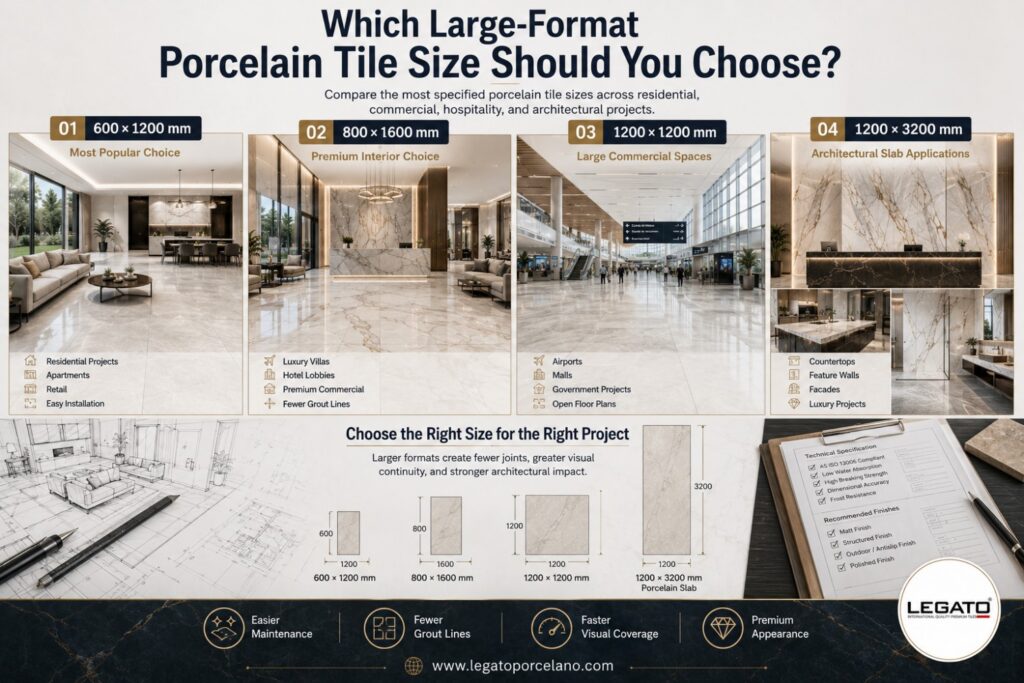
Australian projects specify this size more than any other large format. It gives you the large-format look while staying easy to transport, cut, and install. Volume residential builds, apartment developments, and general commercial floors default to this size.
800×800 mm Porcelain Tiles
Common in commercial floors and larger residential living areas where a square module suits the floor plan better than a rectangular one. Well suited to open-plan spaces with a symmetrical layout.
800×1600 mm Porcelain Tiles
This size makes a stronger visual statement in hotel lobbies, premium residential areas, and feature floors. It weighs more than 600×1200mm and needs a flatter subfloor. Confirm subfloor flatness before you order.
1200×1200 mm and Larger Slabs (up to 1200×3200 mm)
Designers use these large-format porcelain slabs for benchtops, feature walls, and premium facades, not general flooring. These sizes need specialised handling equipment — usually suction-cup lifters and two installers. Reserve them for signature moments, not broad specification.
| Size | Best For | Why Australia Specifies It |
|---|---|---|
| 600×1200mm | Residential, apartment developments, general commercial | Easy to transport and install, with the large-format look |
| 800×800mm / 900×900mm | Commercial floors, larger residential rooms | Symmetrical module suits open-plan layouts |
| 800×1600mm | Hotel lobbies, premium residential, feature floors | Fewer joints create a stronger visual statement |
| 1200×1200mm+ / large slabs | Benchtops, feature walls, facades | Reserved for signature applications given handling complexity |
Common mistake: buyers pick a size from a showroom photo and skip the room-dimension check. That choice often forces heavy cutting and pushes wastage above 15%. That wastage erases any cost advantage the larger format offered.
Popular Porcelain Tile Designs for Australia
Design preference in Australia tracks the indoor-outdoor lifestyle. Buyers also keep shifting toward natural, understated finishes over heavy patterns.
Marble-Look and Concrete-Look Designs Lead
Calacatta and Carrara-style veining leads the premium segment. Buyers choose it for kitchen benchtops, bathroom walls, and feature floors that want a natural-stone look without marble’s upkeep. Concrete-look designs suit the minimalist, industrial-contemporary style common in newer apartment developments and commercial fit-outs.
Natural Stone-Look and Timber-Look Suit Outdoor and Wet Areas
Outdoor and alfresco applications favour travertine, limestone, and sandstone-look designs, since they echo the natural stone Australians already use in outdoor paving. Timber-look designs suit bathrooms, laundries, and moisture-exposed decking, where real timber flooring isn’t practical.
Terrazzo-Look and Solid Tones Round Out the Range
Commercial and hospitality fit-outs increasingly choose terrazzo-look large-format porcelain tiles as a contemporary alternative to solid colour. Whites, greys, and warm neutrals remain the steady baseline for volume residential and commercial projects that need the tile to recede, not compete.
Many Australian buyers pair a large floor format with a matching smaller wall or splashback size. Confirm your supplier makes the same design across multiple sizes before you commit to one.
Legato Porcelano makes its large-format porcelain slabs across marble-look, concrete-look, and stone-look designs. The range matches floor and wall applications in the same design.
Finish & Climate Fit for Australian Conditions
Australia’s climate ranges from humid, cyclone-prone Queensland coastlines to hot, dry interior regions and temperate southern states. Finish selection needs to match both the climate and the application.
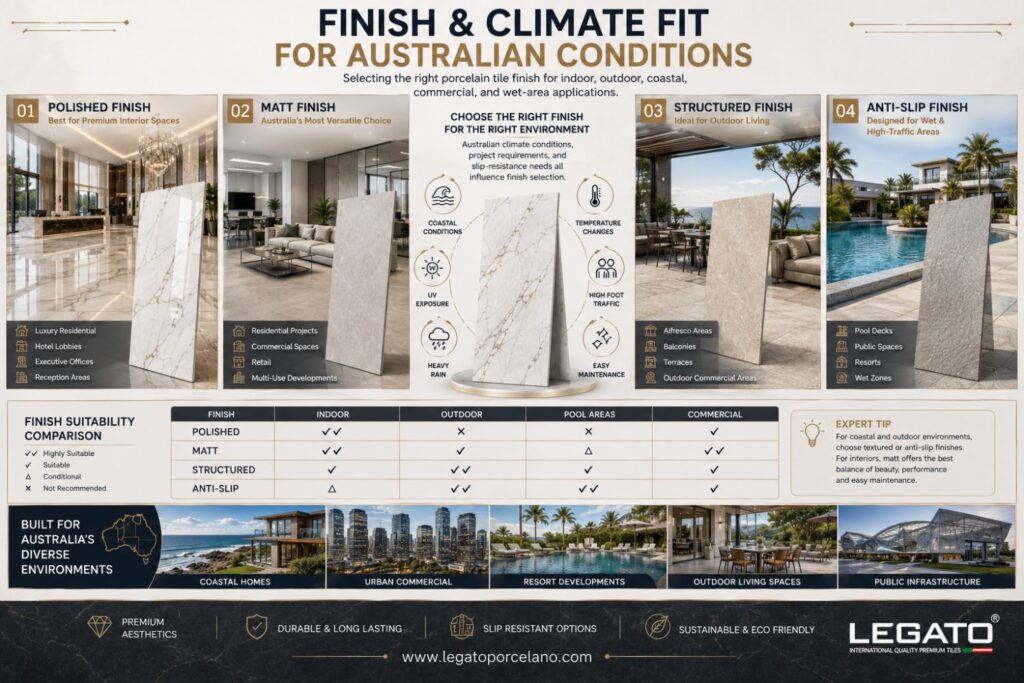
| Finish | Recommended Areas | Climate/Application Note |
|---|---|---|
| Polished | Living areas, feature walls, indoor premium spaces | Indoor use only; slip risk rules it out for wet or outdoor areas |
| Matt | Living areas, offices, general residential and commercial floors | Lower maintenance, with better slip performance than polished |
| Textured / anti-slip | Alfresco areas, pool surrounds, driveways, outdoor commercial paths | Essential outdoors; confirm the AS 4586 rating for the specific area |
| Satin / semi-polished | Hospitality interiors, retail, feature floors | A middle ground for interiors that want some sheen without full polish |
| Structured stone-look | Outdoor terraces, coastal properties | UV-stable pigments matter — coastal and northern sun exposure fades weaker pigments over time |
Common mistake: specifying a polished finish for an outdoor terrace because it matched an indoor sample. Always confirm the AS 4586 slip rating for outdoor and wet-area tiles before you finalise the finish.
Choosing the Right Large-Format Porcelain Tile Size for Your Project
Room Layout and Indoor-Outdoor Flow Set the Baseline
Open, uninterrupted areas handle larger formats well. Rooms with corners, doorways, or built-in cabinetry waste less material at 600×1200mm than at 1200×1200mm or larger. If you’re matching an internal floor to an alfresco or pool area, confirm the design ships in both an indoor-rated and an outdoor slip-rated finish.
Installation Readiness and Budget Narrow the Choice
Slabs above 1200mm on one edge need a flatter subfloor. They also typically need two installers with suction-lifting equipment. Volume residential and rental renovations default to 600×1200mm for cost and installation efficiency. Premium residential and hospitality projects more often justify 800×1600mm or larger.
Long-Term Maintenance Should Factor Into the Decision Too
A widely produced size makes future repairs or partial renovations easier to match. Less common formats become harder to source years later.
In short: pick 600×1200mm for practical, cost-efficient coverage across most floors. Pick 800×1600mm or larger only when the brief calls for a stronger visual statement. Always confirm the choice against installation capability first.
How Manufacturers Produce Large-Format Porcelain Tiles
Production quality decides whether a large-format tile survives shipping, handling, and years of Australian indoor-outdoor use.
- Body preparation — manufacturers mill clay, feldspar, and quartz into a consistent porcelain body. This step sets shade and strength for every later stage.
- Pressing — large formats need higher press tonnage and more even pressure than standard sizes. This stage sets the warpage risk.
- Digital printing — high-resolution inkjet printing applies marble-look, stone-look, timber-look, or solid-colour designs.
- Kiln firing — kilns fire tiles above 1,200°C to reach the low water absorption that true porcelain needs under the international ISO 13006 classification.
- Rectification — precision-cut edges create the tight grout joints that give large-format tile its seamless look.
- Calibration and shade sorting — inspectors check size accuracy and sort tiles by shade batch. Mismatched batches cause one of the most common large-format complaints worldwide.
- Export packaging — large-format tiles need reinforced crating and edge protection, given their size and Australia’s long sea-freight distance.
What Standards Must Porcelain Tiles Meet for Australia?
AS ISO 13006 Sets the Core Quality Requirements
AS ISO 13006 is Australia’s adopted version of the international ceramic tile standard. It classifies tiles by water absorption, production method, and quality group. It also sets minimum requirements for breaking strength, dimensional tolerance, surface abrasion resistance (PEI rating), and stain resistance. Porcelain tiles need water absorption below 0.5% to qualify as fully vitrified porcelain.
AS 4586 Governs Slip Resistance
A second standard matters just as much here: AS 4586. It governs slip resistance testing and assigns a P-rating from wet and dry pendulum or ramp tests. Australian architects, builders, and certifiers reference AS 4586 constantly for wet areas, pool surrounds, alfresco floors, and commercial spaces. It often forms part of National Construction Code compliance.
A tile can meet AS ISO 13006 on general quality and still need separate slip resistance testing for the specific project. Overseas exporters unfamiliar with Australia frequently miss this requirement.
Request Real Test Certificates, Not Marketing Sheets
Ask for test certificates from an accredited laboratory. Builders and certifiers request this documentation often, particularly for NCC wet-area and slip-resistance compliance.
What Should an Australian Importer Verify Before Signing a Contract?
- Test documentation against AS ISO 13006 and, where relevant, AS 4586 slip resistance ratings for the specific application.
- Batch consistency — manufacturers produce porcelain in shade and caliber batches. Mismatched batches create visible variation on one job.
- MOQ alignment with the project or stocking volume, so the order doesn’t force excess inventory.
- Sample approval against physical samples, not digital renders. Screen colours rarely match fired porcelain.
- Packaging suited to the shipping distance — Australia’s freight distance from major manufacturing hubs makes packaging quality a real cost factor.
- Manufacturer status, not a trading company — direct manufacturers usually give buyers more control over pricing, consistency, and scheduling.
Export Logistics for Australia
Shipping Routes and Transit Times
Indian manufacturing hubs typically ship porcelain tile to Australia through Nhava Sheva or Mundra. Shipments arrive at Sydney, Melbourne, Brisbane, Fremantle, or Adelaide. Sea transit generally takes several weeks, depending on the route and any transshipment involved. Ask your supplier or freight forwarder for a current port-to-port estimate. Carrier schedules and seasons shift transit time.
Contract Terms and Documentation
Exporters usually structure terms as FOB or CIF. This choice decides who arranges and insures the sea-freight leg, so clarify it early. It avoids confusion over landed cost later. Shipments should carry a complete commercial invoice, packing list, certificate of origin, and load photos confirming condition before departure.
Customs Clearance and Packaging Requirements
Australian Border Force clears ceramic and porcelain tiles under Harmonized System code 6907. GST and any applicable duty depend on the country of origin and current trade arrangements. Confirm current tariff treatment with a licensed customs broker, since classifications and preferential terms change.
Large-format slabs need reinforced A-frame crating or specialised wooden crating, not standard cartons. The flexing and edge-chipping risk over a long sea route makes this non-negotiable. Confirm packaging directly with any exporter.
Why Legato Porcelano for an Australian Project
Legato Porcelano manufactures from Morbi, Gujarat — one of the world’s largest porcelain tile hubs. The company builds export operations specifically around large-format production and long sea-freight routes. That experience matters in a market like Australia, where every shipment travels a significant distance regardless of origin country.
What to Verify Against Any Supplier, Including Legato
- Manufacturer status — a direct large-format porcelain manufacturer generally controls pricing, consistency, and scheduling more tightly than a trading company.
- Large-format production range extending to 1200×3200mm, so the factory actually presses the sizes you specify.
- AS ISO 13006–referenced test documentation, including water absorption and breaking strength data on request.
- Export packaging built for large-format shipping — reinforced crating and edge protection suited to long transit.
Legato’s export team walks Australian importers and distributors through size selection, technical documentation, and shipment planning. Request a sample and a technical specification sheet, then check the answers against the checklist above.
FAQs
Marble-look and concrete-look designs lead the premium and contemporary segments. Natural stone-look and timber-look designs suit outdoor and wet-area applications.
600×1200mm leads the Australian market. Projects reserve 800×1600mm and larger slabs for premium feature applications.
Yes, as long as the product carries an AS 4586 slip resistance rating suited to that outdoor application.
Buyers most often pick a size or finish from a sample or photo. They skip checking subfloor readiness, room dimensions, or the slip resistance rating for the actual application.
Look for reliable production capacity, consistent quality, technical documentation, and export-ready packaging. Legato Porcelano offers these capabilities for international large-format porcelain requirements.
Yes. Experienced manufacturers can supply Australia with suitable formats, documentation, and export packaging. Legato Porcelano supports international buyers seeking dependable large-format porcelain tile supply.
Final Thoughts
Australia’s large-format porcelain market rewards buyers who treat compliance, design fit, and sourcing with equal rigour. No domestic production exists to fall back on. Every shipment carries real freight distance and packaging risk, regardless of origin country. AS ISO 13006 and AS 4586 documentation isn’t a formality — it decides whether a project clears certification without delay.
Match size and finish to the actual application. Confirm production capability. Request real test documentation before you order. Buyers who follow this sequence avoid the two problems that derail large-format projects everywhere: non-compliant paperwork at certification, and tile damage from packaging that wasn’t built for the route.
Legato Porcelano’s export team can help you match size, design, and documentation to your Australian project before you commit to a container.
