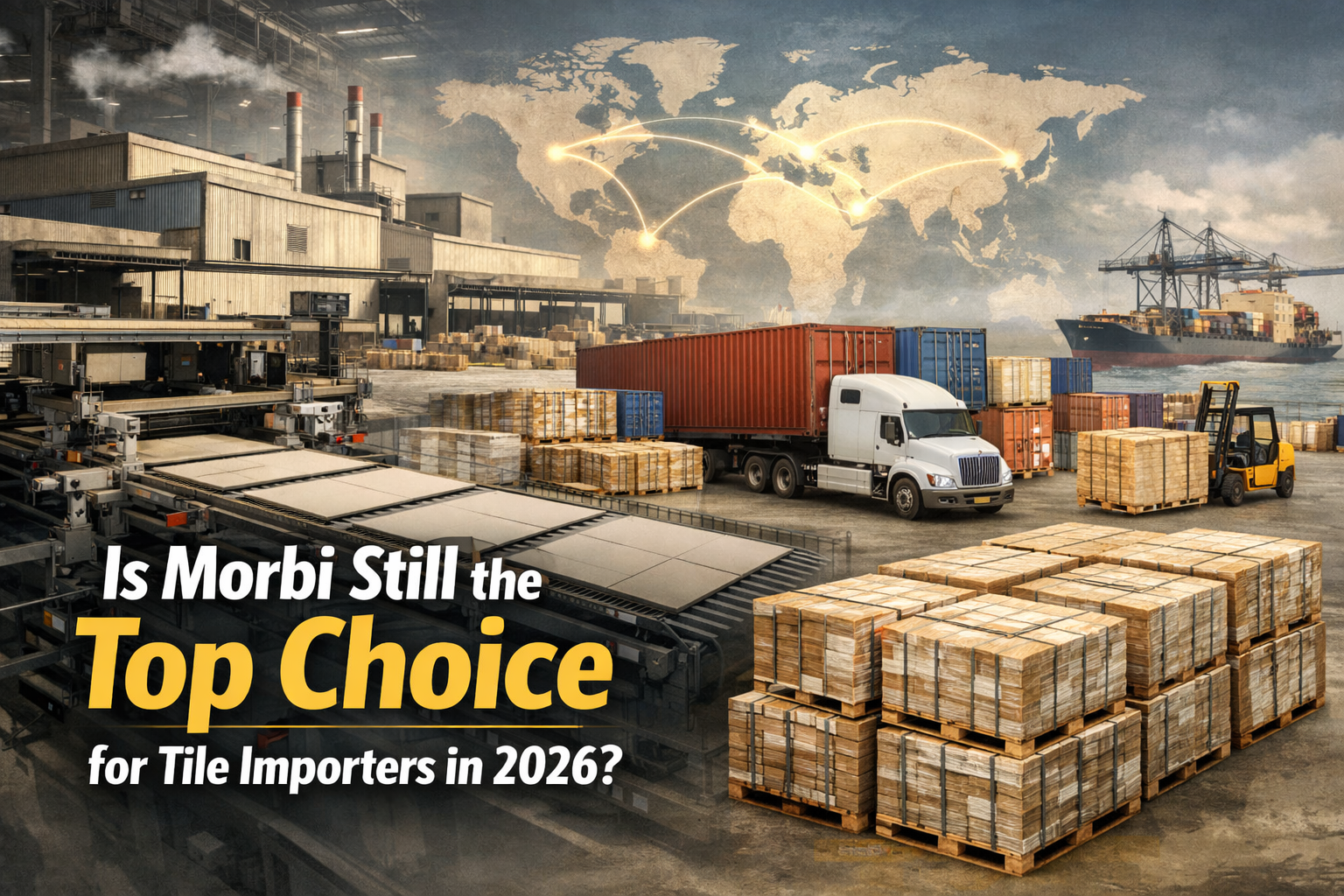
Why do importers buy tiles from Morbi?
Importers source tiles from Morbi for three reasons that matter most when you’re moving containers across borders: competitive pricing, production scale, and product variety. The region is home to hundreds of ceramic factories capable of turning out large volumes of porcelain and ceramic tiles for markets all over the world.
Is Morbi Still the Top Choice for Tile Importers in 2026?
Introduction
For more than two decades, Morbi — a mid-sized city in Gujarat, India — has quietly grown into one of the most influential ceramic manufacturing clusters in the world. Ask any tile importer today, and they’ll tell you: Morbi is the backbone of India’s ceramic tile industry and a go-to global sourcing hub for tile importers across continents. The region exports to more than 150 countries, with buyers in Europe, the Middle East, Africa, and the Americas pulling from Morbi’s factories year after year. But things are shifting. Changing global trade dynamics, energy supply disruptions, and real competition from countries like China and Turkey have put a serious question on the table for international buyers Is Morbi still the best place to source tiles in 2026? This article gives you a straight look at where things actually stand.
The Rise of Morbi as a Global Ceramic Manufacturing Hub
Morbi didn’t become a global tile powerhouse overnight. What started as a small regional pottery center gradually turned into something few people expected — a fully integrated industrial cluster that now sets the pace for ceramic manufacturing across South Asia.
The real turning point came in the early 2000s, when local manufacturers started adopting modern Italian machinery, digital printing technology, and large-scale production methods. Around that same time, the supporting ecosystem filled in quickly — raw material suppliers, packaging companies, machinery dealers, logistics firms, and export agents all set up shop in and around the city.
Today, Morbi is consistently described as the largest ceramic tile manufacturing cluster in India and one of the biggest in the world.
The numbers back this up:
- Morbi produces around 80–90% of India’s ceramic tiles
- The cluster includes hundreds of tile manufacturing factories and supporting industries
- Indian ceramic tile exports reach over 150 global markets
For a detailed overview of India’s ceramic industry growth, the Indian Brand Equity Foundation (IBEF) publishes industry insights and export statistics worth reading.
Global Tile Market Trends Importers Should Know in 2026
1. Rapid Growth of Porcelain Slabs
Large-format porcelain slabs have moved from a niche product to a mainstream demand item. Architects and interior designers want fewer grout lines, cleaner looks, and surfaces that handle heavy use. These slabs now show up in luxury flooring, kitchen countertops, wall cladding, hotel interiors, and commercial spaces — and the demand keeps climbing.
Morbi manufacturers haven’t missed this shift. Many have already moved into slab production to keep pace.
For a full breakdown of where these surfaces are used, see our guide on Porcelain Slab Applications.
2. Supply Chain Diversification
China dominated global ceramic exports for years. But a combination of geopolitical risk, higher freight costs, and trade tariffs has pushed buyers to spread their sourcing across more regions.
Morbi has picked up a meaningful share of that redirected demand. The region offers competitive pricing, high output capacity, improving quality standards, and enough flexibility to accommodate custom orders. That shift away from single-source dependence is expected to continue.
3. Sustainability and Environmental Pressure
Developers and construction companies are under pressure to meet green building standards. That’s pushed demand toward materials with longer lifespans, lower maintenance needs, and cleaner production footprints.
Porcelain tiles check most of those boxes. They’re durable, low-maintenance, and more sustainable than natural stone when produced at scale.
Why Global Tile Importers Still Choose Morbi
Despite the challenges (more on those shortly), Morbi keeps showing up on buyer shortlists. Here’s why.
Competitive Pricing
Manufacturing within a dense industrial cluster cuts costs across the board. Shared infrastructure, local raw material access, and high-volume production all drive unit costs down. For importers handling large orders, that pricing gap versus European manufacturers can mean a significant difference in project margins.
Massive Production Capacity
When hundreds of factories are operating within a tight geographic area, the collective output becomes something hard to match. Morbi can handle bulk export orders and large commercial projects in ways that most other tile-producing regions simply can’t.
Wide Product Range
Morbi manufacturers produce everything from standard floor tiles and wall tiles to marble-look porcelain, stone-look finishes, and large-format porcelain slabs. That means importers can consolidate sourcing instead of splitting orders across multiple regions.
For buyers evaluating slab suppliers, our guide on What Makes High-Quality Porcelain Slabs walks through the quality indicators worth checking before placing an order.s
Challenges Facing the Morbi Tile Industry in 2026
No sourcing destination comes without tradeoffs. Morbi has real challenges that importers need to factor in.
Energy Supply and Fuel Costs
Ceramic kilns run hot — which means they run on a lot of fuel. Natural gas supply disruptions over the past couple of years created temporary production slowdowns at some factories. Costs went up, and schedules slipped.
That said, many manufacturers are investing in energy-efficient kilns and alternative fuel solutions. The factories that have made these upgrades are better positioned to maintain consistent output.
Environmental Regulations
Stricter emissions standards are being enforced across the cluster. Factories are upgrading filtration systems and shifting toward cleaner production methods. This increases compliance costs in the short term, but it also signals that the industry is aligning with the environmental expectations of major export markets.
Rising Global Competition
Morbi isn’t the only player competing for global tile orders anymore. China, Turkey, Vietnam, and Spain are all active in the same markets.
Still, Morbi holds meaningful advantages in scale, speed, and cost — and those don’t disappear quickly.
For global export data, Ceramic World Web regularly publishes tile trade statistics and regional market analysis.
Morbi vs China vs Europe: Which Is Better for Importers?
Many buyers compare Morbi with other manufacturing regions before selecting suppliers. Here’s how they stack up:
| Factor | Morbi | China | Europe |
| Price | Very competitive | Competitive | High |
| Production capacity | Extremely high | High | Medium |
| Lead time | Fast | Medium | Slow |
| Product variety | Wide | Wide | Premium-focused |
| Supply chain ecosystem | Strong cluster | Large industrial base | Specialized manufacturers |
For most importers, Morbi hits the right balance of cost, capacity, and product availability.
How to Choose a Reliable Tile Manufacturer in Morbi
The cluster has hundreds of factories, and the gap between the best and the rest is wider than it looks from the outside. Here’s what to check.
Export Experience
A manufacturer that has been shipping internationally for years knows the documentation, packaging requirements, and logistics realities that first-time exporters often stumble on. That experience reduces risk on your end.
Certifications
Look for ISO standards, CE certification, and evidence of an actual quality control process — not just marketing language about quality. These things exist for a reason.
Production Capacity
If your project requires consistent volume over several months, confirm the factory can actually sustain that output. Some manufacturers oversell their capacity and can’t deliver reliably.
Specialization in Modern Surfaces
The manufacturers investing in large-format porcelain slabs and advanced architectural surfaces are generally the ones keeping up with where the market is heading. Companies like Legato Porcelano focus specifically on premium large-format porcelain surfaces for contemporary architecture and commercial projects.
The Future of the Morbi Ceramic Industry
A few shifts will define Morbi’s next five years.
Automation and Smart Manufacturing
More factories are moving toward automated production lines and advanced digital printing. This improves output consistency and opens up more design flexibility — both things international buyers are asking for.
Expansion of Porcelain Slab Manufacturing
Slab production is one of the fastest-growing segments in the tile industry. Morbi manufacturers are putting serious investment into this category, and output is expected to grow substantially through 2030.
New Export Markets
Africa, Southeast Asia, and Latin America are emerging as strong growth markets for Indian ceramic tiles. As construction activity picks up in these regions, Morbi is well-positioned to capture a larger share of that demand.
Conclusion
Morbi still earns its place on every serious tile importer’s shortlist. The manufacturing scale, the pricing, the integrated supply chain — none of that has gone away. And while energy costs, compliance requirements, and global competition have made things harder, the cluster has shown it can adapt.
The bigger variable is which manufacturer you’re working with. A strong partner in Morbi will give you reliable volumes, solid quality, and fewer surprises. The wrong one will do the opposite. Do the due diligence, verify what matters, and Morbi remains one of the best tile sourcing options available.
FAQ’s
Why is Morbi considered a global hub for tile manufacturing?
Morbi is one of the largest ceramic tile manufacturing clusters globally, producing a significant portion of India’s ceramic tiles. The region offers advanced production technology, competitive pricing, and large-scale export capacity for international buyers.
Is Morbi still the best place to import tiles in 2026?
Yes. Morbi remains a leading sourcing hub due to its massive production capacity, competitive pricing, modern manufacturing technologies, and wide product range including porcelain tiles, vitrified tiles, and large format slabs.
What types of tiles are commonly exported from Morbi?
Manufacturers in Morbi export porcelain tiles, glazed vitrified tiles (GVT), polished vitrified tiles (PGVT), double charge vitrified tiles, full body vitrified tiles, and large-format porcelain slabs used in residential and commercial projects.
Are Morbi porcelain tiles suitable for international markets?
Yes. Many manufacturers in Morbi use advanced Italian machinery and strict quality control processes, producing porcelain tiles that meet international standards required for architectural, commercial, and residential construction projects worldwide.
Why do global tile importers prefer Morbi suppliers?
Importers prefer Morbi suppliers because they provide competitive pricing, consistent production capacity, diverse tile designs, and strong export experience with established logistics networks serving markets across Europe, the Middle East, Africa, and the Americas.
How many ceramic tile manufacturers are located in Morbi?
Morbi hosts more than 800 ceramic and porcelain tile manufacturing units, making it one of the largest ceramic production clusters in the world with a strong export ecosystem supporting global tile distributors and importers.
