
Quick answer: To choose a reliable porcelain slab manufacturer for kitchen countertops, verify their ISO 9001 certification directly with the issuing body, confirm food-safe non-porous glaze, check batch color consistency before ordering in bulk, request physical samples, and review their export packaging standards.
A buyer orders 200 square feet of porcelain slab for a kitchen renovation. The island arrives looking almost right — except it’s a shade warmer than the perimeter counters, and nobody notices until the cabinets are already installed. That single mismatch traces back to one decision made months earlier: which manufacturer got the order.
Kitchen countertops are the most demanding application for porcelain slabs. They take daily heat, knife contact, spills, and constant visual scrutiny at eye level, so the manufacturer behind the material matters as much as the material itself. This guide breaks down exactly what to check before you place an order, written from the perspective of Legato Porcelano, a GVT/PGVT porcelain slab manufacturer based in Morbi, Gujarat, that exports to more than 30+countries.
Here’s what actually separates a dependable supplier from a risky one.
Why Kitchen Countertops Demand a Different Standard
Floor tile and wall cladding tolerate some variation. A countertop doesn’t. It sits under a hot pan one minute and a wet glass the next, gets sliced on directly, and stays in constant view as one continuous surface — especially on an island, where every buyer’s eye goes first.
That’s the core issue: a porcelain slab manufacture that’s perfectly reliable for flooring isn’t automatically reliable for countertop-grade material. Surface hardness, non-porosity, and batch-to-batch color consistency carry far more weight here than they do for a floor that’s walked on and rarely inspected up close.
A manufacturer’s design catalogue tells you how many patterns they offer. It doesn’t tell you whether those slabs are engineered to survive daily kitchen use — that takes a closer look.
1. Verify Certifications That Actually Matter for Countertops
ISO 9001 is the certification most porcelain manufacturers lead with, and for good reason — it confirms the factory follows documented, repeatable quality processes rather than producing inconsistent batches. What it doesn’t do is guarantee any single slab’s performance, so treat it as a starting point, not a finish line.
Don’t take a certificate of faith just because it’s on a letterhead. Check the certificate number, scope, and expiry date directly against the issuing or accreditation body’s public database. Both ISO’s own certification guidance and the IAF CertSearch database allow you to confirm a certificate independently of anything the supplier sends you.
For a countertop specifically, ISO 9001 alone isn’t enough. Ask for two more things:
- Food-contact safety documentation confirming a non-porous, non-toxic glaze — this matters for a surface where food is prepped directly, and it’s often skipped in generic tile-buying guides that don’t distinguish countertops from flooring.
- Third-party lab reports on water absorption (porcelain should sit below 0.5%) and stain resistance, rather than in-house test claims alone.
If a manufacturer can’t produce independent lab reports on request, that’s worth noting before you go further.
2. Confirm Slab Specs Match Countertop Requirements
Not every porcelain slab that looks good in a catalogue photo is built for a countertop span. Thickness, format size, and finish all affect how the material performs once it’s installed over cabinetry.
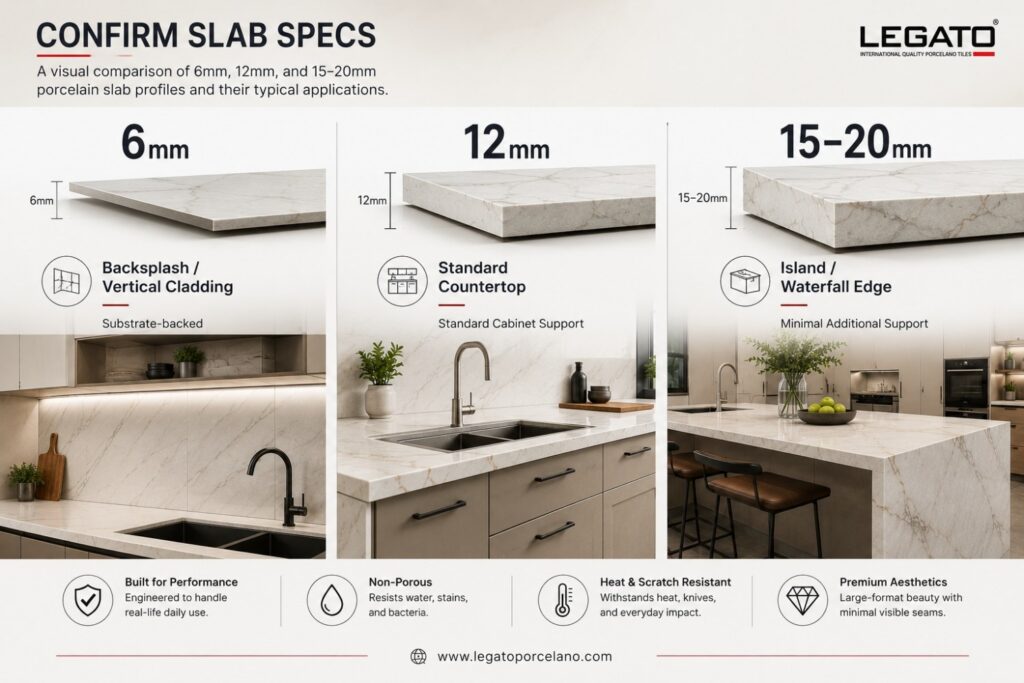
Thickness is the first thing to confirm. Most kitchen countertops use 12mm to 20mm slabs for standard runs and unsupported spans like islands or waterfall edges. Thinner formats, around 6mm, work well for backsplashes or vertical cladding but need substrate backing if used on a countertop — they’re not built to span open cabinet gaps on their own.
Large-format porcelain tile sizing matters more on a countertop than almost any other application, because it directly reduces the number of visible seams across an island or a long run of cabinetry. Fewer seams means a cleaner, more continuous look.
Finish is a smaller but still relevant decision. Matte finishes hide light scratches better and reduce glare under kitchen lighting, while polished finishes offer more shine but show fingerprints and fine scratches more readily in daily use.
| Thickness | Typical Use | Support Needed |
|---|---|---|
| 6mm | Backsplash, vertical cladding | Substrate-backed |
| 12mm | Standard countertops, moderate spans | Standard cabinet support |
| 15–20mm | Islands, waterfall edges, unsupported overhangs | Minimal additional support |
Maximum Slab Dimensions and Seam Reduction
Large-format porcelain matters more on a countertop than almost any other application, because slab size directly determines how many visible seams run across an island or a long cabinetry run. Fewer seams mean a cleaner, more continuous surface — and on a kitchen island, it’s often the single biggest visual difference between a premium result and a patched-together one.
Always ask a manufacturer for their full size range, not just their most popular format. Legato Porcelano’s catalogue currently spans 12 formats, from 300x600mm up to a maximum of 1200x3200mm:
| Format (mm) | Notes |
|---|---|
| 300×600 – 600×1200 | Compact formats, more seams, easier handling |
| 800×800 – 1000×1000 | Mid-size, common for mixed floor/counter projects |
| 800×2400 – 1200×2400 | Large format, suitable for most standard island runs in a single slab |
| 1200×3000 – 1200×3200 | Maximum format — covers most kitchen islands with zero or minimal seams |
A standard kitchen island typically runs 8–10 feet (roughly 2.4–3m). At 1200x3200mm, a single slab can span most residential islands with no interior seam at all — which is the specific detail worth confirming before you order, since not every manufacturer that lists “large format” on their site can actually produce at this ceiling size.
Edge Profiles
The edge profile affects both the look and the safety of a countertop, and it’s worth deciding before you finalize a slab order rather than after.
- Straight/square edge — clean, modern, the easiest to keep consistent across a long run
- Bullnose (rounded) edge — softens the look and reduces sharp corners, often preferred in family kitchens
- Mitered edge — creates the look of a thicker slab by folding a second piece under the front edge, common on 12mm slabs used on islands
Ask your manufacturer which edge profiles they can execute in-house versus which require a third-party fabricator — this affects both lead time and consistency, since an edge cut by a different shop than the one that made the slab introduces another point where color or finish can drift.
Bookmatching and Integrated Sinks
Two features increasingly separate premium slab manufacturers from basic ones:
- Bookmatching — two slabs cut and mirrored so their veining aligns symmetrically across a seam, most often used on waterfall-edge islands where the pattern needs to read as continuous down the side.
- Integrated sinks — the sink and countertop cut from a single slab for a seamless, easy-to-clean look, rather than a drop-in sink installed afterward.
Neither is standard on every order — ask specifically whether a manufacturer offers them, since both require production capability beyond a standard slab run.
3. Check Batch Consistency and Production Transparency
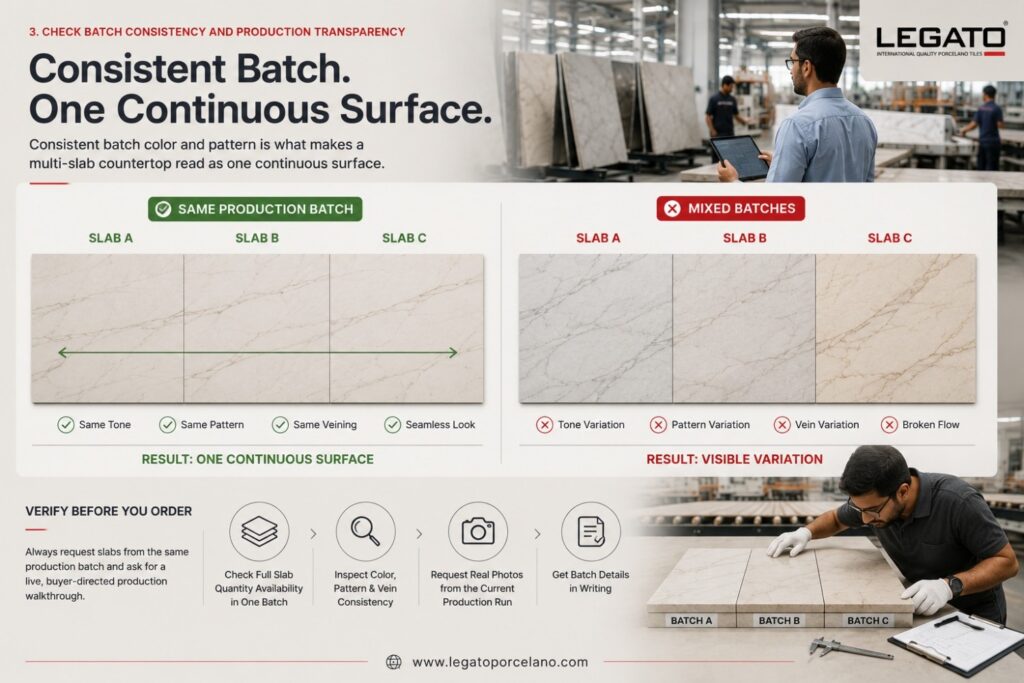
This is where the island-mismatch scenario from the intro actually happens. A countertop isn’t one tile — it’s a continuous surface made of multiple slabs that need to be read as a single material, and that only works if the whole order comes from one consistent production run.
Ask the manufacturer directly how they control color and pattern consistency within a single order, and whether your full quantity can ship from one production batch rather than being pieced together from separate runs. If the answer is vague, that’s a signal worth taking seriously.
A useful verification step here: request a live, buyer-directed video walkthrough of the actual production line, not a pre-recorded promotional reel. Being able to ask questions in real time and see the specific process — not just polished marketing footage — is one of the clearest ways to tell a genuine manufacturer from a trading company reselling mixed-batch stock. It’s also worth asking for a realistic lead time upfront rather than a generic promise, since production and export timelines vary by order size and destination.
4. Request Samples Through the Manufacturer’s Sales Team
For slab-level orders, samples are almost always handled through direct inquiry — an email, a contact form, a conversation with a sales representative — rather than an instant, self-serve sample kit. That’s standard practice across the export slab industry, not a red flag on its own.
What matters is how the manufacturer handles that request. Response time, willingness to send physical material before you commit to a bulk order, and clarity in communication all say something about how they’ll handle the rest of the relationship.
Once a sample arrives, put it through a few practical tests before approving a large order:
- Heat exposure — set a hot pan directly on the surface and check for discoloration or damage.
- Scratch resistance — run a knife edge across the surface under normal pressure.
- Stain resistance — leave a spill of oil or a colored liquid on the surface for a set period, then clean it and check for residue.
These few minutes of testing tell you more than any catalogue spec sheet.
5. Evaluate Export Packaging and Handling for Large-Format Slabs
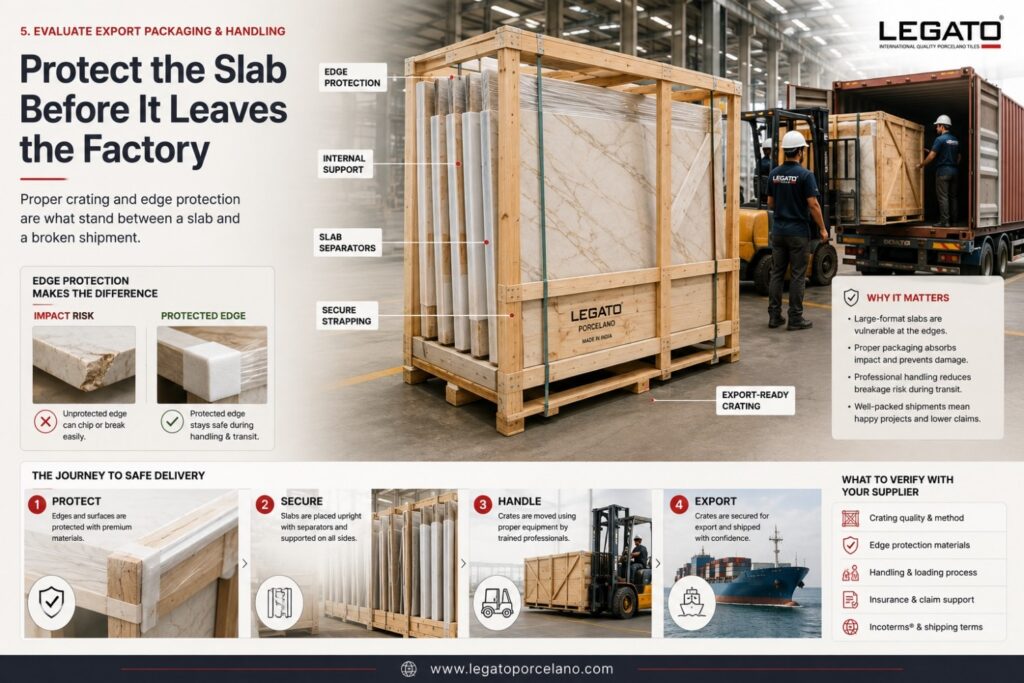
Breakage in transit is consistently one of the top complaints for large-format slab shipments, simply because countertop-size pieces are larger and heavier than standard floor tile and more vulnerable to impact during handling.
Before committing to an order, ask about crating standards and edge protection specifically, along with the insurance coverage and claims process if something does arrive damaged. Shipping terms — FOB or CIF — should also be clear upfront so there’s no confusion about what’s included in the quoted price.
It’s also worth asking for references from buyers who sourced slabs specifically for kitchen countertop projects, rather than general tile clients. Countertop buyers tend to scrutinize color matching and surface quality more closely, so their feedback is more relevant to your own project.
6. Verification Mistakes That Lead to Bad Orders
A few patterns show up repeatedly in countertop sourcing problems, and nearly all of them are avoidable with one extra step before ordering:
- Placing a full order before confirming batch and color consistency on a sample, rather than treating the sample as a checkpoint before committing.
- Assuming standard floor-tile specs will work for a countertop — thickness and finish requirements are genuinely different for a horizontal, load-bearing kitchen surface.
- Skipping certificate verification because a supplier’s website looks established — a polished catalogue and a verified certificate are two separate things.
- Comparing quotes on price alone, without factoring in crating, insurance, and realistic lead times, which can shift the real cost significantly.
- Not requesting a live production video before committing to a large-format countertop order, missing an easy way to confirm the manufacturer actually produces what they’re selling.
7. Red Flags Specific to Countertop-Grade Sourcing
A few warning signs are worth treating as dealbreakers rather than minor concerns:
- No food-safety or non-porosity documentation available on request
- Inability to confirm or guarantee batch consistency across a full order
- Reluctance to provide samples or a live video walkthrough before a bulk order
- Only standard floor-tile specs on offer, with vague answers on countertop-appropriate thickness or format
- Pricing significantly below market average with no clear explanation for the gap
Any one of these on its own might have an explanation. More than one together is a pattern worth walking away from.
The 8-Point Manufacturer Verification Checklist
Save this before you request your next quote:
- ISO 9001 certificate verified directly with the issuing body
- Food-contact safety documentation provided
- Water absorption and stain resistance lab reports available
- Slab thickness matches your specific countertop application
- Batch and color consistency process explained and confirmed
- Live, buyer-directed video walkthrough of production completed
- Physical sample requested and tested before bulk order
- Export packaging, insurance, and reference checks completed
Frequently Asked Questions(FAQ’s)
Most kitchen countertops use 12mm to 20mm porcelain slabs. Thinner slabs (6mm) work for backsplashes or vertical surfaces but need substrate backing for unsupported countertop spans like islands.
Yes, when manufactured correctly. Porcelain is fired at high temperatures into a non-porous, non-toxic surface, but always asks the manufacturer for food-contact safety documentation rather than assuming it by default.
Confirm the entire order ships from a single production batch. Ask the manufacturer directly how they control color and pattern consistency across one run before placing a bulk order.
Timelines vary by destination, order size, and current production backlog. Reliable manufacturers give a realistic estimate upfront rather than a generic promise — always confirm before ordering.
5. What’s the difference between porcelain slabs for countertops versus flooring?
Countertop slabs need higher non-porosity, stain resistance, and batch color consistency since they’re visually continuous and handle daily food contact. Flooring slabs prioritize surface traction and wear resistance instead.
The biggest mistakes are skipping certificate verification, assuming floor-tile specs work for countertops, and ordering in bulk before confirming batch color consistency on a sample.
Choose a manufacturer by verifying certifications, food-contact safety documentation, independent test reports, slab specifications, batch consistency, samples, production transparency, and export packaging. Legato Porcelano recommends checking these factors before placing a bulk countertop order
Final Thoughts
Reliability in a porcelain slab manufacturer comes down to verified certifications, consistent batch quality, food-safe documentation, and transparent production and export handling — not marketing claims. A supplier willing to open all of that up to scrutiny is generally one worth working with.
At Legato Porcelano, we field these exact questions from buyers on a regular basis, which is part of why we put this checklist together. As a GVT/PGVT porcelain slab manufacturer based in Morbi, Gujarat, exporting to more than 30+ countries with over 1,000 designs across 12+ sizes, we’d encourage you to run this same checklist against us.
