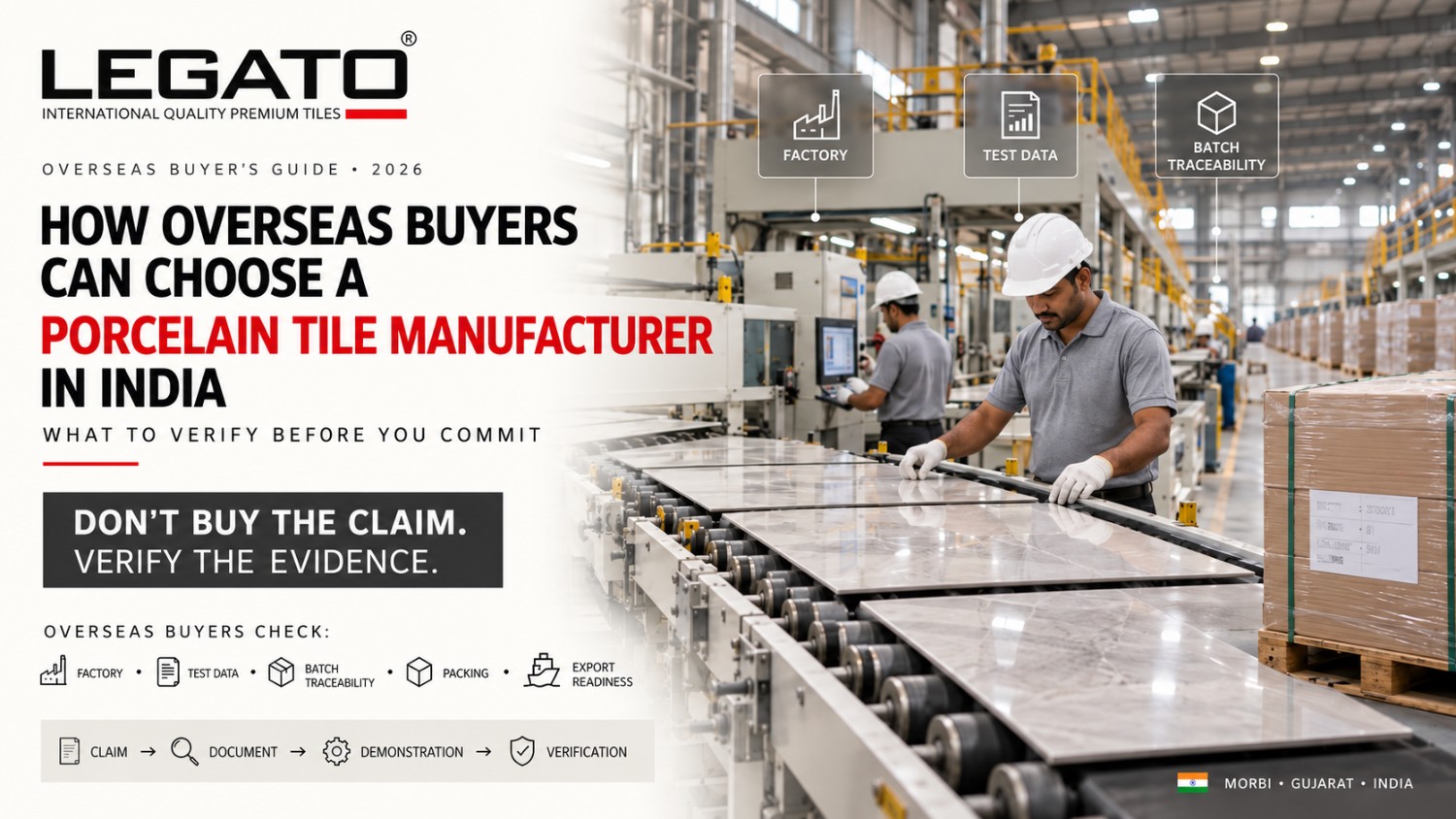
Tile sourcing problems are not always visible when an order is placed. Some appear during production, while others become clear only after packing or delivery: the shade may differ from the approved sample, calibres may be mixed, slabs may show excessive warpage, or reported technical values may not match the agreed specification.
By then, production and freight costs may already be committed. Choosing a porcelain tile manufacturer in India is therefore not only about comparing prices; it is about verifying capability, quality and consistency before committing to volume.
This guide is written for importers, distributors, contractors, architects and procurement teams. It explains how a factory really works, how to confirm that a company manufactures what it sells, how to read test reports and certificates, how to check batch consistency, and how to run samples and a first order so that problems appear early and cheaply. Every section can be read on its own.
Key Takeaways
- Judge a manufacturer by evidence, not by claims: Claim → Document → Demonstration → Independent Verification.
- Different defects can originate at different production stages. Verify how the factory controls each stage and records the results.
- Trade names such as GVT (Glazed Vitrified Tile), PGVT (Polished Glazed Vitrified Tile) or “vitrified” do not by themselves prove porcelain performance. Request the measured water-absorption value, test method and supporting report for the product being evaluated.
- A test report is only useful if it names the product, thickness, method, date and laboratory.
- Compare quotes only within the same grade. Different grades are different products.
- Run a structured sample test and a small trial order before committing to volume.
What Is the Evidence Ladder for Evaluating a Manufacturer?
Short answer: The Evidence Ladder is a four-level framework for testing manufacturer claims: Claim → Document → Demonstration → Independent Verification. The greater the commercial or technical risk, the stronger the evidence you should require before making a sourcing decision.
Every statement a manufacturer makes sits on one of four levels:
| Level | What it is | Example | How much to trust it |
|---|---|---|---|
| 1. Claim | A statement with no proof | “We have strict quality control.” | Low. Treat as a starting question. |
| 2. Document | A written record | A certificate, test report or inspection record | Medium. Check names, dates and scope. |
| 3. Demonstration | Something you see live | A live video of the sorting line, or tracing a carton batch code on camera | High. Hard to fake in real time. |
| 4. Independent verification | A third party confirms it | A visit, an independent laboratory test or a third-party inspection | Highest. Use for critical points. |
The rest of this guide shows how to move important sourcing decisions beyond supplier statements and toward verifiable evidence. Routine information may be supported by documents, while higher-risk claims may justify live demonstration, independent testing or third-party inspection.
The objective is not to reach Level 4 for every point; it is to match the strength of the evidence to the consequence of failure.
Why Does the Choice of Manufacturer Matter So Much?
Short answer: The manufacturer controls shade, size, strength, surface and packing in every shipment, so a weak choice causes repeated losses while a strong one protects margins and customer trust.
When you buy tile, you are also relying on a production process that must repeat within the agreed specification from order to order. Common sourcing and production risks include:
- Shade drift between batches
- Mixed calibres (sizes) in one pallet
- Warpage or poor flatness, especially on large formats
- Edge and corner chipping
- Glaze or printing defects such as pinholes and pattern mismatch
- Technical values that do not match the specification
- Breakage caused by weak packing
The cost can extend beyond the tiles themselves. It may include freight on rejected goods, delays to your customers, time spent resolving claims and damage to commercial relationships. Price comparison alone does not show whether a porcelain tile manufacturer India offers can reproduce the agreed quality across future orders.
A reliable porcelain tile manufacturer reduces these risks through controlled and transparent processes, not through promises.
How Is Porcelain Tile Made, and Where Do Defects Start?
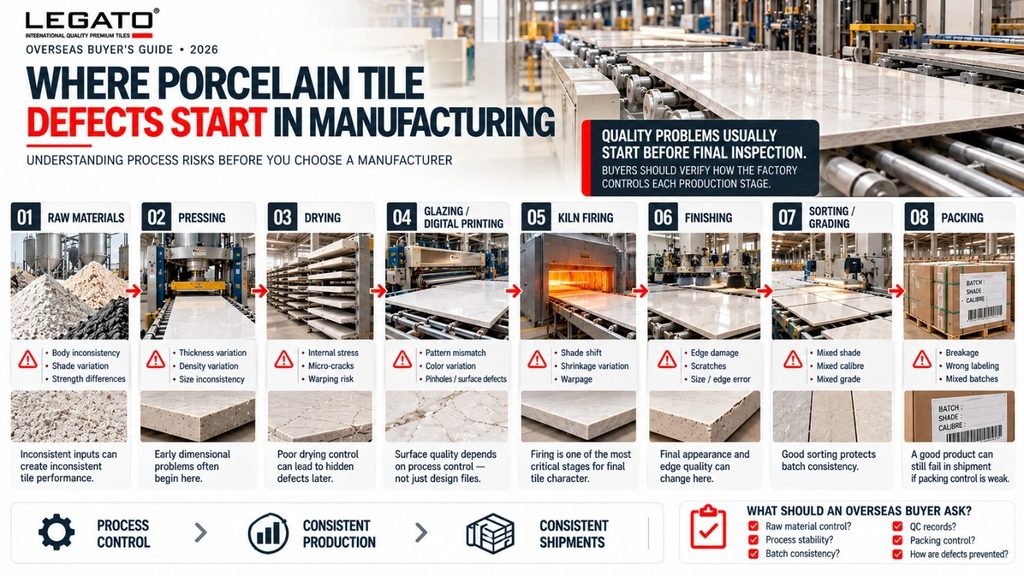
Short answer: Porcelain tile is made by blending raw materials, pressing, drying, decorating, firing, finishing, sorting and packing. Different defects can originate at different production stages, so the relevant controls should be checked at each stage.
A manufacturer should be able to identify which production stages it controls directly and explain how quality is managed through each relevant stage. The table links each stage to defects that can begin there:
| Stage | What happens | Defects that can start here |
|---|---|---|
| Raw materials and body preparation | Clays, feldspar, silica and other minerals are ground and blended | Inconsistent body, shade and strength |
| Pressing | Powder is pressed into tiles or large slabs | Thickness and density variation, size differences |
| Drying | Moisture is removed before decoration and firing | Cracks, internal stress |
| Glazing and digital printing | Surface colour, design and texture are applied | Pinholes, pattern mismatch, colour variation |
| Kiln firing | High-temperature firing densifies the body | Shade variation, shrinkage, warpage |
| Finishing | Polishing, rectification or other surface work | Edge damage, surface scratches, size error |
| Sorting and grading | Pieces are inspected and separated by quality, shade and size | Mixed grades, mixed calibres |
| Packing | Cartons and pallets are prepared for dispatch | Transit breakage, wrong labelling |
Understanding where defects originate helps you request better evidence. Instead of asking whether a factory has quality control, identify the control being evaluated—for example, how firing shrinkage is monitored, how calibre is measured after firing and what records support those checks. The evidence behind the answer matters more than the answer alone.
Why Do Buyers Source Porcelain Tiles From India?
Short answer: India has a large, established ceramic industry with a major production cluster in Morbi, Gujarat, offering a wide choice of sizes, surfaces and designs and an export-oriented supply base.
India is among the largest ceramic producers in the world, and a significant share of production is concentrated around Morbi. Raw material supply, machinery suppliers, skilled labour and export experience sit close together, so buyers can source a wide range of formats and finishes from one region.
The same concentration creates a challenge. When you search for an Indian porcelain tile manufacturer, you will meet large integrated plants, smaller factories, trading firms and marketing companies that outsource all production. They can look identical on a website. Anyone shortlisting a porcelain tile manufacturer India can rely on has to start by separating real factories from resellers.
What Is the Difference Between a Manufacturer, a Trader and a Supplier?
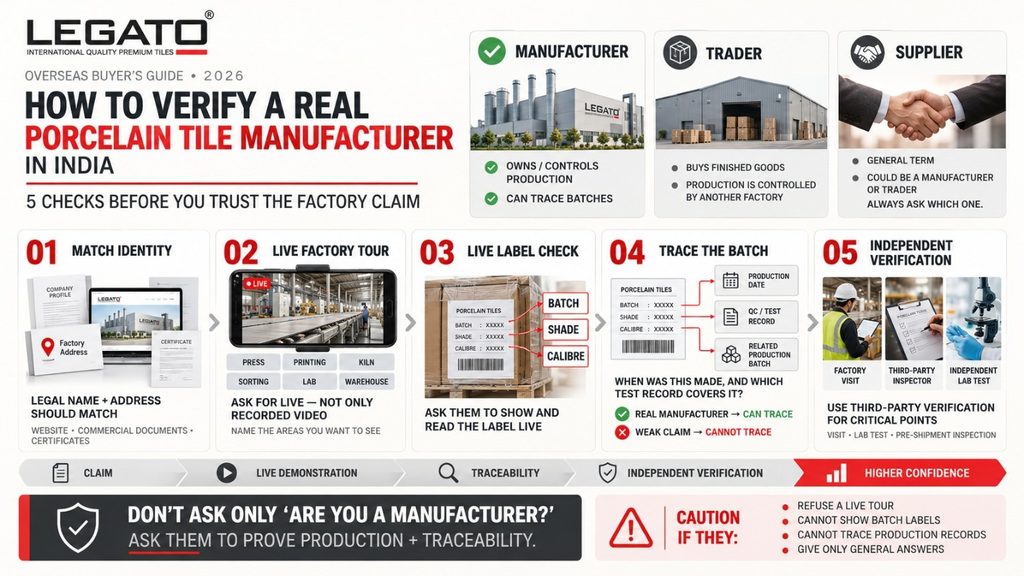
Short answer: A manufacturer produces the tiles in its own facility, a trader buys finished tiles and resells them, and “supplier” is a general term that can mean either.
| Type | What it does | What it means for you |
|---|---|---|
| Manufacturer | Owns and controls production | Direct control over quality, batches and packing |
| Trader | Buys finished goods from one or more factories | Less control, and quality depends on the factory behind it |
| Supplier | General term | Verify who manufactures the product and controls production, testing and batch traceability |
Traders are not automatically bad, but when you shortlist a porcelain tile manufacturer India offers, you should know which category each company falls into. Some traders are honest and useful when you need mixed products from several factories. The problem begins when a trader presents itself as a factory.
Then you may not know who makes your tiles, who tests them and who is responsible when a batch fails. For the broader supplier-side journey, read our guide on sourcing porcelain slabs from India.
Does “Vitrified”, “GVT” or “PGVT” Mean the Tile Is Porcelain?
Short answer: Not automatically. These are trade terms. Porcelain classification depends on measured performance, including water absorption, so verify the measured value, applicable test method and supporting report.
Indian tile trade uses several common names:
- Vitrified tile: a general term for dense, low-absorption tile.
- GVT (Glazed Vitrified Tile): a vitrified tile with a printed glaze surface.
- PGVT (Polished Glazed Vitrified Tile): a GVT with a polished glossy surface.
- Double charge: a tile pressed in two layers, with a pigmented top layer.
- Full body: a tile whose colour runs through the body.
These names describe surface or construction, not guaranteed technical performance. Two products with the same trade name can behave differently. Before comparing products, request the measured water-absorption value together with the applicable test method, sample identification and supporting report. Verify that the evidence relates to the product being evaluated rather than relying only on a generic technical sheet.
How Can You Confirm a Company Really Manufactures?
Short answer: Combine documents with live demonstration: factory address, a live video tour of named areas, and a batch-code traceability test on a real carton.
Verification becomes stronger when you move beyond Level 1 claims toward documents and live demonstration:
- Match identity. The legal company name and address should be consistent across websites, certificates and commercial documents.
- Request a live factory tour rather than relying only on prerecorded footage. During the call, have the supplier show specific areas you select: body preparation, presses, printing line, kiln, sorting line, laboratory and finished-goods warehouse.
- Verify a live production detail. Select a pallet or carton during the call and have the supplier show its product reference, batch, shade and calibre markings.
- Run a traceability test. Select one finished-carton batch code and have the supplier trace it to the production date and available inspection or test records. Where applicable, verify how products from that batch are identified in storage and dispatch.
- Verify process capability. Confirm the equipment and process relevant to your product—such as pressing, digital decoration, firing, rectification and shade or calibre sorting—and request supporting live or documented evidence where the capability affects your order.
- Visit if you can. A visit moves the evidence to Level 4.
A successful traceability test is a strong indicator that production and quality records are linked to identifiable batches.
What Manufacturing Capability Should You Evaluate?
Short answer: Check that the factory can produce the sizes, thicknesses, finishes and designs you need, with equipment and process control suited to them.
Capability decides whether a factory can deliver the product you actually sell. Review:
- Formats and thickness. Standard tiles and large-format slabs place different demands on pressing, firing and handling.
- Surface types. Glazed, polished, matt, textured and rustic finishes all need different control during glazing and firing.
- Printing and design. Confirm the number of design faces available for the selected pattern and review representative pieces or layouts where visual repetition matters.
- Rectification. Rectified edges allow tighter joints and cleaner installation.
- Equipment condition. Presses, kilns and sorting equipment need to be maintained and measured.
- Process discipline. Raw material checks, controlled firing and sorting after the kiln show whether quality is managed or left to chance.
Capability and capacity are different things. A factory may be capable of producing a product without having the available capacity to repeat it at the required volume and lead time. Verify what can be produced for the specific size, thickness and finish you are buying, how repeat bulk orders are scheduled, and how peak-season demand affects production availability. This becomes especially important when you evaluate a porcelain slab manufacturer India offers for large-format work, where capability gaps can become more visible.
How Does Evaluating Large-Format Slabs Differ From Standard Tiles?
Short answer: Large-format slabs require additional verification of flatness, dimensional consistency, handling and packing because their size increases sensitivity to production and transport conditions.
Large-format porcelain is used for floors, wall cladding, countertops and facades. When assessing a porcelain slab manufacturer India offers, add these evidence checks:
- Flatness and warpage. How is flatness controlled during firing, and how is it measured after sorting? ISO 10545-2 covers dimensional and surface quality measurements, including curvature and warpage.
- Size and thickness range. Which slab sizes and thicknesses are standard production, and which need special runs?
- Edge and corner protection. How are edges protected through handling and packing?
- Handling equipment. Are slabs moved, stored and packed with equipment designed for large formats?
- Packing method. How are slabs racked, protected and secured for transport?
- Fabrication needs. If slabs will be cut for countertops or cladding, does the factory understand fabrication and handling requirements?
A porcelain slab manufacturer India buyers are evaluating should be able to support relevant answers with specifics. If the explanation remains general, request current photographs, live video, measurement records or inspection evidence from the actual process. Apply the same verification standard to any Indian porcelain tile manufacturer you shortlist.
What Does Porcelain Manufacturer Quality Control Include?
Short answer: Porcelain manufacturer quality control checks materials and products at several stages, records results and uses them to correct problems. It is much more than a final visual inspection.
Real quality control is built into the stages shown earlier. Here is what a documented system should look like compared with a weak one:
| Stage | Strong system | Weak system |
|---|---|---|
| Raw materials | Incoming checks with records | Accepted on supplier word |
| Pressing | Regular size and thickness checks | Checked only when complaints arrive |
| Firing | Controlled and monitored kiln conditions | Dependent on operator experience alone |
| Sorting | Defined grades, size and shade classification | Visual impression, no defined criteria |
| Packing | Carton check against batch, shade and calibre | Packing from whatever is available |
| Records | Results stored and linked to batches | No traceable records |
Quality-Control Questions That Require Evidence:
- Who has the authority to hold, downgrade, rework or reject material that falls outside the agreed specification?
- Which production and final-inspection results are recorded, and can you show a recent record for a comparable product or batch?
- When material falls outside specification, how is it identified, segregated and prevented from entering an approved order?
- For recurring defects, how is the cause investigated and corrective action recorded?
- Which product tests are performed in-house, which are performed by external laboratories, and how are the results linked to the product or production batch?
A documented system proves nothing alone, but it separates organised factories from those relying on habit.
Which Technical Tests Should You Check Before Ordering?
Short answer: Review the technical properties that affect the tile’s classification, performance and intended use, then confirm that the supporting test results actually relate to the product you plan to buy. The required checks can vary by tile type, finish, application and destination-market specification.
For porcelain tiles, relevant technical checks can include dimensions and surface quality, water absorption, mechanical strength, abrasion resistance, stain and chemical resistance, frost resistance and thermal behaviour where these properties apply to the intended use. These characteristics may be evaluated using applicable methods from the ISO 10545 series.
Water absorption is particularly important when verifying porcelain classification, while dimensions, flatness and breaking strength help determine whether the product matches the agreed physical specification. Abrasion becomes important for floor applications, and frost, chemical or stain resistance should be considered where the installation environment makes those properties relevant.
The objective is not to collect as many test reports as possible. It is to identify the properties that matter for the product you are buying and obtain evidence that supports those requirements.
Test Report Verification Checklist
Before relying on a test report, verify these five areas:
- Product match: Confirm that the product, size, thickness and finish shown in the report correspond to the tile being evaluated.
- Test details: Check the test method, applicable standard, test date and sample identification so you know what was actually tested.
- Laboratory: Identify whether the test was performed internally or by an external laboratory and verify relevant accreditation where independent testing is required.
- Results: Look for the actual measured value or classification and compare it with the agreed product requirement rather than accepting a simple “pass” statement.
- Traceability: For important technical properties, confirm whether the report or inspection result can be connected to the supplied product, production lot or batch where appropriate.
A report carrying an ISO reference is not automatically proof that the product in your order meets the required specification. The value of the report depends on whether the tested sample, test method and results are relevant to the product being supplied.
For porcelain classification, verify the measured water-absorption result against the applicable product standard and project or destination-market requirements. Do not rely only on trade terms such as porcelain, vitrified, GVT (Glazed Vitrified Tile) or PGVT (Polished Glazed Vitrified Tile) as proof of technical performance.
How Do Abrasion, Slip and Application Requirements Fit In?
Short answer: Match the technical rating to the end use. A residential wall, a residential floor and a commercial or wet-area floor need different performance.
- Wear (abrasion). For glazed floor tiles, ISO 10545-7 addresses resistance to surface abrasion. In tile trade terminology, wear classifications are also commonly referred to as PEI (Porcelain Enamel Institute) classes. Verify the test basis and rating stated for the exact product.
- Slip resistance. Methods differ by market and application, including ramp ratings, pendulum test values and DCOF (Dynamic Coefficient of Friction). Identify the method required for the intended application and destination market, then request the corresponding result for the product being evaluated.
- Frost and exterior use. For exterior applications exposed to freeze-thaw conditions, determine whether frost resistance is required and verify the applicable result for the selected product.
- Chemical exposure. Kitchens, laboratories and commercial spaces may need chemical resistance data.
Tell the manufacturer the intended application at the start. A technically competent supplier should clarify relevant details such as interior or exterior use, traffic, wet exposure, freeze-thaw conditions and destination-market requirements before recommending a product.
Which Certifications Matter, and What Do They Actually Prove?
Short answer: Certifications and compliance documents can provide useful evidence about a company, management system or product requirement, but their meaning depends on the document, issuer, scope and applicable framework. They do not replace product-specific test reports or porcelain manufacturer quality control records.
| Certification | What it indicates | What it does not prove |
|---|---|---|
| ISO 9001 | A documented quality management system is in place and audited | That every batch meets a given technical value |
| CE-related compliance documentation | Relevant where applicable construction-product requirements apply to the product and market | That every property suits your specific application |
| Export House recognition (Government of India) | An established export track record | Product quality or technical performance |
Certificate and Compliance Document Verification Checklist:
- Check that the legal name and address match the manufacturer.
- Check validity dates and surveillance audit dates.
- Check the scope, meaning the exact products or activities covered.
- Identify the issuer or certification body and verify its status and relevant accreditation where applicable.
- Use the QR code or online lookup where provided.
- For CE-marked products, review the applicable declaration and the product characteristics it covers under the regulatory framework relevant to the market.
Legato Porcelano LLP, based in Morbi, Gujarat, displays ISO 9001:2015 certification, CE-related compliance documentation and Government of India Export House recognition on its export page. Buyers choosing a porcelain tile manufacturer India provides should apply the checks above to every company, Legato included.
How Do You Check Batch, Shade and Size Consistency?
Short answer: Verify how the factory identifies batch, shade and calibre, then compare representative pieces against the approved sample and written specification. Batch-to-batch variation is an important sourcing risk because dimensional or visual differences may become evident during installation.
Three kinds of consistency matter:
Shade (tone) consistency: Tiles are fired in batches, and shade can vary between them. Factories may grade shade and mark it on cartons. Where a visual-variation classification is specified, confirm the intended class and establish whether different production shades may be combined within the same order. For shade-sensitive projects, put the agreed requirement in the written specification.
Size (calibre) consistency: Small size differences can cause uneven joints and lippage on site. Verify how calibre is measured, how it is identified on cartons or pallets, and what controls prevent unintended calibre mixing within an order.
Surface and design consistency: Glaze, texture and printed designs should remain within the agreed specification across runs. For natural-look designs, confirm the number of available faces and how visual variation is managed.
Batch, Shade and Calibre Control Questions:
- How are batch, shade and calibre identified on cartons and pallets?
- Can the required quantity be supplied within the agreed shade and calibre controls?
- How are different batches, shades and calibres segregated during storage, order picking and container loading?
- If production differs from the approved sample or written specification, how is the deviation identified, documented and resolved before shipment?
A reliable porcelain tile manufacturer has a clear answer to each of these. For more on how batch control connects to packing and shipment checks, see our guide to evaluating a porcelain tile exporter.
Why Must You Compare Quotes Only Within the Same Grade?
Short answer: Factories may sort output into different grades, and grade definitions can vary between manufacturers. A lower quotation may reflect a different grade, specification, sorting tolerance, packing standard or commercial condition, so quotes are comparable only when the grade and specification match.
After firing and sorting, production is commonly separated into grades, often described as Premium, Standard and Commercial or Economy. The names and criteria are set by each factory, so the same word can mean different things at different companies.
Before comparing prices:
- Obtain the grade definition in writing, including the relevant acceptance criteria for visual defects, dimensional variation, shade consistency and packing.
- Confirm that the approved sample and quotation refer to the same grade and written specification.
- Put the agreed grade, size, thickness, finish and design reference in the written specification.
- Do not accept a price difference that comes only from a different grade.
A price cannot be compared properly until the grade and specification behind it are clearly defined.
How Should You Run a Sample Test?
Short answer: Treat the sample as a test of the manufacturer as well as the tile. Measure, lay out and compare several pieces, keep one as a reference and record exactly what was approved.
A practical sample protocol:
- Request multiple representative pieces rather than relying on one selectively chosen tile. Where practical, include pieces from more than one carton so variation can be evaluated.
- Measure size and thickness on every piece and note the variation.
- Check flatness and edge squareness with a straight edge and a square.
- Dry-lay multiple representative pieces where the format permits to assess joint alignment and shade variation together.
- Inspect surface and edges for pinholes, chips and glaze or print defects.
- Compare the specification sheet line by line.
- Observe the process. Note packing quality and the speed and clarity of communication.
- Send critical samples to a laboratory if the project needs verified technical values.
- Keep an approved reference piece and record the approval in writing.
Sampling also gives the buyer an early view of product identification, packing, documentation and communication discipline before a larger order is placed.
What Should You Check in Packing Quality?
Short answer: Check carton strength, accurate labelling, edge and surface protection, and pallet stability, with extra attention to polished tiles and large-format slabs.
Weak packing can cause edge damage, surface damage and breakage during handling and transit, so packing should be evaluated as part of product quality. Review:
- Cartons. Strong, correctly sized and printed with product, size, shade, batch and quantity.
- Inner protection. Corner or edge protection and separators where the product needs them.
- Palletisation. Stable pallets with proper strapping and wrapping.
- Wooden packaging. Where regulated raw-wood packaging is used, verify the applicable ISPM 15 treatment and marking requirements for the destination market.
- Special products. Polished surfaces and slabs may need extra protection against scratching and edge damage.
- Loading discipline. Review how cartons, pallets or slab racks are positioned and secured for transport, and define any destination-specific loading requirements before shipment.
Request current photographs or video of actual packed production comparable to the product being purchased rather than relying only on catalogue or stock images. A porcelain slab manufacturer India buyers evaluate should be able to explain how slabs are racked, protected and secured.
How Do You Assess Export Readiness?
Short answer: An export-ready manufacturer communicates clearly, follows your labelling and packing instructions, documents loading with photographs and handles problems openly.
Not every factory that sells well inside India is organised for international buyers. Export readiness shows up in behaviour:
- Clear, professional communication in English with timely replies.
- Willingness to follow your carton labelling and marking instructions.
- Experience with different destination requirements.
- Loading photographs and batch records that you can match against delivery.
- Openness to third-party pre-shipment inspection.
- Consistency between website, catalogue and sales messages.
Detailed commercial terms can be discussed directly with the manufacturer’s export team. At the evaluation stage, focus on whether the manufacturer can consistently follow agreed labelling, packing, documentation, inspection and shipment-control requirements.
How Should You Structure a First Order?
Short answer: Start with a written specification, an approved reference sample and a smaller trial order, then inspect on arrival before scaling up.
A structured first order reduces risk:
- Write the specification. Product name, size, thickness, finish, design reference, grade and packing.
- Approve a reference sample and keep it.
- Place a trial order before committing to a larger volume.
- Consider third-party inspection during production or before loading.
- Inspect on arrival. Check quantity, carton labelling, batch, shade, calibre and breakage before signing off.
- Record issues with evidence. Photographs and batch numbers make any claim easier to resolve.
- Review and decide. Scale up only when the trial order meets the specification.
With any porcelain tile manufacturer India has available, the way the company handles a trial order provides useful evidence of how its processes may perform at larger volumes.
How Do You Judge Reputation and Transparency?
Short answer: Look at whether answers are specific, whether information is consistent across channels and how the company responds to difficult questions.
- References. Where commercially appropriate, request references or evidence of relevant supply experience in comparable markets, while recognising that confidentiality may limit what can be shared.
- Consistency. The website, catalogue, certificates and sales messages should tell the same story.
- Specific answers. Specific, verifiable answers provide more useful evidence than general assurances.
- Handling difficulty. Request an explanation or redacted example showing how material that fails inspection is identified, segregated, reviewed and resolved.
- Online identity. The manufacturer’s legal identity, manufacturing location and contact details should be clear and consistent.
Inconsistent or withheld basic information makes identity, capability and accountability harder to verify.
What Red Flags Should You Watch For?
Short answer: The main red flags are refusing verification, vague answers about testing, mismatched certificates, unproven superlatives and unexplained low prices.
| What you hear or see | Why it matters |
|---|---|
| Refuses a factory visit or live video | The company may not control production |
| Cannot explain testing in specific terms | Quality control may be informal |
| Certificate name differs from company name | The certificate may not cover this company |
| “Best”, “top” or “leading” with no evidence | Marketing without proof |
| Price far below the market | May indicate a different grade, specification, packing standard or commercial condition and requires clarification |
| Vague grade definitions | Room for later disputes |
| Specification changes between sample and offer | The sample may not represent production |
| Slow or inconsistent replies | A preview of future service |
One red flag does not automatically disqualify a manufacturer, but multiple unresolved issues should increase the level of verification before you commit.
What Is a Practical Scorecard for Comparing Manufacturers?
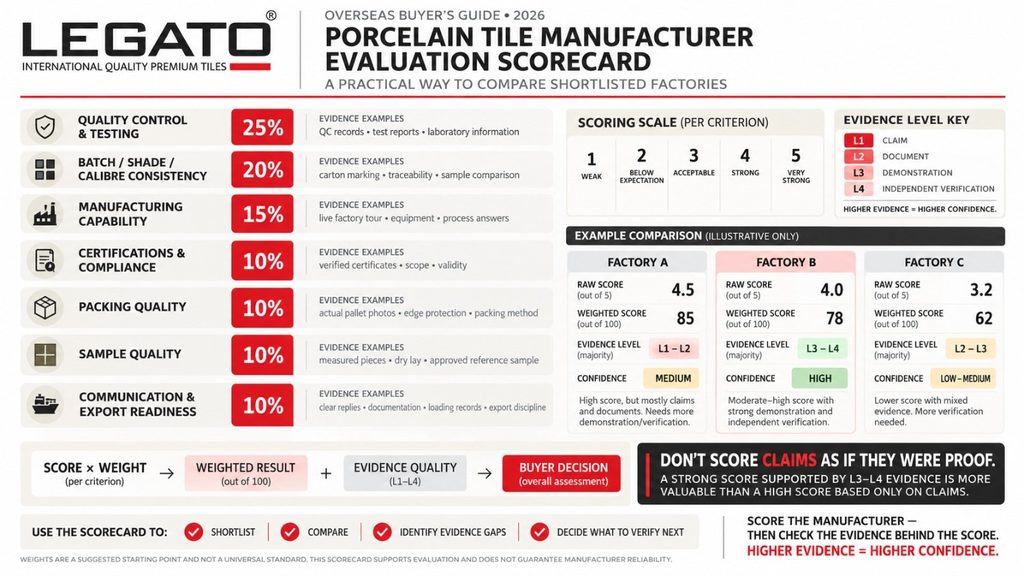
Short answer: Score each manufacturer from one to five on weighted criteria, and write the evidence level next to each score so the decision can be reviewed later.
The weights below are a suggested starting point. Adjust them for your market and project:
| Criterion | Suggested weight | Evidence to collect |
|---|---|---|
| Quality control and testing | 25% | Records, test reports, laboratory information |
| Batch, shade and calibre consistency | 20% | Carton marking, traceability test, sample comparison |
| Manufacturing capability | 15% | Live tour, product range, process answers |
| Certifications and compliance | 10% | Verified certificates and applicable compliance declarations |
| Packing | 10% | Photos of real pallets, slab packing method |
| Sample quality | 10% | Measured results and dry-lay test |
| Communication and export readiness | 10% | Response quality, loading documentation approach |
Add a note beside each score: Level 1 claim, Level 2 document, Level 3 demonstration or Level 4 independent verification. A high score supported by Level 1 evidence should count for less than a moderate score supported by Level 3 or 4 evidence. This works for any porcelain tile manufacturer India has to offer, large or small.
What Mistakes Do Buyers Commonly Make?
Short answer: Common buyer mistakes include choosing on price alone, trusting claims without evidence, approving a single sample piece and skipping the written specification.
- Price alone. A low price may reflect a different grade, looser sorting, weaker packing or other specification differences.
- Superlatives as proof. “Best” and “top” are marketing, not evidence.
- Unverified certificates. A logo on a website is not verification.
- One sample piece. One tile does not show variation.
- Ignoring packing. Careful production is wasted if tiles arrive broken.
- Verbal agreements. Without a written specification, disputes are difficult to resolve.
- No batch planning. On larger projects, mixed batches can produce visible differences.
- No trial order. Scaling before testing the relationship multiplies risk.
How Does Legato Porcelano Approach Manufacturer Evaluation?
Short answer: Legato Porcelano LLP is a manufacturer based in Morbi, Gujarat, and invites buyers to apply the same evaluation criteria to it.
Legato Porcelano manufactures porcelain tiles and slabs and serves international buyers, so buyers can assess it as a porcelain slab manufacturer India offers directly, not through a middleman. Its export page displays ISO 9001:2015 certification, CE-related compliance documentation and Government of India Export House recognition. You can view the range on the porcelain tiles collection page or learn more about the company on the Legato Porcelano website.
If you are comparing manufacturers, use the Evidence Ladder and the scorecard for every company on your list, including this one. Collect relevant evidence, verify applicable certificates or compliance documents and evaluate communication quality from the first conversation.
Frequently Asked Questions (FAQ’s)
Request a live factory tour, verify the company’s registered identity and address, inspect production and quality-control areas, and test whether carton labels and batch records can be traced to specific products.
Compare the company’s legal address with its factory location, request a live production walkthrough, and inspect manufacturing equipment, quality-control records, and batch traceability rather than relying solely on product catalogues.
No. GVT and PGVT are trade terms, not proof of measured performance. Request a water-absorption report identifying the test method, product sample, and actual result before approving technical suitability.
Check the product identification, size and thickness where relevant, test method, report date, laboratory details, actual results, and sample traceability. For critical requirements, consider independent testing through a suitably qualified laboratory.
Approve a representative reference sample, confirm shade and calibre codes, and require consistent batch identification on cartons. Before shipment, verify that the supplied quantities match agreed specifications and documented batch records.
Compare quotations against identical specifications, including size, thickness, finish, grade, technical requirements, packaging, and agreed delivery terms. Different grades or specifications can make apparently cheaper offers misleading and commercially incomparable.
Check slab dimensions, thickness consistency, flatness, edge protection, handling equipment, and export packaging. Legato Porcelano is one manufacturer buyers can evaluate using the same documented checks and evidence standards.
Use a documented scorecard covering quality control, batch consistency, manufacturing capability, certification, packaging, samples, and communication. Legato Porcelano should meet the same evidence-based evaluation criteria as any competing manufacturer.
Conclusion
The right manufacturer is the one whose claims survive verification. Confirm that the company produces its own tiles, understand where defects begin, ask for test reports you can actually read, check certificates for scope and issuer, test batch consistency, compare quotes only within the same grade, and run a structured sample and trial order before committing to volume.
A reliable porcelain tile manufacturer will welcome these checks, because they show a buyer who takes quality as seriously as the factory does.Whether you are speaking to a large group or a smaller Indian porcelain tile manufacturer, apply the same method.
The same approach works if your focus is large format and you are comparing each porcelain slab manufacturer India has to offer. Done carefully, it protects your margins, your customers and your reputation, and it helps you find a porcelain tile manufacturer India can be proud of as a long-term partner.
