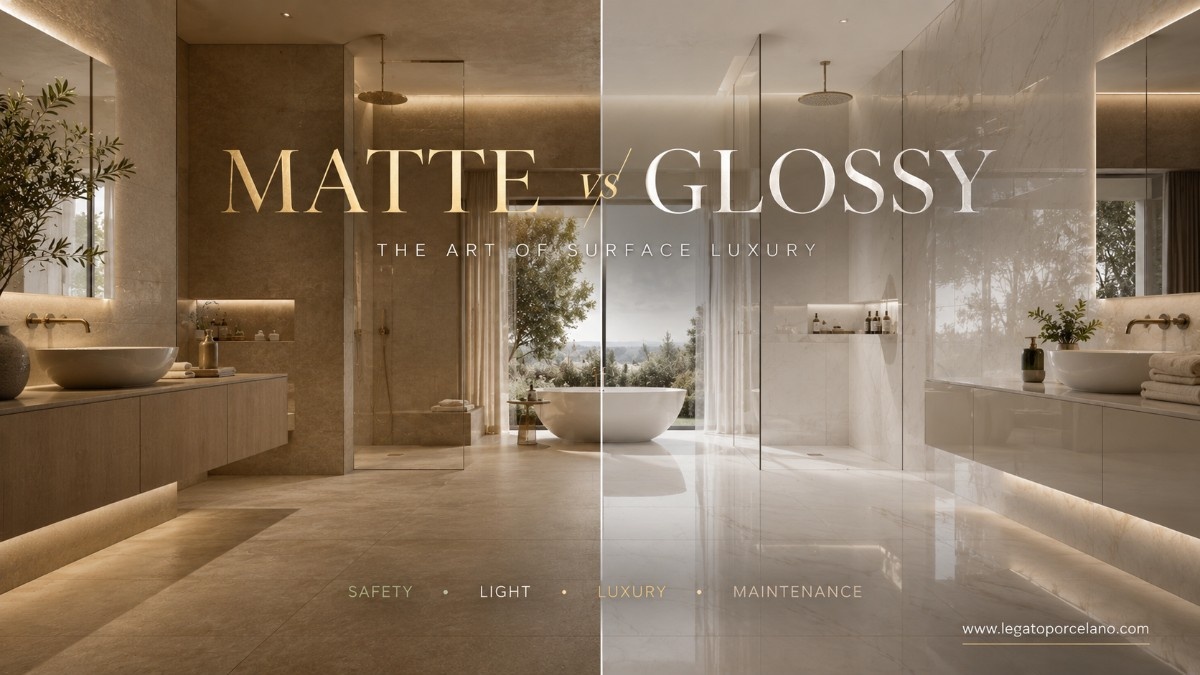
Brand: Legato Porcelano
Category: Bathroom Porcelain Tiles
Reading Time: ~7 Minutes
→ Part of the: Porcelain Tiles for Bathroom: Complete Luxury Design & Buying Guide Series
| Quick Answer: Wet bathroom floors → matte or textured (DCOF ≥ 0.42). Walls & dry surfaces → either finish. The most sophisticated bathrooms use both deliberately: matte floors, glossy walls. This guide tells you exactly why — and how. |
The Physics of Finish
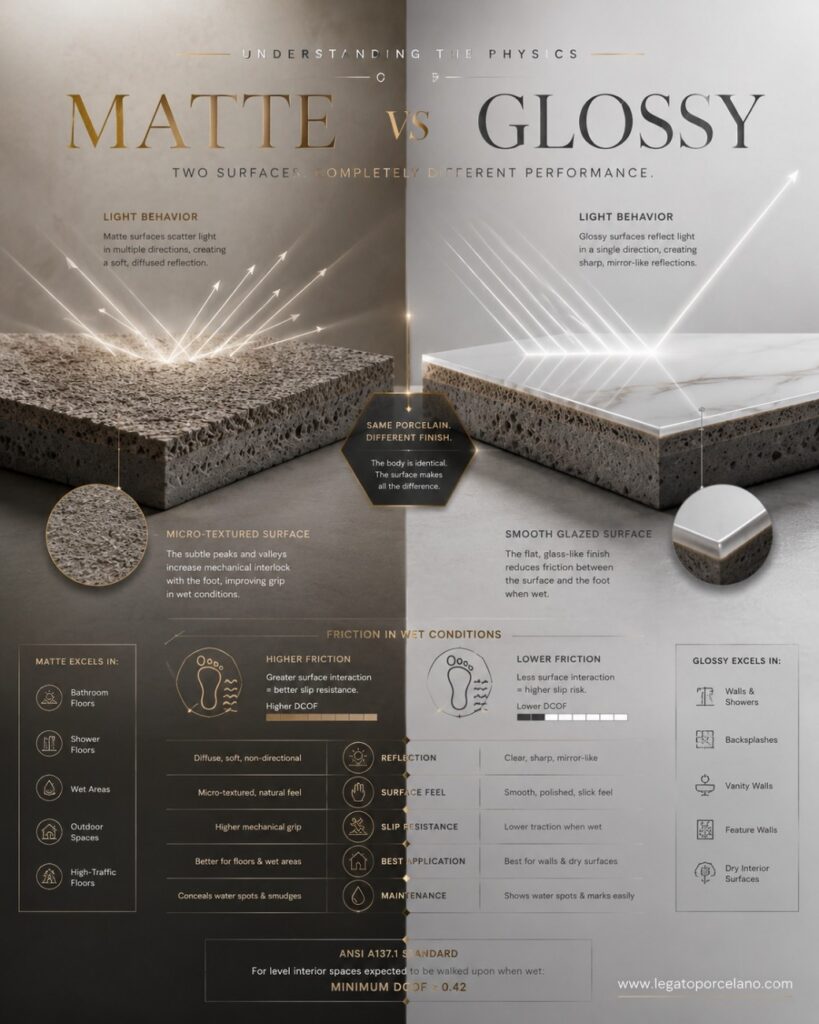
Both finishes start from the same fired porcelain body. What diverges is the surface treatment — and that single difference changes everything: safety, light, maintenance, and feel.
Matte Porcelain
A non-reflective glaze or surface texture is applied before firing, creating micro-relief that scatters light rather than bouncing it. Result: a grounded, soft, organic surface. Critically — the micro-texture increases friction, which is exactly what keeps wet feet safe.
Glossy Porcelain
A glass-forming compound is fired at high temperature, creating a smooth, vitrified surface that mirrors light. Beautiful on walls. The same smoothness that makes it reflective makes it hazardous when wet — friction drops sharply.
Note: within the gloss family, a glazed gloss (surface-applied) differs from a polished finish (mechanically ground after firing). Both share floor-safety limitations in wet conditions.
Slip Resistance — The Non-Negotiable
This section overrides personal taste. If you’re specifying tiles for any wet bathroom floor, slip resistance is a code requirement.
The DCOF Standard
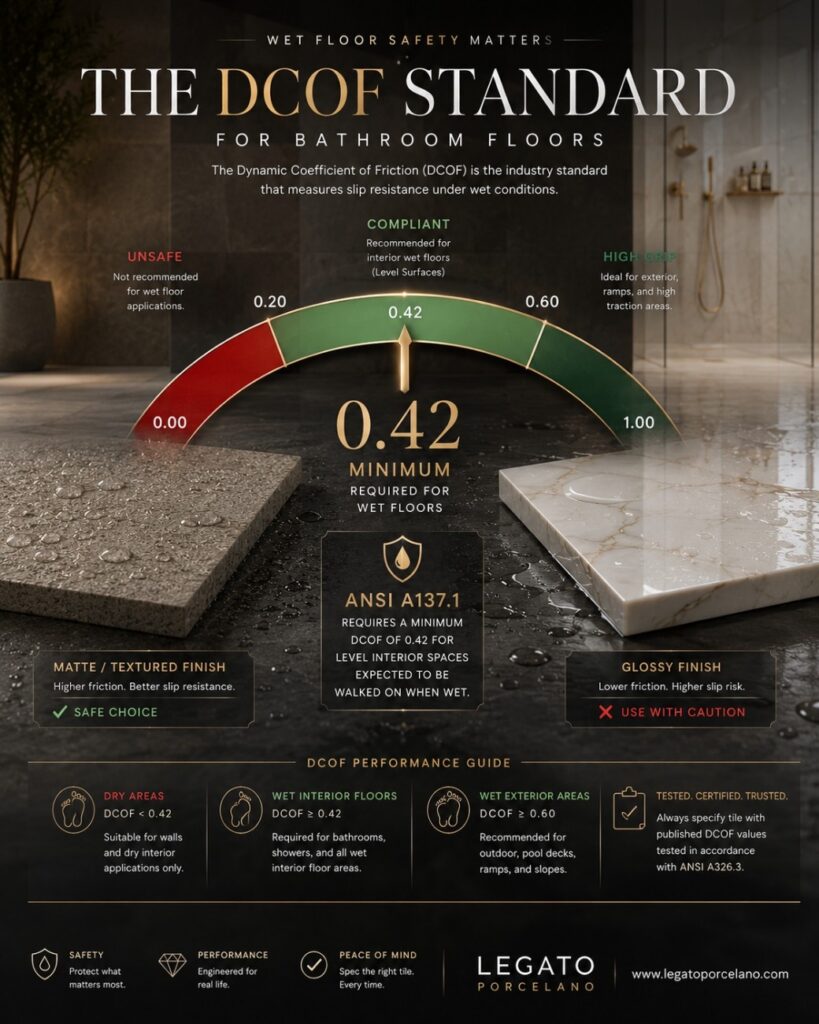
ANSI A137.1 (incorporated into the 2012 International Building Code) requires a minimum Dynamic Coefficient of Friction (DCOF) of 0.42 for porcelain tiles in level interior wet spaces. Measured by tribometer (BOT-3000E) per ANSI A326.3.
0.42 is the floor, not the target. For shower floors and continuous water exposure, specify higher.
How Each Finish Performs
- Matte porcelain: typically R10–R11 on the European DIN 51130 ramp test. Comfortably exceeds 0.42 DCOF.
- Glossy / polished: can fall below 0.42 when wet — especially with soap or shampoo present. Must be independently DCOF-tested before any wet floor use.
- Highly polished tiles: explicitly noted by tile industry sources as unsuitable for wet bathroom floors unless independently rated.
Code & Safety Requirement
ANSI A137.1: bathroom floor tiles in wet interior spaces must achieve minimum wet DCOF of 0.42. Matte and textured porcelain consistently meet this. Glossy tiles must be independently tested — never assume compliance based on appearance alone. — ANSI / Tile Council of North America
Verdict:
” Matte wins decisively for floor safety. Glossy on walls, matte on floors — this is the professional standard.”
Design & Light — What Each Finish Does to a Space
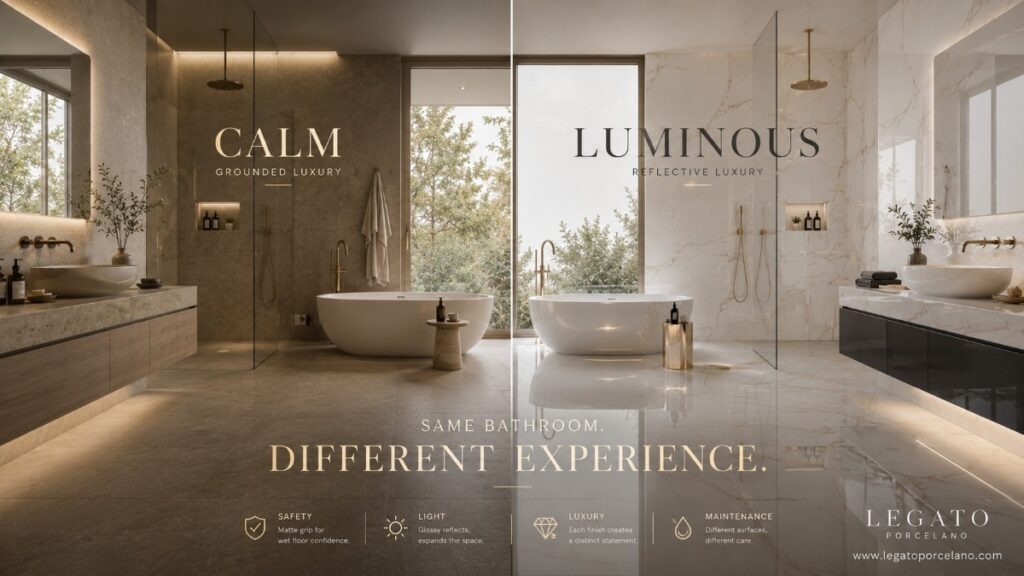
Matte: Grounded, Warm, Architecturally Considered
- Absorbs and diffuses light — creates warmth, not drama
- Water marks, fingerprints and soap residue nearly invisible on non-reflective surface
- The defining finish of Japandi, Wabi-Sabi, and biophilic design — the dominant styles in 2024–2026 high-end residential globally
- Large-format matte tiles in light tones with tonal grout read as spacious, not small — ignore the myth that matte shrinks a room
Glossy: Light, Drama, Spatial Expansion
- Reflects light directionally — the most effective tool for making a small or poorly lit bathroom feel larger
- Formal luxury vocabulary: hotel bathrooms, spa reception, classic European tiling traditions
- Full-height glossy white walls are unambiguously architectural and luminous
- Shows every water mark and fingerprint — requires more frequent cleaning in daily-use spaces
“Matte and gloss are not competing aesthetics — they are complementary tools. The most sophisticated bathroom interiors use both: matte to ground, gloss to elevate. — Interior Design Principle” — Interior Design & Architecture Principle
4. Maintenance Reality
Most bathroom tile regrets come from underestimating how a finish behaves in daily use — not from the choice itself.
Matte
- Water marks and soap residue virtually invisible
- Micro-texture may trap fine grime — occasional scrubbing needed, not daily
- Weekly cleaning is sufficient for a busy family bathroom
- Hard water areas: very forgiving — diffused surface hides mineral deposits significantly better
Glossy
- Every water drop and fingerprint shows on the reflective surface
- Easy to wipe clean when you do — smooth surface releases dirt with minimal effort
- Daily or near-daily wiping needed in family bathrooms to maintain appearance
- Hard water areas: calcium deposits highly visible — higher maintenance commitment
The rule: matte for daily-use family bathrooms. Glossy for guest bathrooms, powder rooms, or feature walls where contact is infrequent but visual impact is the goal.
Side-by-Side Comparison
| FACTOR | MATTE PORCELAIN | GLOSSY PORCELAIN |
|---|---|---|
| Surface | Micro-textured, diffuses light | Smooth, glass-like, reflects light |
| Floor safety (wet) | DCOF ≥ 0.42 — code compliant | Must be independently tested |
| Wall use | All wall applications | Ideal — light amplification |
| Light behaviour | Absorbs & diffuses — warm, soft | Reflects & amplifies — bright, expansive |
| Water mark visibility | Low — marks nearly invisible | High — every drop shows |
| Cleaning frequency | Weekly sufficient | Daily wiping often needed |
| Hard water areas | Very forgiving — hides scale | Scale deposits highly visible |
| Design aesthetic | Japandi · Spa · Warm contemporary | Hotel luxury · Classic · High drama |
| Best for | Master baths, family bathrooms, wet rooms | Guest baths, powder rooms, feature walls |
| 2025–26 trend | Dominant — warm & nature-inspired | Strong on feature walls & marble looks |
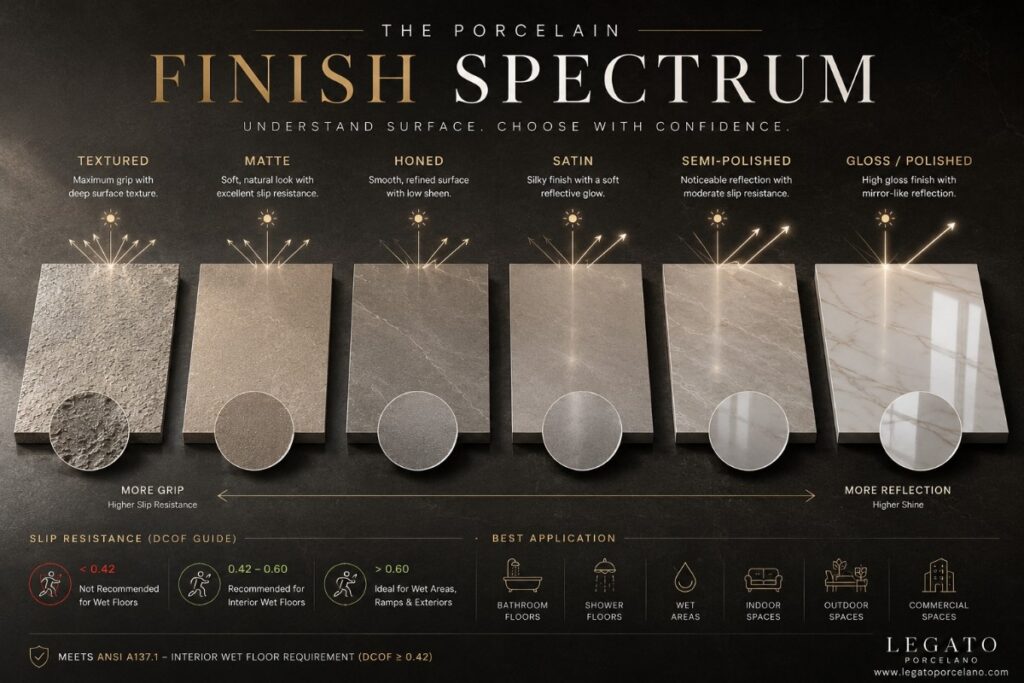
Beyond Matte & Glossy — The Full Finish Spectrum
The space between matte and glossy holds some of the most architecturally refined tile options available.
Honed — The Architect’s Middle Ground
Ground to a smooth, low-sheen surface between matte and glossy. Refined without drama. Retains more slip resistance than polished — usable on floors subject to DCOF verification. The specification of choice for marble-look porcelain in spa-inspired bathrooms where a quieter Calacatta aesthetic is desired.
Satin — Subtle Warmth
Low-to-medium reflectivity. Colours appear slightly muted and intimate. Suitable for interior walls in residential settings. Not recommended for wet floors.
Textured — Maximum Safety Performance
Highest slip resistance in the porcelain category: R11 and above. Correct specification for shower floors, pool surrounds, and any area with continuous water exposure. The aesthetic range has expanded significantly — warm travertine and limestone-look textured tiles now deliver both maximum safety and premium character.
The Professional Strategy: Combining Both
The most resolved bathrooms don’t choose — they combine intentionally, with each finish doing the work it’s suited for.
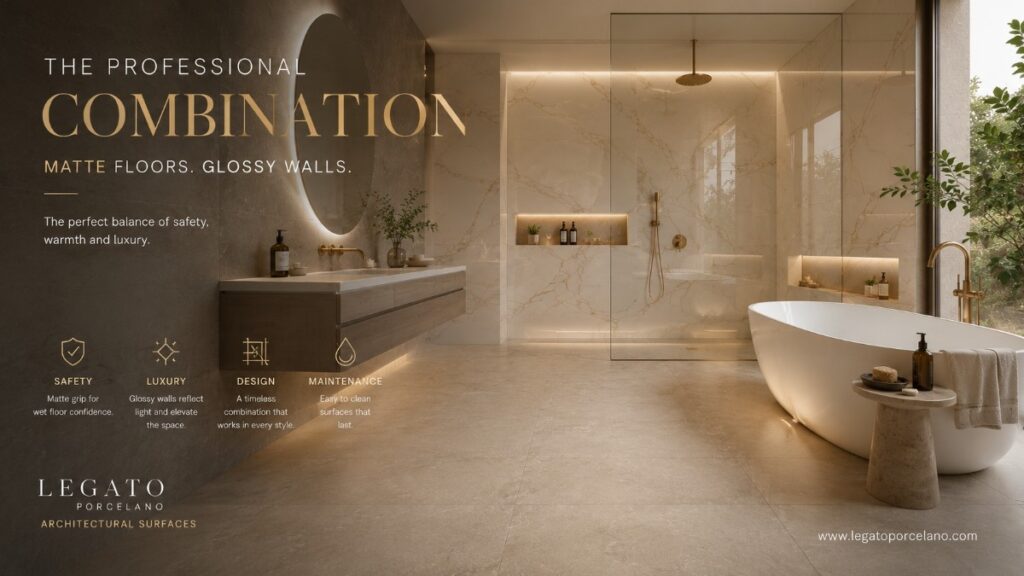
The Classic Pairing: Matte Floor + Glossy Wall
Matte or textured porcelain for all floor surfaces (DCOF ≥ 0.42 for wet areas) + gloss or semi-polished porcelain in the same tonal family for walls. The floor is safe, grounded, low-maintenance. The walls amplify light, add drama, carry luxury language. No compromise on either front.
Many manufacturers offer the same marble-look design in both a matte/honed floor version and a polished wall version — purpose-built for this specification. Used consistently in five-star hotel bathroom design worldwide.
Tonal Coordination — The Rule
When combining finishes, keep tonal harmony: floor and wall tiles share colour family and design character even as the finish creates contrast. A matte warm grey floor with a polished warm grey wall creates unity through colour and contrast through light behaviour. Introducing different colours between floor and wall is a deliberate design decision — not a default.
Feature Wall Strategy
A single glossy or polished feature wall — behind the vanity, shower back wall, or bath surround — in an otherwise matte bathroom creates deliberate focal-point luxury at low maintenance cost. Among the most cost-effective ways to introduce high-gloss visual impact into a primarily matte design.
Room-by-Room Decision Guide
| ROOM TYPE | FLOOR | WALLS | SHOWER FLOOR |
|---|---|---|---|
| Master ensuite | Matte large-format (DCOF ≥0.42) | Gloss or matte per design | Textured R11 |
| Family bathroom | Matte / textured (highest DCOF) | Matte — low maintenance | Textured R11+ |
| Guest / powder room | Either (no wet zone) | Glossy — light & drama | N/A |
| Luxury wet room | Textured R11+ | Polished / large-format | Textured integrated |
| Small bathroom | Matte large-format | Glossy — light amplification | Textured |
5 Specification Mistakes to Avoid
1. Glossy tile on a wet shower floor
The most consequential specification error in bathroom tiling. Polished and high-gloss tiles on shower floors are a safety hazard and a potential building code violation. Always verify DCOF. Default to matte or textured when uncertain.
2. Full gloss walls in a high-use family bathroom
The visual impact that makes gloss compelling in a showroom becomes a maintenance burden in a real household. For daily-use family bathrooms, matte walls deliver the same architectural scale with far less upkeep.
3. Mixing finishes without tonal cohesion
Different colours between matte floor and glossy wall creates a space that feels assembled rather than designed. The finish contrast should be the design decision; colour should unify the room.
4. Assuming all matte tiles are safe for wet floors
Matte is a strong indicator — not a guarantee. Some matte glazes can be closer to the 0.42 DCOF threshold than expected. Always request and verify DCOF test data from your supplier before floor specification in wet areas.
5. Forgetting that gloss exposes installation quality
Grout lines, tile lippage, and installation imperfections are far more visible in a glossy bathroom. High-gloss tiles demand high-quality installation. Invest in an experienced tiler and discuss lippage tolerances and rectified tile specification from the outset.
Professional Insight:
” One rule to govern all others: matte or textured for any floor surface that will get wet — glossy for walls where light amplification and dramatic effect are the design goal. Everything else is refinement of this principle.”
Conclusion
Matte and glossy porcelain are architectural tools, not competing choices. Each is designed for specific conditions and specific design intent.
- Matte delivers: safety, warmth, low maintenance, and the refined understatement that defines the finest contemporary residential and hospitality bathrooms.
- Glossy delivers: light, spatial expansion, visual drama, and formal luxury.
- The most resolved bathrooms use both — matte where it must perform, glossy where it can inspire.
Always with DCOF verification before any floor specification in a wet zone. That is the professional standard.
“The finish you specify is the last thing the eye registers and the first thing the body feels. Get both right, and a bathroom becomes something more than a room.”
FAQs
Glossy porcelain tiles can become slippery when wet, especially on shower floors.
For wet areas, matte or textured tiles with proper DCOF ratings are the safer choice.
Matte tiles hide water spots, soap marks, and fingerprints much better than glossy surfaces.
They may need occasional scrubbing, but overall maintenance is easier in daily-use bathrooms.
Textured or matte porcelain tiles with high slip resistance are best for shower floors.
Brands like Legato Porcelano offer modern anti-skid porcelain collections designed for wet bathroom spaces.
Glossy wall tiles reflect light and can make compact bathrooms appear larger and brighter.
Many designers combine glossy walls with matte floors for balanced luxury and practicality.
Yes — combining both finishes is a common professional bathroom design strategy.
Matte floors provide safety, while glossy walls add depth, light, and visual elegance.
The right choice depends on lighting, maintenance expectations, and where the tile will be installed.
Many homeowners prefer matte floors and glossy feature walls from brands like Legato Porcelano for a refined contemporary bathroom look.
