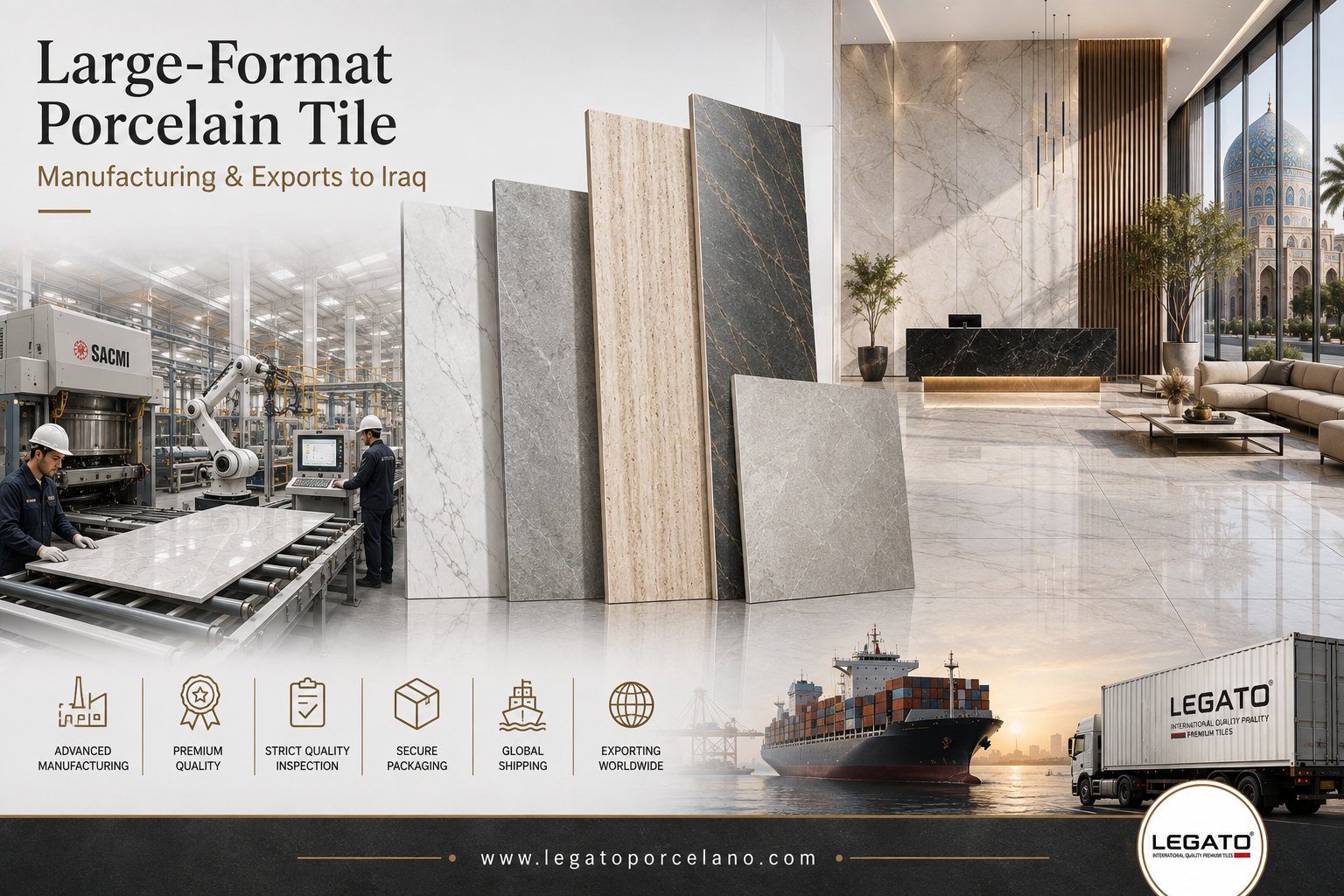
Large-format porcelain tiles have become a preferred choice for modern construction projects across Iraq, from Baghdad’s reconstruction developments to Erbil’s expanding residential and hospitality sector, as well as the growing commercial and tourism infrastructure in Basra, Najaf, and Karbala. Architects, developers, contractors, and procurement teams value these tiles for their seamless appearance, durability, and long-term performance.
However, selecting the right large-format porcelain tile manufacturer involves much more than comparing designs or prices. Manufacturing capability, product consistency, quality control, export experience, and reliable delivery all play a critical role in project success. Since large-format porcelain tiles require advanced production technology and precise manufacturing standards, partnering with an experienced export-focused manufacturer helps reduce installation issues, minimize material waste, and ensure consistent quality across every shipment.
According to IBEF India has become one of the world’s leading porcelain tile exporters, with Morbi, Gujarat serving as one of the largest ceramic and porcelain tile manufacturing hubs globally. Backed by modern production facilities, strong export infrastructure, and a long-standing trade relationship with Iraq, Indian manufacturers have become a trusted sourcing choice for buyers seeking high-quality large-format porcelain tiles.
Quick Summary
If you’re sourcing large-format porcelain tiles for projects in Iraq, choosing the right manufacturer is just as important as selecting the right design. Product quality, manufacturing precision, export experience, and reliable delivery all contribute to the long-term success of your project.
In this guide, you’ll learn:
- What large-format porcelain tiles are and why they are increasingly used across Iraq.
- How the manufacturing process impacts quality, durability, and installation.
- Which tile sizes— 600 × 1200 mm, 800 × 1600 mm, 1200 × 1200 mm, and 800 × 2400 mm —are best suited for different applications.
- How to evaluate manufacturing standards such as dimensional accuracy, flatness, rectification, and shade consistency.
- What to look for in export packaging, documentation, and shipment planning.
- A practical framework for comparing the best large-format porcelain manufacturers and reducing procurement risks
- How to choose a reliable export partner for residential, commercial, hospitality, and government projects.
Whether you’re an importer, distributor, contractor, architect, or procurement professional, this guide provides practical insights to help you make informed sourcing decisions and select a manufacturing partner with confidence.
Why Large-Format Porcelain Tiles Are Growing in Iraq
Iraq’s construction sector — from Baghdad’s ongoing reconstruction projects to Erbil’s high-rise residential towers and Basra’s growing hospitality market — has shown sustained demand for modern architectural materials that combine durability with contemporary design.
Unlike traditional tile sizes, large-format porcelain creates expansive surfaces with fewer visible joints, giving interiors a cleaner, more contemporary appearance while simplifying long-term maintenance. As architectural trends move toward minimalist, spacious design, developers and consultants are specifying larger formats to achieve a premium finish without compromising durability.
This shift is visible across nearly every project category in the country, not just luxury developments — though not every space benefits equally from large-format formats which is worth confirming before you commit to a size or finish.”
Increasing Demand Across Multiple Sectors:
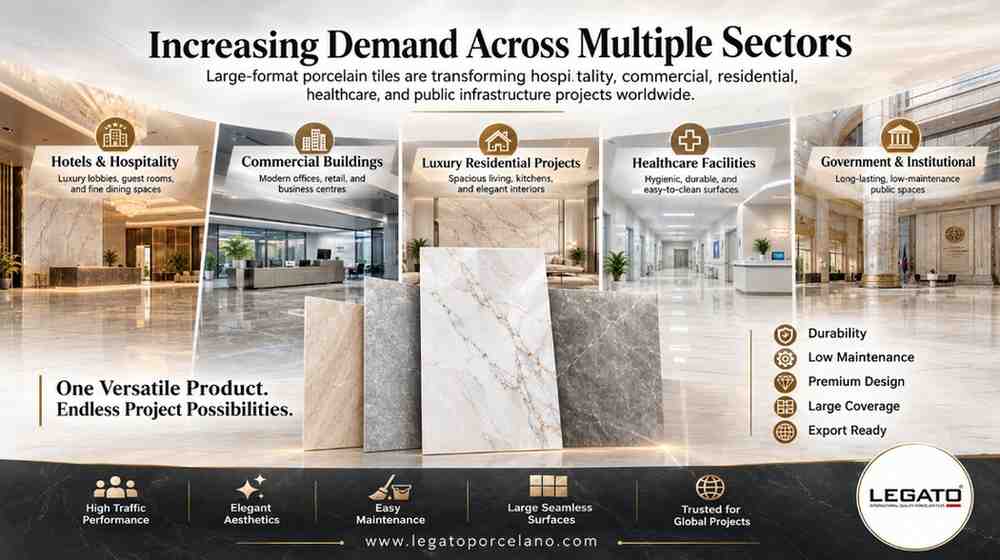
Hotels and Hospitality:
Modern hotels aim to create elegant, uninterrupted spaces that leave a strong first impression. Large-format porcelain tiles reduce grout lines in lobbies, guest rooms, corridors, restaurants, and wellness areas — hospitality projects in particular tend to favor specific size and finish combinations, given the mix of high-traffic and guest-facing areas involved. .
Commercial Buildings:
Office towers, business centers, retail complexes, and shopping malls benefit from large-format tiles’ professional appearance and resistance to continuous foot traffic — commercial-scale projects often have different sizing and logistics priorities than residential or hospitality work. Easier maintenance also translates into lower operational costs over time.
Luxury Residential Projects:
High-end villas and premium apartments increasingly use large-format porcelain in living areas, kitchens, bathrooms, and outdoor spaces. The larger dimensions enhance the perception of space and create a refined, seamless aesthetic that smaller tiles can’t replicate.
Healthcare Facilities:
Hospitals and medical centers need hygienic, durable, easy-to-clean surfaces. Fewer grout joints mean fewer seams where dirt and bacteria can accumulate — directly supporting infection-control and maintenance standards.
Government and Institutional Projects:
Government buildings, educational campuses, and public infrastructure prioritize durability, low maintenance, and decades of service life, while still needing a modern, professional appearance for public-facing spaces.
Architects and designers favor large-format porcelain for the same underlying reasons across all of these project types: a seamless, modern aesthetic; fewer grout joints; an enhanced sense of spaciousness; compatibility with contemporary architectural styles; availability in stone, marble, concrete, and wood-inspired finishes; and consistent design continuity across floors and walls.
Traditional Tiles vs. Large-Format Porcelain Tiles
| Feature | Traditional Tiles | Large-Format Porcelain Tiles |
|---|---|---|
| Grout Lines | More visible joints | Fewer joints for a seamless finish |
| Visual Appeal | Conventional | Modern and premium |
| Installation Coverage | Smaller coverage per piece | Faster coverage with larger pieces |
| Maintenance | More grout to maintain | Easier cleaning and maintenance |
| Perception of Space | Standard | Makes spaces appear larger |
| Suitable for Large Projects | Good | Excellent |
| Luxury Appearance | Moderate | High |
For Iraqi importers and distributors, this shift represents more than a design trend — it’s a commercial opportunity. Large-format porcelain carries higher perceived product value, growing demand from premium construction projects, and stronger appeal across both residential and commercial interior design. But these advantages only convert into real business results when the tiles are manufactured to consistent quality standards and backed by an experienced export partner — which is why manufacturer selection, covered next, matters as much as the product itself.
Benefits for Iraqi Importers and Project Buyers
For importers and distributors, large-format porcelain tiles represent more than a design trend. They offer commercial advantages that can improve customer satisfaction and strengthen market positioning.
Some of the key benefits include:
- Higher perceived product value.
- Growing demand from premium construction projects.
- Opportunities to serve architects and developers.
- Wider application across residential and commercial sectors.
- Strong appeal in modern interior design trends.
However, these benefits can only be fully realized when the tiles are manufactured to consistent quality standards and supplied by an experienced export partner.
How Large-Format Porcelain Tiles Are Made
Every stage of production affects whether the finished tile is flat, consistent, and strong enough to survive shipping and installation at large sizes:
- Body preparation — clay, feldspar, and quartz are milled and blended into a consistent porcelain body. Consistency here is what determines shade and strength consistency later.
- Pressing — the body is pressed under high tonnage into the tile blank. Large-format pressing requires significantly higher press tonnage and more precise pressure distribution than standard sizes — this is where warpage risk is set.
- Digital printing — high-resolution inkjet printing applies the surface design (marble-look, wood-look, stone-look, or solid finishes).
- Kiln firing — fired at high temperature (porcelain typically fires above 1,200°C) to achieve the low porosity that defines true porcelain versus standard ceramic, as classified under ISO 13006, the international standard for ceramic tile definitions and characteristics.
- Rectification — edges are precision-cut to exact size, enabling the tight grout joints (often 1.5–2 mm) that give the large-format its seamless look.
- Calibration and sorting — tiles are checked for size accuracy and sorted by shade batch. An inconsistent shade batch is one of the most common complaints in large format porcelain tiles orders.
- Packaging for export — large-format tiles need reinforced crating and edge protection specifically because of their size; standard-tile packaging isn’t adequate.
Choosing the Right Large-Format porcelain tiles Size for Iraqi Projects
Selecting the right tile size is one of the most important decisions in any construction or renovation project. While aesthetics often influence the initial choice, experienced procurement teams also evaluate installation efficiency, maintenance requirements, material wastage, project budget, and the intended application.
Large-format porcelain tiles are available in multiple dimensions, each designed to meet different architectural and functional needs. The ideal size depends on factors such as room dimensions, traffic levels, design objectives, and installation methods. For projects in Iraq, where developments range from luxury hotels and shopping malls to residential villas and government buildings, choosing the appropriate format can significantly improve both visual appeal and long-term performance.
The table below provides a quick comparison of the most commonly specified sizes — though project type often determines the ideal format more than the table alone can show Each size links to its full technical specification on Legato’s site.
| Tile Size | Best For | Floor | Wall | Visual Impact | Installation | Common Projects |
|---|---|---|---|---|---|---|
| 600 × 1200mm | Versatile Applications | ✅ | ✅ | ★★★★☆ | Easy | Residential, Offices, Hospitals, Retail |
| 800 × 1600mm | Premium Interiors | ✅ | ✅ | ★★★★★ | Moderate | Hotels, Villas, Corporate Offices |
| 1200 × 1200mm | Large Open Spaces | ✅ | Limited | ★★★★★ | Moderate | Shopping Malls, Airports, Government Buildings |
| 800 × 2400mm | Feature Walls & Luxury Spaces | Limited | ✅ | ★★★★★ | Advanced | Hotel Lobbies, Showrooms, Reception Areas |
600 × 1200 mm: The Most Versatile Large-Format Porcelain Tile
The 600 × 1200 mm format is one of the most versatile large-format porcelain tile sizes available. It provides the modern appearance of large-format surfaces while remaining practical for transportation, handling, and installation. This balance makes it a preferred choice for projects that require consistent design across multiple areas without increasing installation complexity.
It is commonly specified for residential developments, office buildings, hospitals, educational institutions, retail stores, restaurants, and mixed-use commercial projects. Its adaptability makes it an excellent option for buyers looking for a single tile size that performs well across a wide range of applications.
800 × 1600 mm: Ideal for Hotels and Premium Interiors
The 800 × 1600 mm format is designed for projects where architectural impact and premium aesthetics are key priorities. With fewer grout joints and larger continuous surfaces, it creates a sophisticated look that complements contemporary interior designs and high-end developments.
This size is widely used in luxury hotels, premium villas, executive offices, shopping malls, and upscale commercial spaces. It is particularly well suited for projects seeking to recreate the elegance of natural marble or stone while benefiting from the durability and low maintenance of porcelain.
1200 × 1200 mm: Best for Large Commercial Floors
The 1200 × 1200 mm square format is ideal for large open-plan spaces where symmetry and visual continuity are important. Its balanced proportions help create spacious interiors with a clean, modern appearance, making it a popular choice for commercial and institutional projects.
It is frequently specified for shopping centres, airport terminals, government buildings, convention centres, corporate headquarters, and luxury residential living areas. In expansive environments, this format enhances the perception of space while reducing the number of grout joints required across the floor.
800 × 2400 mm: Designed for Feature Walls and Luxury Spaces
The 800 × 2400 mm format is an oversized porcelain panel developed for projects that demand maximum visual impact. Rather than functioning solely as a flooring material, it is often used to create seamless architectural surfaces that become focal points within a space.
This format is commonly selected for hotel lobbies, reception areas, luxury bathrooms, feature walls, corporate headquarters, showrooms, and premium restaurant interiors. Because of its larger dimensions, successful installation requires experienced professionals, careful handling, and well-planned transportation to ensure the tiles arrive and are installed in optimal condition.
Which Large-Format Porcelain Tiles Size Should You Choose?
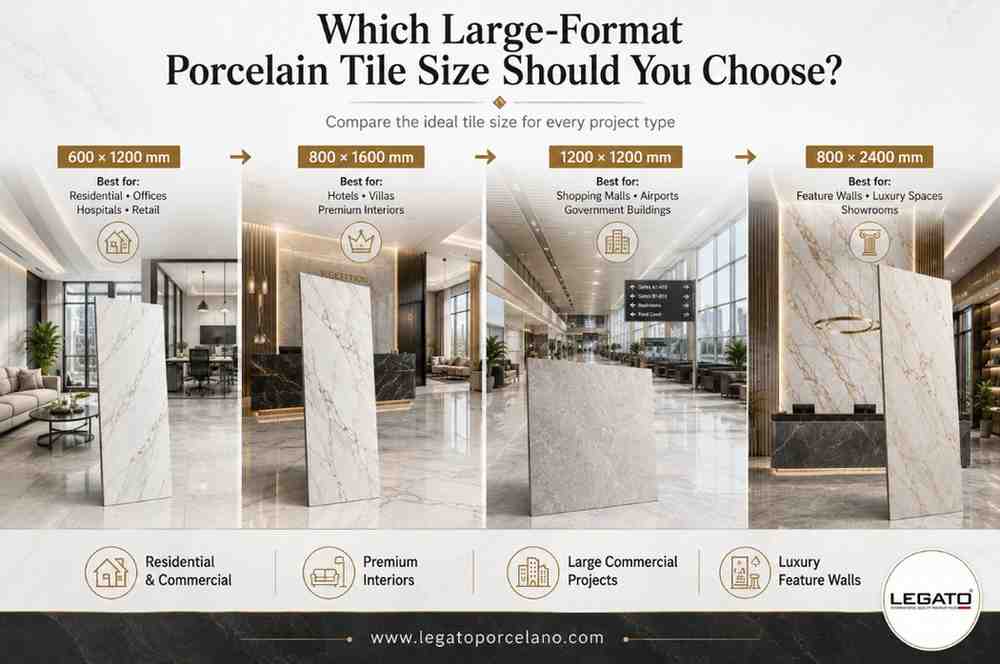
The best tile size ultimately depends on your project’s design objectives and functional requirements.
- Choose 600 × 1200 mm for versatile residential and commercial projects that require easy installation and broad application.
- Choose 800 × 1600 mm for luxury hotels, villas, and premium interiors where seamless aesthetics are a priority.
- Choose 1200 × 1200 mm for spacious commercial environments that benefit from symmetrical layouts and expansive flooring.
- Choose 800 × 2400 mm for architectural feature walls and statement spaces where maximum visual impact is the primary objective.
Selecting the appropriate tile size at the planning stage helps optimize installation efficiency, maintain design consistency, and achieve the desired architectural outcome for residential, commercial, hospitality, and institutional projects.
Legato’s production catalogue also extends to 800 × 3200 mm, 1200 × 2400 mm, 1200 × 2800 mm, and 1200 × 3200 mm for projects requiring even larger architectural statements, with thickness and finish options per size detailed in the technical specifications.
Common mistake:
choosing a size based on the room’s visual proportions alone, without checking whether the installation crew and subfloor are equipped for that format. A 240 cm slab needs a different handling method (typically two installers plus suction-cup lifters) and a flatter subfloor tolerance than a 60 cm tile — confirming this before ordering avoids a costly on-site surprise.
Choosing the Right Surface Finish
Tile size should also be considered alongside the surface finish. The right combination enhances safety, durability, and the desired visual effect.
| Finish | Recommended Areas |
|---|---|
| Polished | Luxury residences, hotel lobbies, reception areas |
| Matt | Offices, residential spaces, commercial buildings |
| High Gloss | Premium interiors and decorative spaces |
| Carving | Feature walls and accent areas |
| Sugar Finish | Contemporary architectural designs |
| Satin | Hotels, restaurants, executive spaces |
Selecting the appropriate finish ensures the tile performs well in its intended environment while maintaining the desired design aesthetic.
Factors to Consider Before Selecting a Large Format Porcelain Tiles Size
Choosing a large-format porcelain tile should involve more than design preferences. Procurement teams should evaluate several practical factors before placing an order.
Project Scale & Space Planning:
The tile size should complement the dimensions and function of the space. Larger formats perform best in open areas where they enhance visual continuity and reduce grout joints, while moderately sized large-format tiles are often more practical for smaller rooms with multiple corners, partitions, or architectural interruptions.
Long-Term Maintenance & Replacement:
Projects should consider future maintenance requirements before standardizing a tile size. Selecting widely available formats with consistent production quality makes replacement, renovations, or project expansions easier while helping maintain uniform dimensions, surface finishes, and visual consistency across different installation phases.
Total Project Cost & Logistics:
Material cost is only one component of the overall investment. Transportation, installation complexity, labor efficiency, packaging, wastage, and project timelines all influence the total cost of ownership. Evaluating these factors together helps buyers select the most practical and cost-effective tile size for their project.
How to Choose the Right Large-Format Porcelain Tile Manufacturer
Selecting a large-format porcelain tile manufacturer is one of the most important procurement decisions in any Iraqi construction project — and one of the easiest to get wrong if it’s based on a single quotation or country of origin alone. Even within the same manufacturing hub, factories can differ significantly in production technology, quality management, export experience, and customer support. Those differences directly affect product consistency, delivery reliability, and how smoothly the project comes together on site.
Morbi, Gujarat has grown into one of the world’s leading porcelain tile manufacturing hubs, and several exporters there now specialize specifically in large-format production for Iraqi buyers, supplying projects across the Middle East, Europe, North America, and Africa But manufacturing capability — not geography — is what determines whether a supplier can actually deliver on a large-format project. Professional buyers evaluate manufacturers against measurable criteria, not marketing claims or price alone.
Executive Supplier Evaluation Framework
Before requesting quotations or finalizing a supplier, compare every manufacturer using the same criteria:
| Evaluation Area | Questions Every Buyer Should Ask | Why It Matters |
|---|---|---|
| Manufacturing Capability | Does the factory produce the required large-format sizes using modern production technology? | Ensures production precision, dimensional accuracy, and consistent product quality. |
| Quality Management | How are dimensions, shade variation, surface finish, and inspections controlled across production batches? | Reduces installation issues and maintains visual consistency throughout the project. |
| Production Capacity | Can the manufacturer deliver the required order volume within the agreed project timeline? | Supports reliable scheduling for both large and repeat orders. |
| Export Operations | How are products packaged, documented, loaded, and prepared for international shipping? | Minimizes transportation damage, customs delays, and logistics risk. |
| Technical Support | Are specifications, installation guidelines, certifications, and documentation readily available? | Helps architects, contractors, and procurement teams make informed decisions. |
| Communication & Project Support | Is there a dedicated export or project team that responds promptly throughout the process? | Improves coordination and ensures smoother execution from quotation to delivery. |
Manufacturing capability :
Large-format porcelain tiles demand precision at every stage of production — oversized formats are far less forgiving of inconsistency than standard sizes. Review the manufacturer’s production technology, rectification process, kiln control, and calibration procedures, and confirm they can manufacture the specific large-format sizes your project needs.
Quality management :
Quality should be judged by repeatability, not by a single sample. A reliable manufacturer maintains consistent dimensions, shade, surface finish, and structural performance across every production batch — which matters most on projects requiring multiple containers or phased deliveries, where even small batch-to-batch variation becomes visible in a finished space. Ask for documented inspection procedures before production begins.
Production capacity :
Large commercial developments often require thousands of square metres delivered against a fixed construction schedule. Confirm the manufacturer can support your required volume without compromising quality or lead times — capacity and delivery reliability should be evaluated together, not as separate questions.
Export operations :
Manufacturing excellence alone doesn’t guarantee a smooth delivery. Reinforced export packaging, careful container loading, accurate technical and commercial documentation, and coordinated shipment scheduling all reduce the risk of damage and customs delays. Ask how these are handled before placing an order, not after production is finished.
Technical support.
The strongest manufacturing partners do more than ship product — they support procurement teams with specifications, product recommendations, installation guidance, finish selection, and documentation that make specification and coordination easier for architects, contractors, and buyers alike.
Procurement perspective: The lowest quotation is rarely the most economical decision. Total project cost includes production reliability, logistics, installation efficiency, and long-term supplier performance — not just the price per square metre.
A successful sourcing decision comes down to one thing: choosing a manufacturer that combines production precision, disciplined quality management, dependable export execution, and responsive technical support — evaluated against the criteria above, not price or country of origin alone.
Technical Specifications Buyers Should Verify
Before finalizing a supplier, procurement teams should review the technical specifications of large-format porcelain tiles to ensure they meet project requirements and international quality standards.
Key specifications include :
- Water Absorption (ISO 10545) — Low water absorption is a defining characteristic of porcelain tiles, providing excellent durability and moisture resistance.
- PEI Rating — Indicates the tile’s resistance to surface wear and helps determine suitability for residential or commercial applications.
- Slip Resistance (R10 / R11 / DCOF) — Important for areas where pedestrian safety is a priority, including commercial buildings, hotels, healthcare facilities, and public spaces.
- Breaking Strength — Measures the tile’s ability to withstand heavy loads and impacts, making it particularly important for high-traffic installations.
- Available Thicknesses — Depending on the application, large-format porcelain tiles are commonly available in 9mm, 12mm, and 20mm thickness options.
- Frost Resistance — Essential for projects exposed to outdoor environments or fluctuating temperatures.
- Porcelain Slab Formats — Large porcelain slabs provide expansive, seamless surfaces for premium walls, floors, countertops, and architectural applications.
Ready to Source Large-Format Porcelain Tiles for Iraq?
Choosing the right large-format porcelain tile manufacturer is about more than selecting a product—it’s about partnering with a supplier that can consistently deliver quality, meet project timelines, and support international procurement with confidence.
Whether you’re sourcing for a luxury residential development, hotel, commercial complex, healthcare facility, or government project, working with an experienced export-focused manufacturer can help reduce procurement risks and improve project outcomes.
At Legato Porcelano, we support Iraqi importers, distributors, contractors, architects, and procurement teams with reliable manufacturing, consistent product quality, and organized export operations tailored to international projects.
Discuss Your Project Requirements
If you’re planning a project in Iraq, our team can help you:
- Select the most suitable large-format porcelain tile sizes and finishes.
- Review technical specifications and product options.
- Understand production timelines and export processes.
- Receive project-specific quotations for your procurement requirements.
- Coordinate international shipments with complete export documentation.
Whether your requirement is a single container or a multi-phase development, our export team is ready to support your sourcing process from enquiry to delivery.
Request a quotation, explore our large-format porcelain tile collections, or speak with our export specialists to discuss your upcoming project in Iraq.
Frequently Asked Questions(FAQ’s)
No — Iraq applies the same CIF-based duty and 15% VAT regardless of tile size, but large-format shipments need accurate HS code and packing documentation to avoid valuation disputes at clearance.
Large-format porcelain generally falls under standard COSQC building-material conformity rules, not a separate category, but buyers should confirm with their supplier since documentation requirements can vary by product classification and shipment size.
Yes, when packed in reinforced export crating designed for oversized slabs — standard tile packaging isn’t sufficient. Ask manufacturers directly how they crate panels above 1600mm before confirming an order.
It’s used for smaller volumes, but oversized panels face higher vibration-damage risk over long road transit than sea freight. Most suppliers recommend sea routing even for Kurdistan-bound large-format orders.
Incomplete documentation causes most delays, not the product itself. Shipments with complete commercial invoices, certificates of origin, and conformity paperwork prepared in advance clear noticeably faster.
Established Morbi-based exporters like Legato Porcelano regularly ship large-format porcelain to Iraq, with export documentation and packaging processes already built around Iraqi customs and shipping requirements.
Manufacturers with dedicated export support, such as Legato Porcelano, typically offer size and finish guidance directly, helping Iraqi buyers avoid costly mismatches between design intent and installation reality.
Final Thoughts
From Baghdad’s ongoing reconstruction to Erbil’s expanding residential and hospitality developments, large-format porcelain has moved from a niche architectural choice to a standard specification across Iraq’s construction sector. Hotels in Basra serving the region’s oil-driven business travel, religious tourism infrastructure around Najaf and Karbala, and government rebuilding programs across the country are all converging on the same material for the same reasons: durability, low maintenance, and a modern finish that holds up under heavy use.
What separates a successful project from a costly one isn’t the tile itself — it’s the sourcing decision behind it. Buyers who evaluate manufacturers against clear criteria, confirm export documentation before production begins, and account for Iraq’s shipping and customs realities from the outset consistently avoid the delays and inconsistencies that derail less-prepared procurement processes.
For Iraqi importers, contractors, and project teams sourcing from Morbi or elsewhere in India, the opportunity is real — but it rewards buyers who treat manufacturer selection as seriously as design selection.
