Quick Answer
The most-imported tile size in Iraq is 600×1200 mm porcelain, followed closely by 800×800 mm for mid-range volume. Marble-look porcelain in polished or lappato finish is the dominant design category across almost every price segment. Every shipment — regardless of size or value — requires a pre-shipment Certificate of Conformity (CoC) from a COSQC-appointed body before it can clear an Iraqi port. Erbil and the Kurdistan region run on a different logistics route (via Mersin, Turkey) than the rest of the country and increasingly favor large-format Porcelain slabs over standard sizes.
Iraqi importers sourcing porcelain tiles are working with a market that’s grown more demanding, not just bigger. Reconstruction spending, a persistent housing shortfall, and renewed infrastructure investment have kept import volumes strong through 2026, but distributors and contractors on the buying end have gotten far pickier about size, finish, and documentation than they were five years ago. Local ceramic production still doesn’t close that gap — which is why Indian, Iranian, Turkish, and Chinese suppliers keep competing for share — but the suppliers who win repeat orders are the ones who get specification and compliance right the first time.
Demand Looks Different by City — Sourcing Should Too
Treating Iraq as one market is the most common mistake importers make on a first order. Matching container specification to the wrong city is how distributors end up with slow-moving stock.
| City | Dominant Sector | Popular Tile Type | Preferred Sizes |
|---|---|---|---|
| Baghdad | Villas, apartments, commercial | PGVT marble-look, large-format Porcelain GVT | 600×1200, 800×800, 1200×1200 |
| Basra | Oil-sector housing, retail | Plain-surface vitrified | 800×800, 600×1200 |
| Erbil | Premium villas, malls, hospitality | Large slab, PGVT, wood-look | 1200×2400, 800×1600, 600×1200 |
| Sulaymaniyah | Mid-range residential, retail | GVT, double-charged | 600×600, 800×800 |
| Najaf / Karbala | Hotels, religious-tourism infrastructure | Polished marble-look, plain white | 600×1200, 800×800 |
Baghdad carries the largest volume and the widest spread — budget apartments through premium villas and commercial towers — so distributors serving it generally need breadth across the full size range rather than a bet on one format.
Basra demand tracks the oil sector’s housing footprint. Buyers favor straightforward, plain-surface products over heavy patterning: practical, consistent, easy to reorder.
Erbil is the outlier worth understanding in detail. Gulf investment and international hospitality brands have pulled specification toward large-format porcelain slabs and premium finishes that were rare in Iraq five years ago — and Erbil runs on a different logistics route than the rest of the country, which changes lead-time and MOQ math (see Logistics, below).
Sulaymaniyah sits geographically near Erbil but behaves like Basra — standard formats, price-sensitive.
Najaf and Karbala punch above their population size because of religious-tourism hotel demand, typically specifying durable, presentable flooring at commercial volume.
Tile Sizes: What’s Actually Moving and Why
Floor Tiles
| Size (mm) | Market Position | Where Used Most |
|---|---|---|
| 600×600 | Entry-to-mid residential, shrinking share | Budget apartments, service areas |
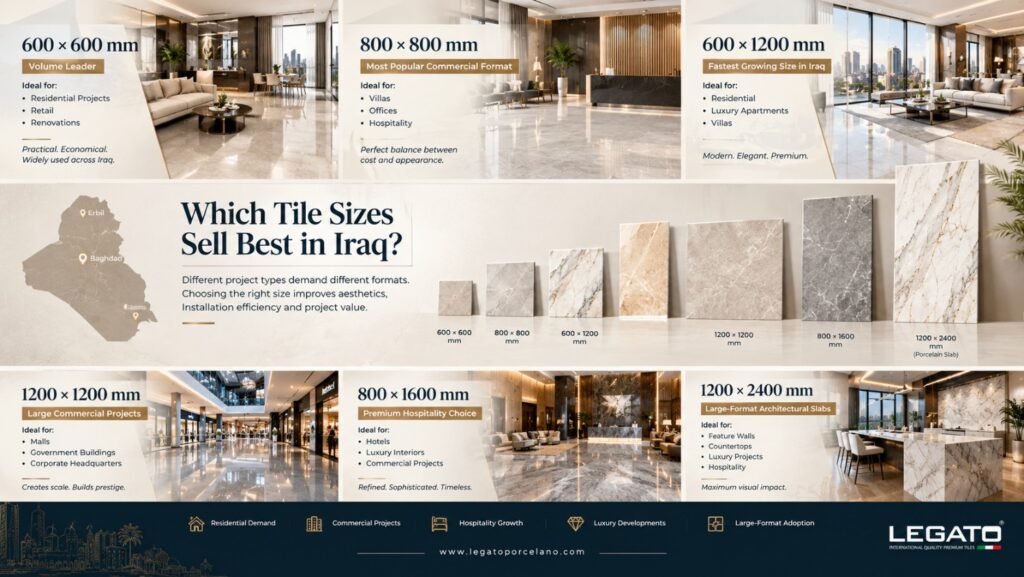
| 800×800 | Mid-range standard, stable volume leader | Living rooms, corridors, retail floors, standard villas |
| 600×1200 | Fastest-growing mainstream size | Main halls, master bedrooms, hotel lobbies |
| 1200×1200 | Premium residential/commercial | High-end villas, showrooms, reception areas |
| 800×1600 | Premium and hospitality | Erbil hospitality interiors, luxury villa main areas |
| 1200×2400+ (slab) | Ultra-premium, growing niche | Feature floors, countertops, cladding |
600×1200 mm has become the sweet spot for import volume. It delivers a visually larger surface than 800×800 without the handling complexity and breakage risk of full slabs — a real factor where skilled large-format Porcelain installers aren’t available outside major cities. Distributors without depth in this size are increasingly at a disadvantage in tender situations, where it’s now closer to an expected baseline than a premium upgrade.
Legato’s GVT/PGVT tile range covers this size alongside the adjacent formats Iraqi buyers tend to order together.
800×800 mm remains the volume workhorse and isn’t losing relevance — it’s the default mid-range spec and forgiving to install.
600×600 mm still moves, but its share is shrinking, increasingly confined to service areas and the most cost-sensitive housing. Overstocking it relative to demand is a common mistake among suppliers who haven’t refreshed their Iraq assortment recently.
Wall Tiles
| Size (mm) | Common Application |
|---|---|
| 300×450 | Older housing stock, traditional bathrooms |
| 300×600 | Standard bathroom/kitchen walls, all segments |
| 300×900 | Vertical stack-pattern bathrooms, modern residential |
| 600×600 | Kitchen walls where full large-format Porcelain isn’t needed |
| 600×1200 | Feature walls, open showers, premium villa bathrooms |
Wall sizing has moved far more conservatively than floor sizing. 300×600 mm remains the default across nearly every price point, and 600×1200 mm wall applications stay limited to feature walls rather than becoming a mainstream standard.
Finishes: Reading the Formal-vs-Functional Split
Finish selection in Iraq tracks a cultural pattern as much as a design trend — the sharp distinction between formal reception spaces and functional living areas.
| Finish | Best For | Trade-Off | Demand Trend |
|---|---|---|---|
| Polished / High-gloss | Majlis, reception rooms, formal corridors | Shows dust and footprints quickly | Stable, still dominant in formal spaces |
| Lappato (semi-polished) | Marble-look living areas | Slightly less depth than full polish | Fastest-growing finish category |
| Matt | Kitchens, offices, covered outdoor areas | Less “premium” visual impact | Stable, standard for commercial |
| Sugar / Micro-texture | Bathrooms, wet areas | Less aspirational look | Steady, spec-driven not trend-driven |
| Carving / Embossed | Feature walls, accent areas | Niche, limited application | Small, stable niche |
Lappato is the finish worth watching. It’s growing specifically inside marble-look designs because it delivers most of the visual depth of a full polish with meaningfully easier daily upkeep — a genuine consideration in a climate that generates heavy dust.
Polished still owns the formal room. The majlis and sitting room carry real social weight in Iraqi homes, and high-gloss marble-look flooring remains the default there regardless of the maintenance trade-off.
Matt owns everything functional — kitchens, commercial floors, covered outdoor space — where slip resistance and low upkeep outrank formal appearance.
Design Categories Driving Actual Orders
| Design Category | Volume Share | Trend Direction | Typical Buyer |
|---|---|---|---|
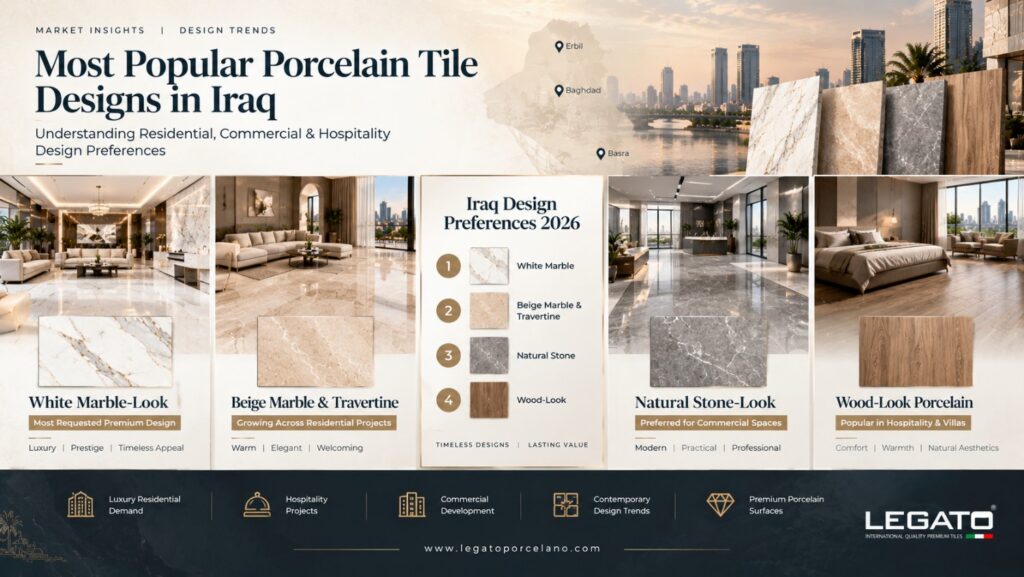
| Marble-look (white/beige/grey) | Largest by far | Stable, dominant | All segments |
| Wood-look (plank format) | Moderate, steady growth | Growing | Residential — bedrooms, family rooms |
| Plain large-surface (grey/beige/greige) | Smaller, fastest-growing | Growing | Contemporary villas, commercial interiors |
| Geometric/decorative accent | Small, niche | Stable | Feature walls, entry foyers |
Marble-look porcelain dominates across virtually every price segment, not just premium — it carries genuine cultural resonance while delivering the look at a fraction of natural stone’s cost and upkeep.
Wood-look porcelain has grown for a specific, defensible reason: real timber doesn’t hold up against Iraq’s wide seasonal temperature swings, while wood-look GVT/PGVT tiles hold their finish regardless. Narrow plank formats (roughly 200–300 mm wide) in warm oak, walnut, and grey-ash tones are the standard specification.
Large plain surfaces are the smallest category here but the fastest-growing, concentrated in newer Baghdad and Erbil construction where architecture favors clean, minimal-pattern surfaces over heavy prints.
[Image suggestion: Close-up texture shots of the four design categories in a 2×2 grid — marble-look, wood-look, plain large-format Porcelain , geometric accent — alt text: “Four leading porcelain tile design categories for the Iraq market”]
Technical Specifications That Actually Get Checked
Iraq’s climate is the direct reason certain specs recur in tenders and RFQs, not a marketing talking point. Summer temperatures in Baghdad and Basra routinely exceed 48°C, and the resulting thermal cycling stresses tile, adhesive, and grout as a system.
| Specification | Requirement | Why It Matters |
|---|---|---|
| Water absorption | Below 0.5% (ISO 13006 / EN 14411 Class BIa) | Distinguishes genuine porcelain from discounted lower-grade vitrified product |
| Breaking strength | 1300 N min. residential / 1800 N+ commercial | Handles thermal-cycling stress and heavy foot traffic |
| Slip resistance | R9+ (DIN 51130) | Required for bathrooms, kitchens, covered outdoor areas |
| Frost resistance | Situational | Relevant only for Sulaymaniyah / Kurdish highland projects |
| Abrasion (PEI rating) | PEI 3 min. residential / PEI 4 commercial | Determines suitability for high-traffic flooring |
On tender-based and government work, expect these requested as documented lab test certificates, not accepted as supplier claims — and they’re also the underlying data your COSQC Certificate of Conformity application will need (see below).
The Compliance Step Most Sourcing Guides Underweight: COSQC and the CoC
This is where importers lose more time and money than they do on size or finish decisions, and it deserves to be treated as its own workflow rather than a line on a documents checklist.
Since 2020, Iraq’s Central Organization for Standardization and Quality Control (COSQC) has required a Certificate of Conformity (CoC) for regulated product categories before goods clear customs — and construction and building materials, including ceramic and porcelain tiles, sit squarely inside that scope. It runs under COSQC’s ICIGI program (the pre-shipment inspection, testing, and certification regime for goods entering Iraq), and it applies to every shipment, not just first-time imports.
Logistics: Two Routes, Two Different Risk Profiles
| Destination | Route | Typical Transit |
|---|---|---|
| Baghdad, Najaf, Karbala | Sea via Umm Qasr, then road | ~18–22 days sea + 1–3 days inland |
| Basra | Sea via Umm Qasr | ~18–20 days, closest port |
| Erbil, Sulaymaniyah | Sea to Mersin (Turkey), then road; or overland via Jordan | ~20–28 days |
Most Indian tile exports move by sea from Mundra or Nhava Sheva to Umm Qasr port near Basra, serving Baghdad, Basra, Najaf, and Karbala. Port congestion at Umm Qasr is a recurring, well-documented variable — importers who build in schedule buffer, rather than quoting the optimistic transit time to their own customers, tend to have fewer disputes downstream.
Erbil and Sulaymaniyah run through Mersin, Turkey, then road, or overland via Jordan — a materially different route with its own timing profile. Confirm which route your supplier actually has standing experience on; a supplier fluent in the Umm Qasr route can still under-quote lead times for the north.
Import duty on ceramic and porcelain tiles generally sits in the 5–15% range depending on tariff classification, but the exact rate depends on HS sub-code and should be confirmed with a licensed Iraqi customs broker before finalizing landed cost — treat it as shipment-specific, not fixed.
What Distinguishes a Supplier Iraqi Distributors Actually Reorder From
| Factor | Why It’s a Filter |
|---|---|
| Shade consistency across batches | The most common distributor complaint — a mismatched reorder is a problem they have to explain to their own customer |
| Depth in 600×1200 & 800×800 | These two sizes now cover most tender-eligible volume nationally |
| Named, specific COSQC/CoC process | A vague assurance here is the clearest early warning sign of a difficult shipment later |
| FOB pricing transparency | Experienced importers cross-check pricing and prefer managing their own freight |
| Packaging built for the Umm Qasr route | Corner/edge protection on large-format Porcelain product is cost-avoidance, not a nice-to-have |
| Fast physical sample turnaround | Iraqi buyers frequently finalize specification through sample approval, not catalogue images |
Legato Porcelano’s export team works within this exact framework day to day — sizing, finish depth, and CoC documentation are treated as one sourcing decision, not three separate conversations, which is generally what shortens the distance between a first inquiry and a repeat order.
Why Legato Supplies the Iraq Market
Legato Porcelano’s presence in Iraq isn’t accidental. Iraq sits inside the size and finish range the company already produces at volume — 600×600 mm through large-format slabs, in the marble-look and wood-look designs carrying the most demand — which means an Iraqi order doesn’t require a special production run or an unfamiliar specification.
As a porcelain tiles exporter shipping to markets across the Middle East, Europe, and beyond, Legato’s export process is built around the same documentation load Iraq’s COSQC requirements demand: lab test reports, production and lot data, and transport paperwork prepared ahead of a buyer’s request rather than assembled after one.
FAQs
600×1200 mm is the fastest-growing size for main living areas, while 800×800 mm remains the highest-volume standard across mid-range residential and commercial floors.
Both move significant volume for different reasons — polished and lappato finishes dominate formal reception rooms, while matt finishes are the default for kitchens, commercial interiors, and functional spaces.
Yes. Under COSQC’s ICIGI program, ceramic and porcelain tiles fall under regulated construction materials, and every shipment needs a valid, pre-shipment CoC from a COSQC-appointed certification body — there’s no exemption by shipment size.
Gulf investment and international hospitality operators have pulled Erbil’s specification toward large-format Porcelain slabs, premium finishes, and wood-look tiles at a pace the rest of the country hasn’t matched.
Incomplete or mismatched COSQC documentation — not product quality — is the most commonly cited cause, which is why a supplier’s CoC process should be a selection criterion, not an afterthought.
ISO 13006 / EN 14411 compliance for water absorption and breaking strength, PEI rating for commercial floors, and R9+ slip resistance for wet areas — ideally as lab-issued certificates that also support the CoC application.
A reliable supplier should offer consistent quality, experience with COSQC documentation, strong packaging standards, and dependable production capacity. Legato Porcelano supports Iraqi importers with export-ready documentation, popular market-specific sizes, and dedicated assistance throughout the sourcing process.
Yes. Experienced exporters often recommend different product combinations based on local demand, project type, and price positioning. Legato Porcelano’s export team regularly assists distributors in selecting appropriate sizes, finishes, and design categories for markets such as Baghdad, Basra, Erbil, Sulaymaniyah, and Najaf.
Conclusion
Iraq’s tile market rewards suppliers who match specification to city-level demand — 600×1200 and 800×800 depth for Baghdad and Basra, large-format Porcelain and wood-look product for Erbil — and who treat COSQC compliance as a standing process, not a per-shipment scramble. Legato Porcelano’s full size and finish catalogue and export documentation process are available on request for distributors and project buyers evaluating sourcing partners for Iraq.
