Brand: Legato Porcelano
Category: Bathroom Porcelain Tiles
Reading Time: ~7 Minutes
→ Part of the: Bathroom Tiles Complete Guide › Matte vs Glossy: Finish Guide › Marble Look Tiles
📌 This article is part of the Tile Finish Series and the Porcelain Tiles for Bathroom Pillar.
Introducation
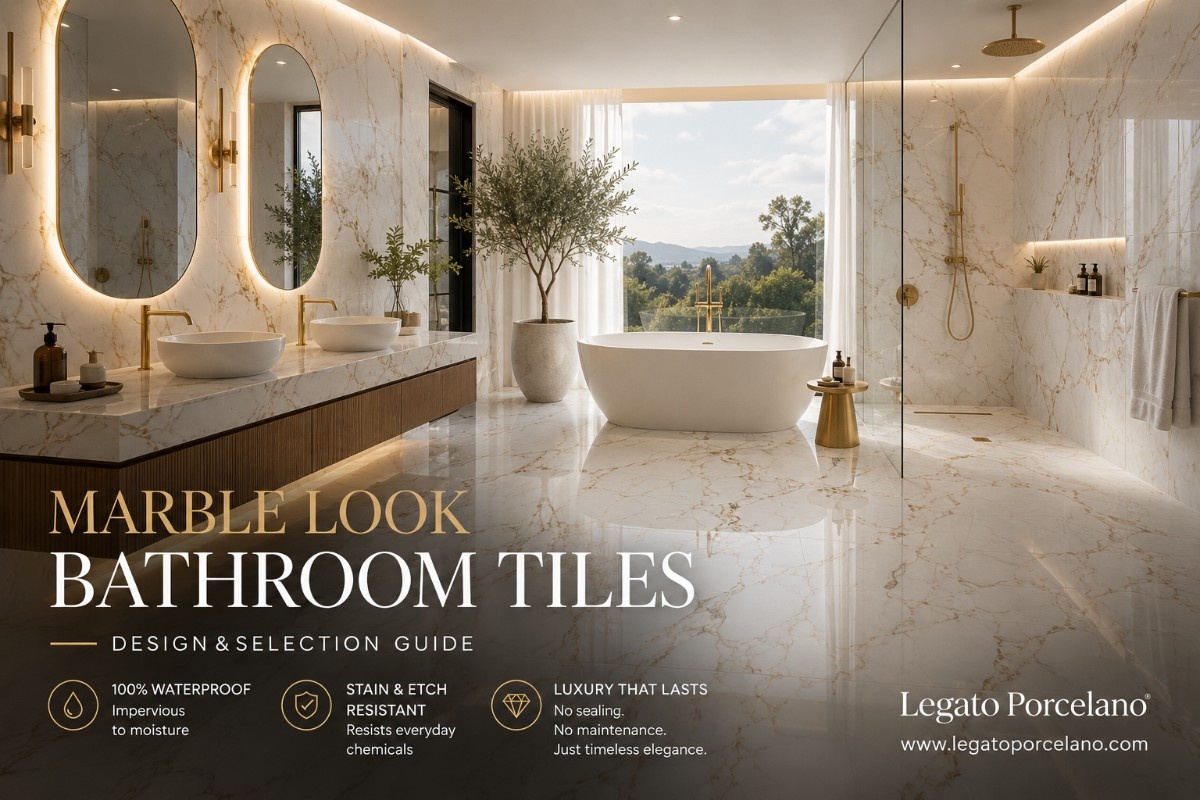
Marble look bathroom tiles have become the defining surface choice for luxury modern bathrooms. Inspired by Italian stones like Calacatta, Carrara, and Statuario, marble look porcelain tiles deliver the visual depth of natural marble without the sealing, etching, or long-term maintenance requirements.
For architects, interior designers, and homeowners seeking timeless luxury, marble look bathroom tiles offer the elegance of natural stone with the performance advantages of porcelain. The result is a bathroom surface that feels architectural, refined, and built for daily life.
Marble has defined architectural luxury for three thousand years. The Pantheon, the Taj Mahal, Michelangelo’s David — all owe their visual permanence to Italian stone. In today’s bathroom design, that same language is available without the maintenance schedule, the etching risk, or the six-figure installation cost that accompany the natural material.
Marble-look porcelain tile delivers the veining, tonal depth, and spatial authority of natural marble with a body that is impervious to moisture (≤0.5% water absorption per ANSI A137.1), requires no sealing, and resists everyday bathroom chemicals. Per verified industry data from Angi and Fixr, natural Calacatta marble requires regular resealing every 6–12 months, while marble look bathroom tiles eliminate that maintenance cycle entirely.
This guide covers the three marble looks that define professional bathroom design — Calacatta, Carrara, and Statuario — their visual characters, finish options, design applications, and the selection criteria that separate a bathroom that references marble from one that commands it.
ANSWER UPFRONT
Calacatta = bold veining, bright white ground, high drama — best for feature walls and statement spaces. Carrara = soft grey ground, fine veining, restrained elegance — best for large-area installations. Statuario = pure white, crisp dark veins, museum contrast — best for vanity walls and luxury wet rooms. All three: polished for walls, matte/honed for wet floors.
Natural Marble vs Marble-Look Porcelain: The Specification Reality
| Property | Natural Marble | Marble-Look Porcelain |
|---|---|---|
| Water absorption | 0.1–0.6% — porous; sealing mandatory | ≤0.5% impervious — ANSI A137.1 certified |
| Sealing requirement | Every 6–12 months | None required |
| Etching risk | High — shampoo, soap, toothpaste cause damage | Zero — impervious to all bathroom acids |
| Colour consistency | Natural variation — no two slabs identical | Consistent across large-scale installations |
| Lifespan | Decades with diligent maintenance | 50–75+ years; no sealing lifecycle |
The choice between natural marble and marble-look porcelain is not a debate about authenticity — it is a specification decision based on what each material requires from a bathroom environment. The data makes the distinction clear.
“Natural marble is defined by authenticity and natural beauty. Marble-look porcelain is defined by performance and accessibility. A bathroom renovation should be guided by what the space genuinely needs.” — Dionyssomarble, 2025
The Three Marble Looks That Define Luxury Bathroom Design
Calacatta, Carrara, and Statuario are three visually distinct Italian marble types — all quarried in or near the Carrara region of Tuscany, but with fundamentally different visual characters. Understanding the distinction is the first decision in any marble-look bathroom specification.
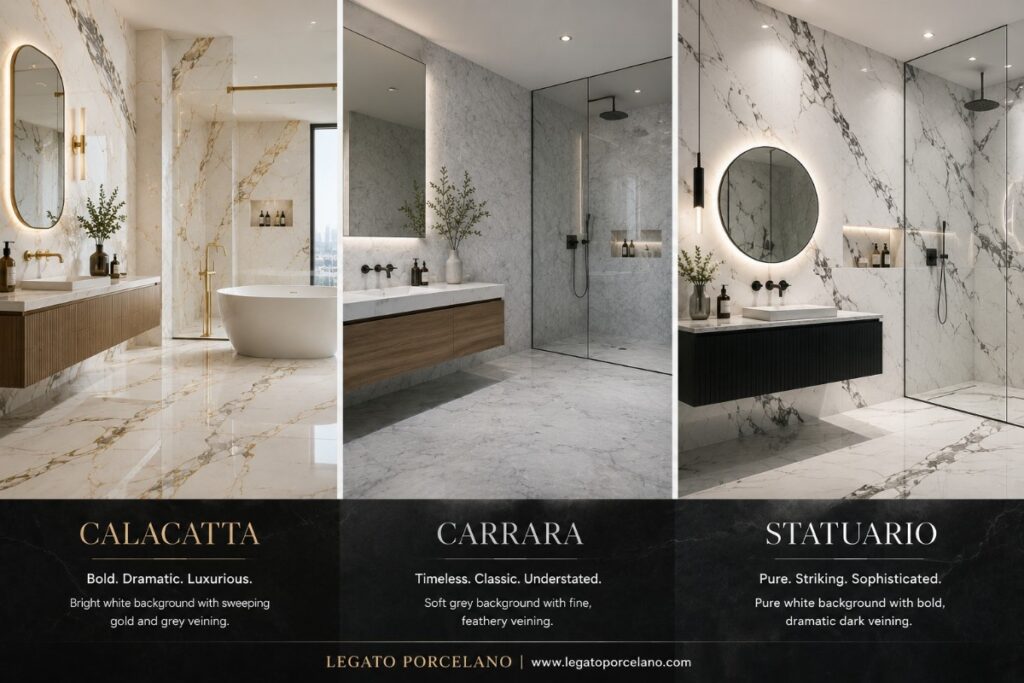
| CALACATTA | CARRARA | STATUARIO |
|---|---|---|
| GROUND: Bright warm white | GROUND: Blue-grey cool tone | GROUND Pure, brilliant white |
| VEINING: Bold, sweeping — gold & grey | VEINING: Fine, feathery, understated | VEINING: Crisp, dark, high-contrast |
| BEST FOR: Feature walls · Vanity surrounds · Shower centrepieces | BEST FOR: Large-area floors · All-over bathrooms · Minimalist spaces | BEST FOR: Vanity walls · Luxury wet rooms · Statement shower back |
| FINISH: Polished walls · Matte/honed floors | FINISH: Polished walls · Matte floors (grey grout) | FINISH :Polished (walls) · Honed (residential) · Matte (floors) |
Calacatta — Drama Specified Correctly
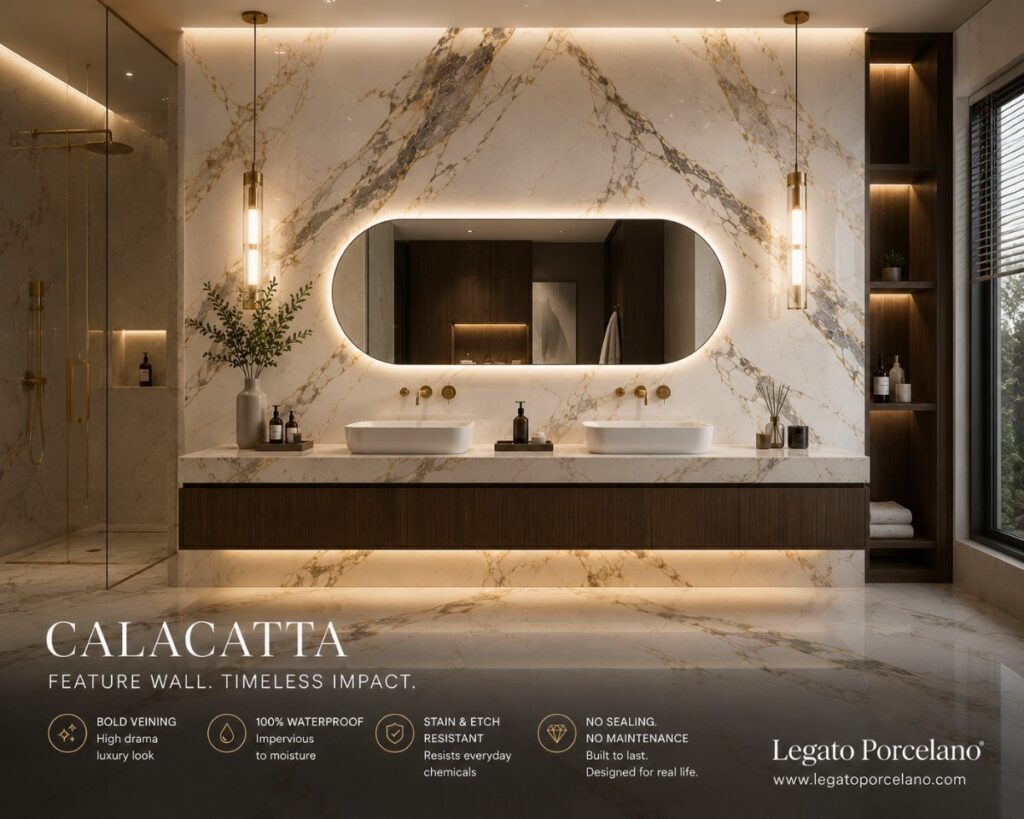
Calacatta’s power comes from containment. Use it where the tile is the centrepiece — vanity back walls, shower feature walls, floor-to-ceiling hotel-style applications. Dispersed across an entire room, the bold veining competes. Concentrated, it commands. Calacatta Gold adds warm amber tones ideal for brass-fixture bathrooms; Calacatta Borghini runs darker and more graphic for contemporary spaces.
Carrara — Large-Area Authority
Carrara’s cooler grey ground makes it the only marble look that reads as cohesive and intentional across full-room, large-format floor installations. Where Calacatta demands focal-point placement, Carrara rewards repetition. Fine feathery veining creates movement without visual competition. The specification default for architects working on large-footprint master bathrooms and luxury wet rooms.
Statuario — The Rarest White
Historically the stone reserved for sculpture, Statuario’s defining quality is the contrast between a pure bright-white field and crisp, bold dark veins. Minimal colour variation across tiles creates a consistent, museum-like clarity. The most versatile of the three for fixture pairing — the neutral white-and-dark palette works equally with brass, chrome, nickel, or matte black.
Finish Selection: Polished, Honed, and Matte — Where Each Belongs
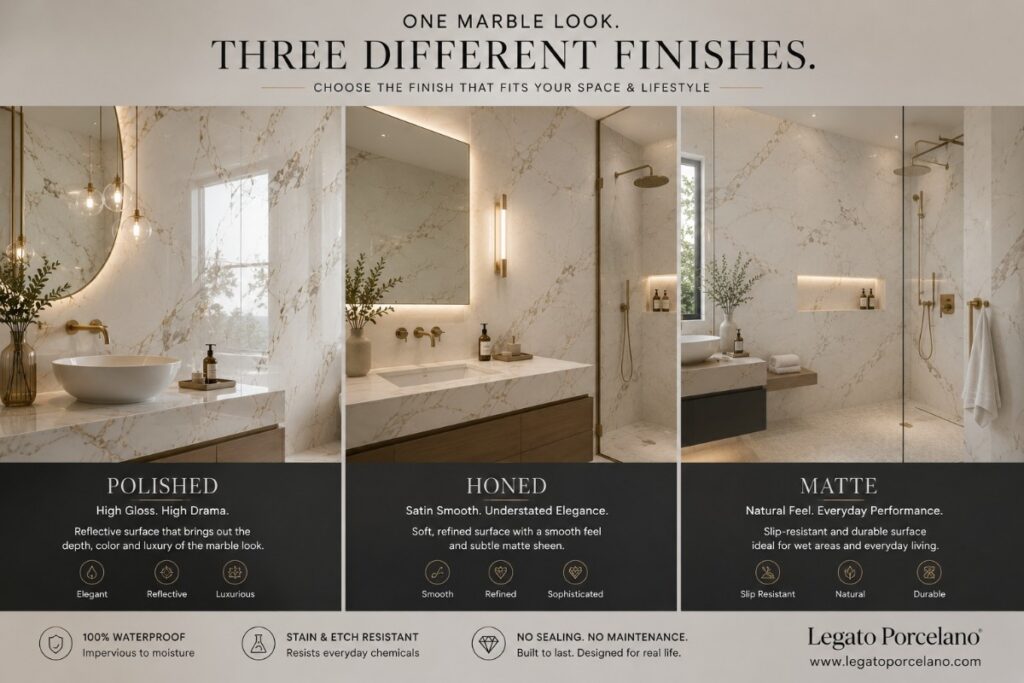
Marble-look porcelain is available in polished, honed, and matte finishes. Each produces a fundamentally different result from the same design — and each has a specific, correct placement within a bathroom. This is the decision most buyers rush; it is the one most worth slowing down for.
Polished — Maximum Drama, Walls Only
Polished marble-look porcelain is mechanically ground to a mirror surface. It maximises the visual depth of the veining and amplifies light throughout the room — the finish most associated with five-star hotel bathrooms and luxury residential interiors. Reserved for walls, vanity backs, dry-area feature surfaces, and powder rooms. On wet bathroom floors, polished porcelain frequently falls below the ANSI A137.1 minimum DCOF of 0.42 — always verify independently before floor specification.
Honed — The Architect’s Preference
Honed tiles are ground smooth with minimal sheen. Per Marazzi’s published finish glossary, honed surfaces are smooth to the touch with low reflectivity — refined without drama. The veining remains clearly visible; the room reads warmer and more residential. For marble-look porcelain in spa bathrooms and master suites, honed is the finish of choice among professional specifiers because it sits between the maintenance demands of polished and the purely functional register of matte. Viable for floors subject to DCOF verification.
Matte — Floor-Safe, Underestimated
Matte marble-look tiles are the correct specification for all wet bathroom floors and shower areas. The veining character of Calacatta or Carrara reads clearly on a matte surface — the visual impact is softer than polished but entirely appropriate. Matte tiles in marble-look collections typically achieve DCOF values well above the 0.42 ANSI A137.1 threshold for wet interior floors. They also hide water marks and soap residue, which is a significant daily-use advantage that polished surfaces cannot offer.
→ Deep dive on finish decisions: Matte vs Glossy Porcelain Tiles — Complete Finish Guide
PROFESSIONAL FINISH RULE
“Polished marble-look walls + matte marble-look floors, same collection, matched grout. This is the professional pairing used in luxury hotels worldwide — maximum drama above, maximum safety below, visual continuity throughout.”
Design Applications: Four Ways to Use Marble-Look in a Bathroom
Vanity Feature Wall
A polished marble-look wall behind the vanity creates instant luxury and elegant visual focus. Floor-to-ceiling continuity enhances depth while making the bathroom feel calm and refined.
- Brushed brass fixtures
- Warm concealed lighting
- Minimal grout lines
- Hotel-inspired styling
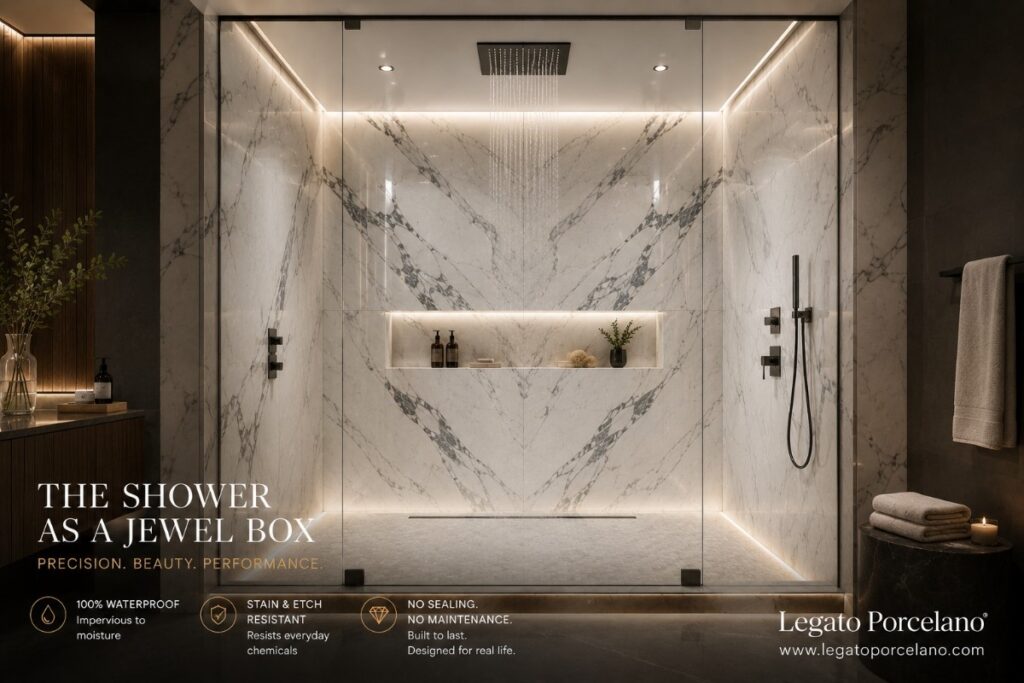
Shower as a Jewel Box
Use contrasting marble-look finishes inside the shower to create architectural depth and drama. The shower becomes the feature element while the rest of the bathroom stays minimal and balanced.
- Textured floor finish
- Frameless glass enclosure
- Integrated niche lighting
- Rainfall shower design
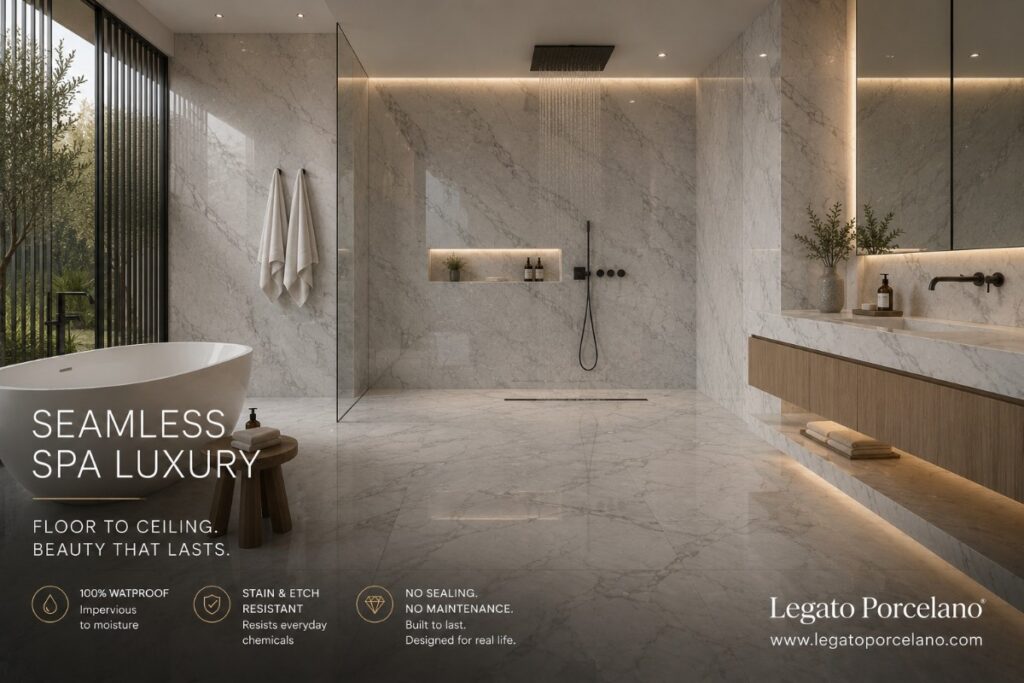
Floor-to-Ceiling Continuity
Using the same surface across walls and floors creates a seamless spa-inspired atmosphere. Continuous finishes reduce visual clutter and improve spatial flow.
- Spa-inspired atmosphere
- Minimal grout lines
- Architectural cohesion
- Strong visual flow
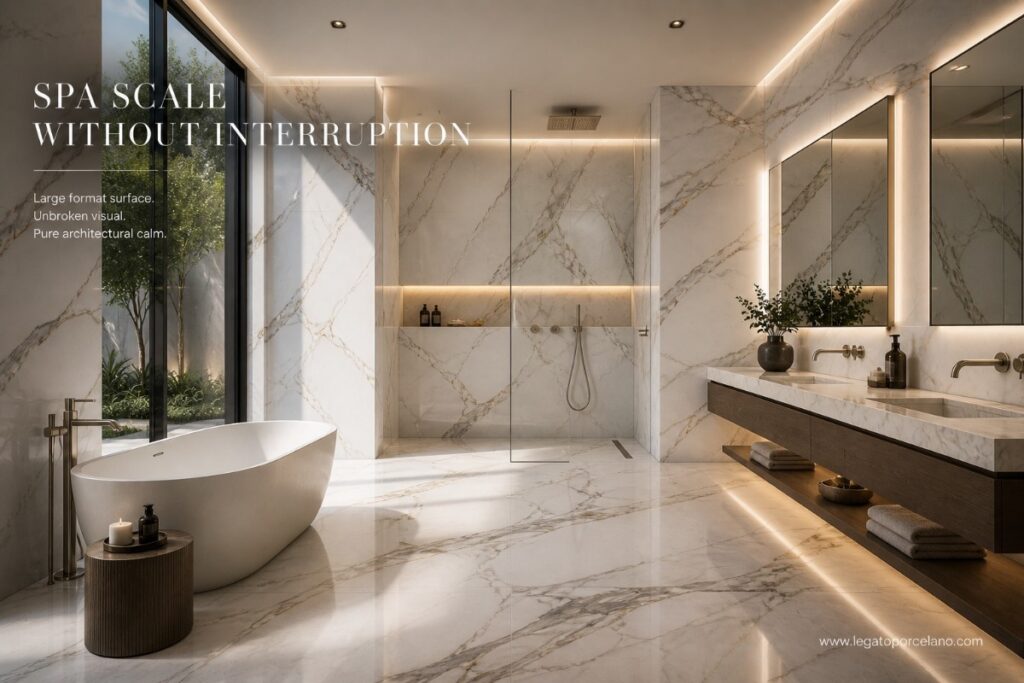
Large Format for Spa Scale
Large-format marble-look porcelain creates cleaner surfaces with fewer visual interruptions. The uninterrupted veining enhances spaciousness and architectural elegance.
- Premium spatial continuity
- 120×60 cm formats
- 120×120 cm formats
- Minimal visual clutter
→ Internal Links: Large Format Bathroom Tiles | Spa-Inspired Bathroom Design | Small Bathroom Tile Ideas
5 Selection Criteria for Getting It Right
1. Match Veining Scale to Room Scale
Bold, large-scale Calacatta veining works best in contained statement areas or large rooms. Fine Carrara veining is safer across large installations — it creates cohesion without visual competition with the room’s architecture.
2. Verify DCOF for Every Floor Tile
Request DCOF test data (ANSI A326.3) for any marble-look tile being specified on a wet bathroom floor. Do not assume compliance from a polished tile. Matte and honed finishes are your safe defaults for floor application.
3. Plan Grout Colour Before Purchase
Grout covers 5–15% of the total tile surface. For Calacatta: warm ivory or off-white grout, cool light grey. For Statuario: pure white or pale grey. Grout that closely matches the tile’s base colour creates the most seamless, stone-like result.
4. Review Samples Under Your Actual Lighting
Marble-look porcelain changes substantially under warm (3000K) vs cool (5000K) light. Calacatta Gold’s warm veining amplifies under warm bulbs; Carrara reads cooler and more blue-grey. Always evaluate samples under your bathroom’s actual or closest-equivalent light conditions.
5. Pair Metal Finishes Deliberately
Calacatta Gold (warm veining) → brushed brass, antique gold, warm bronze. Carrara (cool grey) → polished chrome, brushed nickel, matte black. Statuario (neutral white and dark grey) → any metal finish; the most versatile of the three. The fixture choice either harmonises or competes — decide before you tile.
Conclusion:
Marble-look porcelain has reached visual fidelity where the distinction from natural stone, at installation distance, is negligible. What is not negligible is the maintenance difference: no sealing, no etching risk, no pH-restricted cleaning regime. For a bathroom that will be used daily for decades, that is not a small advantage.
Calacatta for drama. Carrara for elegance. Statuario for pristine contrast. Polished for walls. Matte for floors. Large format for continuity. These decisions, made deliberately and specified correctly, produce bathrooms that do not reference luxury — they embody it.
“The best marble-look bathroom uses the language of stone — scale, veining, continuity — with the precision that only an engineered material can deliver.”
| 🏛 | EXPLORE MARBLE-LOOK AT LEGATO PORCELANO Calacatta, Carrara, and Statuario-inspired porcelain tile collections in polished, honed, and matte finishes. legatoporcelano.com/blog/ |
↑ Matte vs Glossy Finish Guide | ↑ Bathroom Tiles Complete Pillar | Explore all Legato Porcelano collections
Yes. Large-format marble look bathroom tiles reduce grout lines and create a more continuous stone-like appearance. Many premium collections at Legato Porcelano are specifically designed for this luxury large-format aesthetic.
Yes. Marble look porcelain tiles are highly water-resistant and ideal for bathrooms, shower walls, and wet-room applications when paired with the correct matte or honed floor finish.
Calacatta features bold dramatic veining with a brighter white background, while Carrara offers softer grey veining and a more understated, classic appearance.
No. Unlike natural marble, marble look porcelain tiles do not require sealing, polishing, or special chemical maintenance for daily bathroom use.
Luxury collections from brands like Legato Porcelano are often used in floor-to-ceiling bathroom designs to create seamless spa-inspired interiors with minimal maintenance.
Polished finishes work best for walls and vanity features, while matte or honed finishes are recommended for wet bathroom floors due to better slip resistance.
