Choosing the right tile format affects far more than the final appearance of a space. Size influences grout lines, layout, cutting, handling, substrate preparation, installation and even shipment planning. For architects, importers and project buyers, these practical factors matter just as much as colour or surface design.
600×1200 porcelain tiles have become an important middle ground between conventional tile sizes and much larger porcelain slabs. Their rectangular proportion gives designers greater visual continuity while remaining more manageable for many projects than oversized panels.
Also described as 60×120 cm porcelain tiles, this format is widely considered for residential interiors, hospitality spaces, retail environments and other architectural applications. This guide explains where the format works, how it compares with other sizes, what buyers should verify and how to specify it more confidently.
Quick Answer: What Are 600×1200 mm Porcelain Tiles?
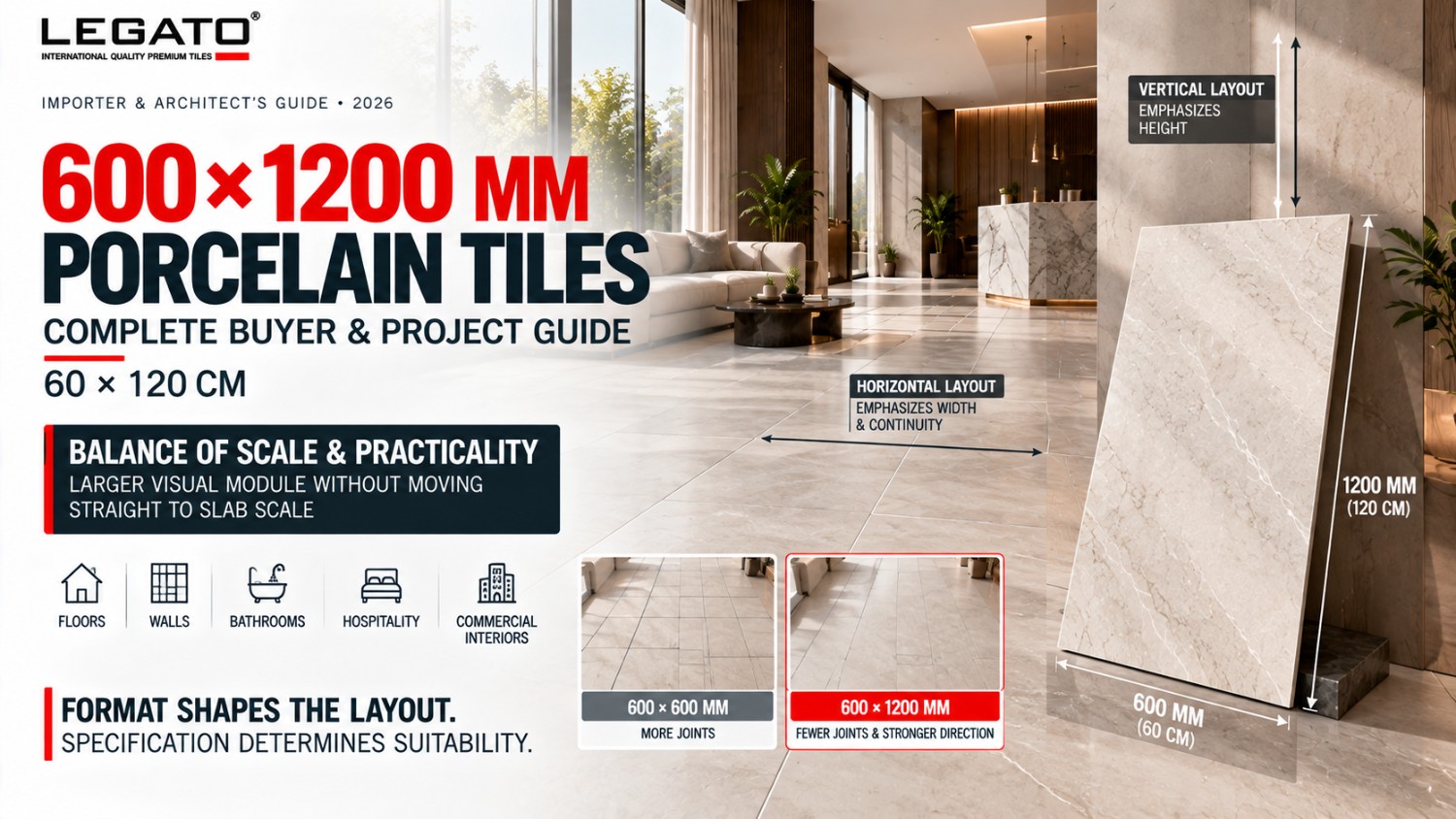
600×1200 mm porcelain tiles are rectangular porcelain tiles with nominal dimensions of 600 mm by 1200 mm, or 60 cm by 120 cm. One nominal tile covers about 0.72 square metres before joints, cuts and site wastage are considered.
The format is large enough to reduce the visual frequency of grout joints but smaller than many full-size porcelain slabs. That balance makes it useful for floors, walls, bathrooms, kitchens, hotels, offices and selected commercial environments.
However, format alone never determines suitability. The selected finish, technical performance, installation system and conditions of use must match the project.
600×1200 mm Tile Dimensions and Coverage
The 1:2 rectangular proportion is one of the main reasons this size behaves differently from square tiles. Installed horizontally, it can reinforce width and continuity. Installed vertically, it can emphasize height and create a more architectural wall composition.
You may see the format written as 600×1200 mm, 60×120 cm, 600 x 1200, 60 x 120 or sometimes as a nominal 24×48-inch class. These descriptions are commonly used for the same format family, but buyers should always confirm the actual declared manufacturing dimensions.
The best way to use a porcelain tile size guide is not to search for one “ideal” size. Instead, compare the room dimensions, desired visual effect, cutting pattern, installation conditions and project logistics before selecting the format.
Why Projects Choose 600×1200 Porcelain Tiles
The strongest advantage of 600×1200 porcelain tiles is balance. They create a larger visual module than traditional square tiles without automatically introducing the specialist handling associated with very large slabs.
Because fewer pieces are needed across the same surface area, the installation can appear calmer and less fragmented. This is especially valuable in open-plan interiors, hotel spaces, reception areas and large wall elevations where excessive joint lines can interrupt the design.
The rectangular shape also gives architects more directional control. A horizontal layout can visually stretch a wall, while a vertical arrangement can reinforce height. This flexibility is one reason large format porcelain tiles are increasingly considered as part of coordinated floor-and-wall schemes.
Large dimensions should not be confused with guaranteed performance. A bigger tile is not automatically stronger, safer or more suitable for demanding traffic. Those decisions still depend on the product specification and installation system.
600×1200 vs 600×600 Porcelain Tiles
The choice between 600×1200 and 600×600 is not a question of which format is universally better. Each solves a different planning problem.
| Factor | 600×600 mm | 600×1200 mm |
|---|---|---|
| Shape | Square | Rectangular |
| Visual rhythm | Regular grid | Directional |
| Joint frequency | Higher | Lower |
| Handling | Generally simpler | Requires more care |
| Compact rooms | Often easier to plan | More cut planning may be needed |
| Large walls | Suitable | Strong visual continuity |
| Open floors | Flexible | Larger visual module |
| Layout direction | Neutral | Can emphasize width or length |
In smaller or highly irregular spaces, 600×600 can sometimes reduce awkward cuts. In larger, cleaner layouts, 600×1200 may create stronger continuity.
A good porcelain tile size guide should therefore treat tile size as a design-and-installation decision rather than a trend ranking.
Where 600×1200 Tiles Work Best
The format can perform well across many interior settings when the correct product is selected. In practice, 600×1200 porcelain tiles work best when the room geometry and technical requirements support the larger rectangular module.
The useful question is not simply, “Where can this size be installed?” A better question is, “What does this application require from the tile, finish and installation system?”
Residential Floors
In living rooms, dining rooms and open-plan spaces, 600×1200 floor tiles can create long uninterrupted visual lines. They work particularly well where the room geometry supports a clear directional layout.
Before finalizing the design, consider door transitions, furniture positions, cut locations and the relationship between tile direction and natural light. A larger format does not automatically make every room look bigger; proportion and layout still matter.
Wall Applications
600×1200 wall tiles are particularly effective on large interior elevations, feature walls and bathrooms. Their rectangular module creates fewer visual breaks and gives marble-look or stone-look graphics more room to develop.
Horizontal layouts can make broad walls feel more continuous, while vertical layouts can emphasize ceiling height. Pattern direction should be planned before installation rather than decided tile by tile on site.
Bathrooms
Bathrooms are a natural application for 60×120 cm porcelain tiles because the format can reduce visual fragmentation on walls and create a cleaner overall composition.
The same size may also work on floors, but wet-area requirements must be checked separately. Surface performance, drainage, falls, waterproofing and cut complexity are more important than appearance alone.
Never assume that a matte or textured finish is automatically suitable for a wet floor. Product-specific performance should be verified before specification.
Kitchens
In kitchens, the format can work across flooring, feature walls and selected backsplash layouts. Larger modules can help connect cooking, dining and living zones where the interior uses one continuous material language.
The finish should be selected according to cleaning requirements and the actual location. A decorative surface that performs well on a wall may not be the right choice for a heavily used floor.
Hospitality and Commercial Interiors
Hotels, offices, showrooms and retail spaces often need materials that combine design consistency with repeatable project planning.
Porcelain tiles for commercial projects should be selected from the performance requirement backward, not from the catalogue image forward. Traffic, cleaning procedures, slip requirements, substrate conditions and maintenance expectations should be defined first.
Only then should the project team choose the appropriate size, finish and product specification.
Choosing the Right Surface Finish
Tile size and surface finish are separate specification decisions. Two products can share the same dimensions but behave very differently because of their surface characteristics.
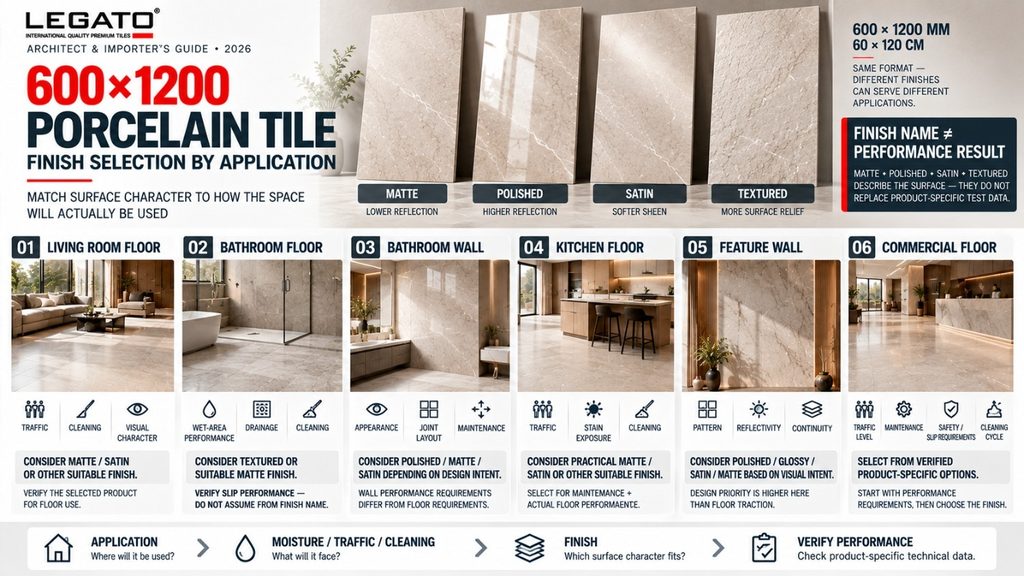
Common porcelain tile finishes may include matte, glossy, high-gloss, satin, carving or structured surfaces, depending on the manufacturer’s collection. Each produces a different combination of reflectivity, texture, maintenance behaviour and visual character.
For a living-room floor, the priority may be appearance and routine maintenance. In a bathroom, wet-area safety may become more important. On a feature wall, reflectivity and graphic continuity may dominate the decision.
This is why porcelain tile finishes should always be evaluated by application rather than by appearance alone.
How to Choose the Right Porcelain Tile Finish
A useful specification starts by identifying what the surface must do.
| Application | Main Considerations |
|---|---|
| Living-room floor | Traffic, cleaning, visual character |
| Bathroom floor | Wet-area performance, drainage, cleaning |
| Bathroom wall | Appearance, joint layout, maintenance |
| Kitchen floor | Traffic, stain exposure, cleaning |
| Feature wall | Pattern, reflectivity, continuity |
| Hotel lobby | Traffic level, maintenance, specification |
| Retail floor | Wear, safety, cleaning cycle |
| Commercial wall | Appearance and long-term maintenance |
The right choice may therefore vary within the same project. One collection can offer visual coordination while different surfaces are specified for different locations.
For buyers comparing porcelain tile finishes, product-specific technical data is more valuable than broad labels such as “premium,” “luxury” or “anti-slip.”
Layout and Design Planning
Layout should be resolved before installation begins. With a large rectangular format, poorly positioned cuts or inconsistent alignment can become more noticeable across the finished surface.
A straight grid gives the cleanest and most predictable joint pattern. Horizontal layouts can strengthen width, while vertical layouts can emphasize height. Selected offset patterns may also be possible, but they should be planned with actual tile flatness, joint width and porcelain tiles manufacturer recommendations in mind.
For marble-look or directional graphics, review more than one tile at a time. Vein direction, repetition, rotation and adjacent pieces all affect the final appearance.
On larger projects, a dry layout or digital layout plan can help the team control visual continuity before fixing begins. When using 600×1200 wall tiles, this preparation is especially useful because eye-level wall surfaces make pattern and alignment errors easy to notice.
Installation Requirements for 600×1200 Porcelain Tiles
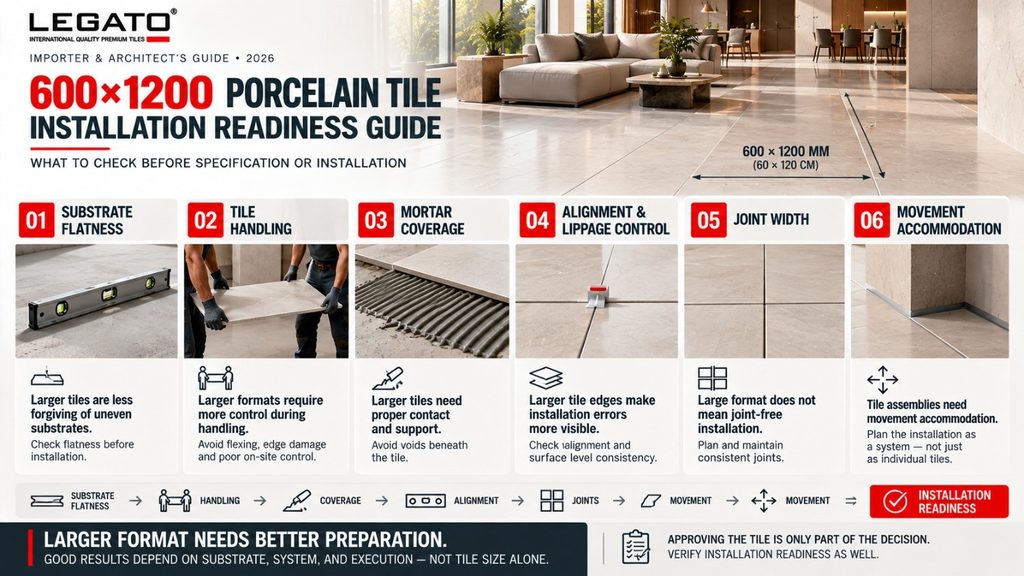
Successful installation starts before the first tile is laid. Because 600×1200 porcelain tiles cover a larger area per piece, errors in substrate preparation or alignment can become more visible across the finished surface.
The substrate should be checked for flatness, stability and surface condition. Trying to correct significant substrate irregularities only with setting material during installation is poor practice and can contribute to lippage or inconsistent coverage.
The fixing system should suit the tile, substrate and environment. Wall and floor installations may require different considerations, while wet areas and exterior conditions introduce additional requirements.
600×1200 floor tiles also need appropriate mortar contact beneath the tile. Voids and poor coverage can undermine the finished installation even when the tile itself meets the required technical specification.
Joint width should not be reduced simply to create a “seamless” appearance. Tile dimensions, edge condition, variation, layout and substrate movement all influence joint design.
Movement accommodation should also be planned as part of the assembly rather than treated as an afterthought.
Technical Specifications Buyers Should Check
Design images can help shortlist a collection, but they are not enough for professional specification. Buyers should review product-specific technical information before approving a project order.
For porcelain products, water absorption is one of the fundamental characteristics to verify. The international classification and marking requirements for ceramic tiles are covered by ISO 13006. Legato’s published GVT technical specification references ISO 13006 / EN 14411 Group BIa and lists water absorption below 0.50% for the products covered by that sheet.
Dimensional characteristics also matter. Length, width, thickness, straightness, rectangularity and surface flatness can directly affect alignment across a large installation.
Mechanical performance should be checked according to the project. Depending on the application, this may include breaking strength, modulus of rupture, wear behaviour, chemical resistance or other relevant test data.
For wet or safety-sensitive floors, request the appropriate slip-performance information for the specific surface. A finish name should never substitute for measured product data.
This technical review is particularly important when specifying porcelain tiles for commercial projects, where traffic levels and maintenance conditions can differ significantly from residential use.
What Importers Should Check Before Ordering
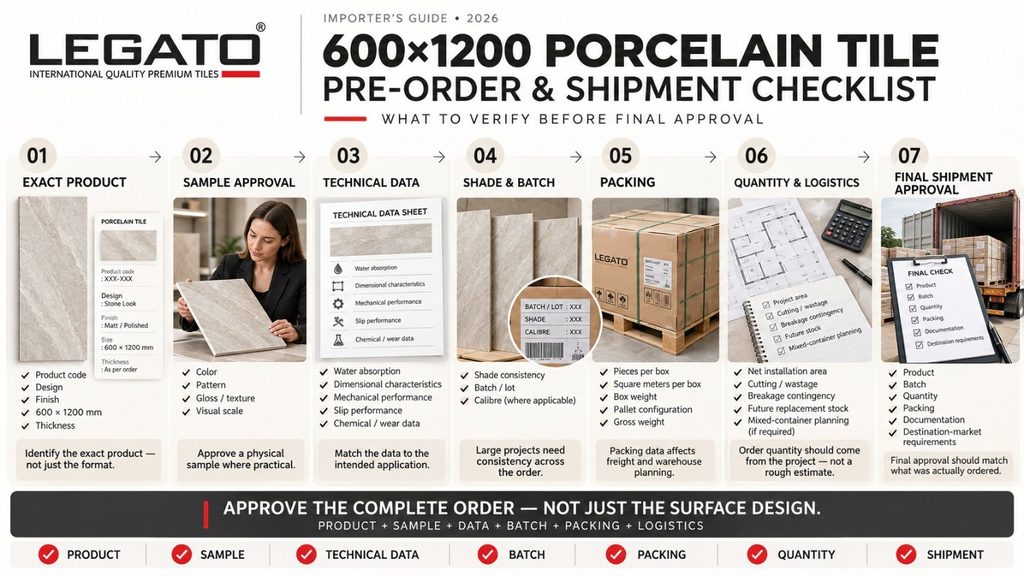
Bulk buying requires a different level of control from selecting tiles for a single room. When 600×1200 porcelain tiles are purchased for a project or distribution program, consistency across product, batch, packing and documentation becomes especially important.
Start by confirming the exact product code, design, surface, nominal size, thickness and intended application. Physical sample approval is valuable because screens can alter colour, contrast, gloss and perceived texture.
Shade and batch management should also be discussed before production or dispatch. Where a project relies on visual continuity, later replacement material from another batch may be difficult to match exactly.
Technical documentation should be reviewed according to the destination market and intended use. For applicable Indian product specifications, buyers can consult the Bureau of Indian Standards(BIS) ceramic tiles resources and verify the relevant standard and certification requirements for the product being supplied.
For large international orders, 600×1200 mm porcelain tiles should be evaluated as a complete product-and-logistics package rather than simply as a surface design.
600×1200 vs Larger Porcelain Formats
As tile dimensions increase, visual continuity improves but handling and installation complexity can also increase.
| Factor | 600×1200 | Larger Formats / Slabs |
|---|---|---|
| Visual scale | Large | Very large |
| Joint reduction | Strong | Greater |
| Handling | Manageable with large-format planning | More specialized |
| Cutting | Professional tile tools | May require slab-specific tools |
| Transport | Relatively straightforward | Greater logistical planning |
| Complex rooms | More adaptable | More cutting implications |
| Large feature walls | Strong option | Maximum continuity |
| Replacement | Generally easier | More involved |
For many projects, 600×1200 porcelain tiles work well when a large visual module is needed but slab-scale surfaces are unnecessary.
Bigger is not automatically better. The ideal format is the one that fits the architecture, installation resources and project budget.
This comparison is another reason a porcelain tile size guide should include logistics and installation—not just room aesthetics.
Packaging, Handling and Export Planning
Export planning begins with an accurate project quantity. The buyer needs to account for the net installation area, cutting, layout wastage, breakage contingency and any stock required for future replacement.
Packing data should then be checked against the selected product. Pieces per box, square metres per box, box weight, pallets and container capacity all affect the final order.
For 600×1200 mm porcelain tiles, handling procedures should also consider the larger rectangular shape. Correct packaging and controlled loading help reduce avoidable transit damage.
When several collections or sizes are shipped together, mixed-container planning should be based on actual packing information rather than rough estimates.
Cleaning and Maintenance
Porcelain is generally straightforward to maintain, but cleaning should still match the selected surface.
Routine care normally begins with removing loose dirt and using an appropriate cleaner according to the supplier’s recommendations. Spills should be addressed in reasonable time, and grout joints should be included in the maintenance plan rather than ignored.
Highly polished and structured surfaces may respond differently to aggressive cleaners or abrasive pads. Before using strong chemicals or specialist stain removers, check the recommended cleaning method and test where appropriate.
Post-installation cleaning also matters. Grout haze or construction residue can make a good surface look defective if it is not removed correctly.
Who Should Choose This Format?
Architects may choose the format when they want larger modules, strong directional layouts and fewer visible joints without moving immediately to oversized slabs. Interior designers can use the rectangular proportion to control visual rhythm across floors and walls.
Importers and distributors should look beyond appearance and evaluate product mix, finish range, technical documentation, packing efficiency and target-market demand. Contractors should confirm that the site conditions and installation team can support large-format work.
Homeowners can also benefit from the format, but the decision should still begin with room proportions and layout rather than trend alone.
For users specifically comparing 60×120 cm porcelain tiles with smaller formats, the biggest practical difference is the combination of longer visual lines, fewer joints and increased installation planning.
Buyer Checklist Before Final Approval
Before signing off a bulk or project order, verify the exact product, finish, size and thickness. A physical sample should be approved where practical, and the relevant technical data should be reviewed against the intended application.
Shade and batch expectations should also be clear before production. Packaging, shipment quantities, the installation system and expected project wastage should then be checked together rather than as separate decisions.
For international orders, destination-market requirements should be confirmed before the final shipment is approved.
A short final review like this can prevent far more expensive problems later in the project.
Explore Legato’s 60×120 cm Collection
Once the format, application and performance requirements are clear, product selection becomes much easier.
Explore Legato Porcelano’s 60×120 cm porcelain tile collection to review available designs and surface options. Buyers can then compare the visual range with the project’s technical and application requirements.
For broader selection, the main porcelain tile collection can help buyers compare multiple sizes. Technical specifications and packing details should also be reviewed before a large project or export order is finalized.
This separation is useful: the Master Guide explains how to evaluate the format, while the product page helps buyers choose the actual collection.
Frequently Asked Questions (FAQ’s)
Divide the net area by 0.72 m² per nominal tile, then account for cuts, layout complexity and breakage. Confirm actual product dimensions, box quantities and packing data before ordering.
Compare the exact dimensions, thickness, finish, technical data, approved samples and packing configuration. Similar-looking collections may differ in performance, batch consistency and suitability for the intended application.
They can require more careful cutting and layout planning in compact or irregular spaces. Review room dimensions, door transitions, joint alignment and expected offcuts before choosing the format.
Pre-planning helps control cut positions, joint alignment, directional patterns and visual repetition. For marble-look designs, reviewing several tiles together can reduce noticeable mismatches across prominent walls and floors.
Review application suitability, dimensional characteristics, relevant mechanical performance, wear behaviour and slip data where required. Match the evidence to expected traffic, cleaning routines, environmental conditions and local project requirements.
Approve a physical sample and agree on shade and batch expectations before production or dispatch. Confirm how batches will be identified, packed and managed, especially when visual continuity matters across large areas.
Request pieces per box, square metres per box, gross weight, pallet configuration and container-loading details. Legato Porcelano buyers should verify these figures against the exact selected product before finalizing freight and order quantities.
Choose 600×1200 mm tiles when the project needs substantial visual continuity without the handling and installation demands of oversized slabs. Legato Porcelano’s available formats can be compared against project layout, technical requirements and logistics.
Final Thoughts
600×1200 porcelain tiles are valuable because they sit in a practical middle ground. They provide stronger visual continuity than many conventional formats while avoiding some of the logistical and installation demands of much larger slabs.
The best result comes from treating size as one part of a complete specification. Application, surface finish, technical performance, layout, installation, packing and logistics all need to work together.
For architects and designers, that creates more predictable finished spaces. For importers and project buyers, it reduces avoidable specification and procurement risk.
And for anyone comparing 60×120 cm porcelain tiles with other sizes, it provides a much clearer basis for choosing the right format rather than simply choosing the largest one.
