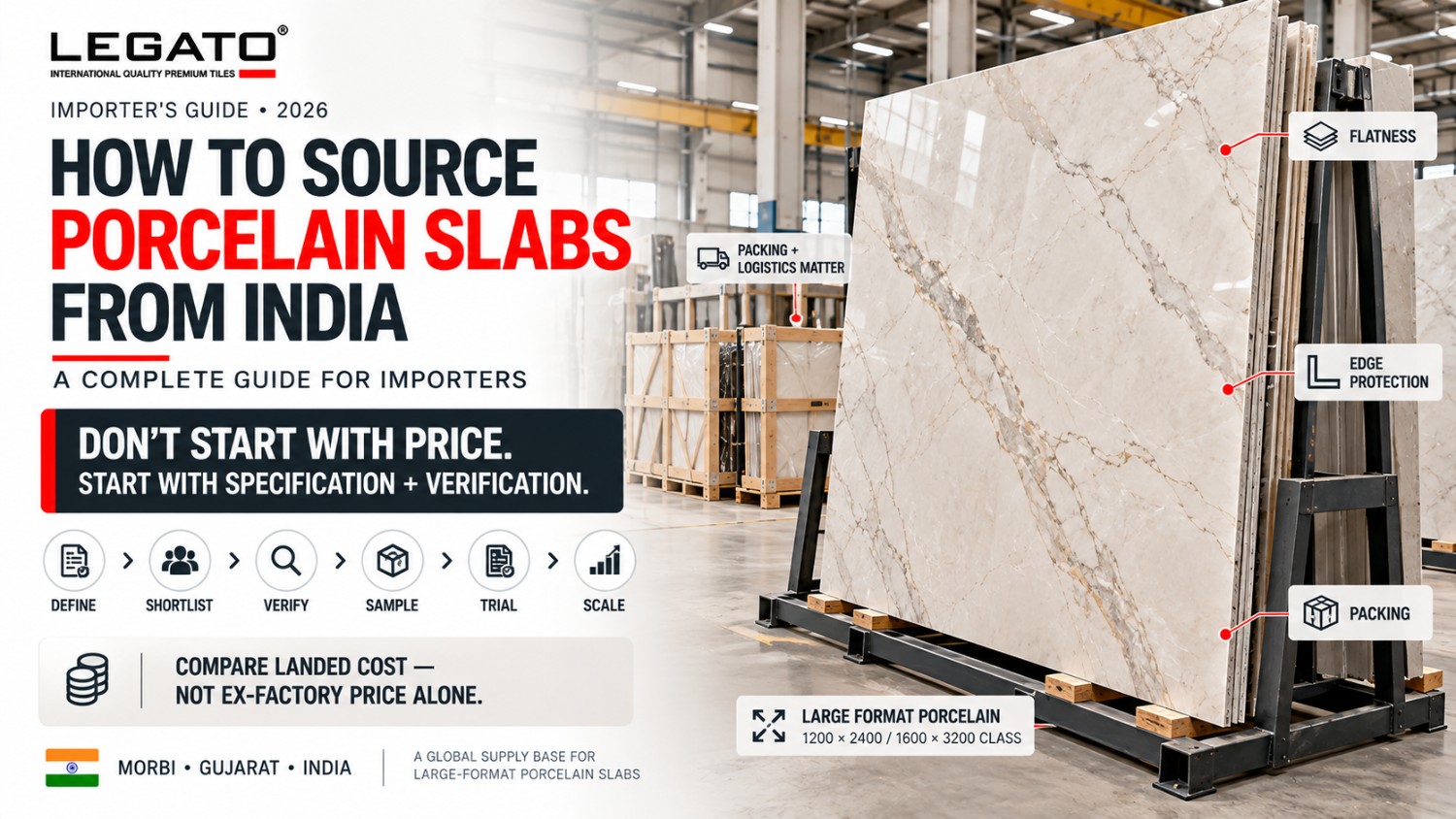
Large-format porcelain raises the cost of every sourcing error. Slabs are big, heavy and fragile, end customers judge them visually, and small differences in flatness, shade, edge condition or packing can become expensive once freight and fabrication are involved. Yet many importers still start by asking for a price list. A better approach is to treat sourcing as a sequence of decisions: define what you need, map the market, shortlist, request evidence, test, compare true cost and only then scale.
This guide shows importers, wholesalers, distributors and project buyers how to source porcelain slabs from India in that order, so that problems can be identified before larger production, freight and project commitments are made.
This guide covers the buying process. It does not repeat how to inspect a factory in depth, which is the subject of our guide to choosing a porcelain tile manufacturer, or the shipment-level checks covered in our checklist for evaluating a porcelain tile exporter. Each section here can be read on its own, and each ends with the buyer decision it supports.
Key Takeaways
- Write the specification before contacting suppliers. A vague request produces quotations that cannot be compared.
- Treat supplier statements as claims until they are supported by evidence that applies to the product, specification or production being bought.
- A small sample and a full-format slab answer different questions. Verify full-format characteristics separately.
- A standard’s name on a datasheet is a reference, not proof. Evidence is a result with its method, date, laboratory and applicable product.
- Manufacturers, exporters and traders carry different responsibilities. Map who controls production, quality release, shipping and claims.
- Compare landed cost per usable square metre, not ex-factory price per square metre.
What Does the Importer Journey Look Like at a Glance?
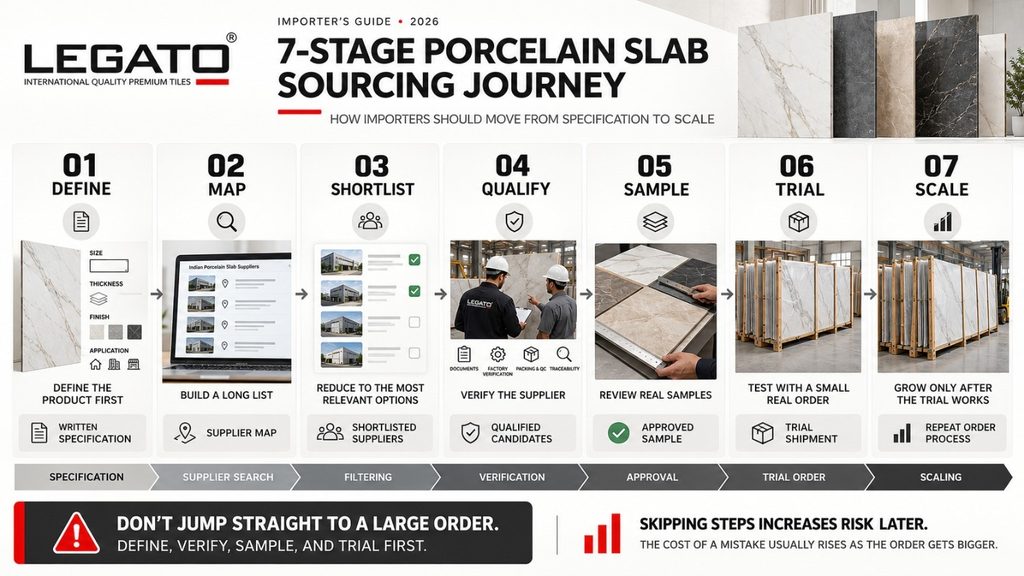
Short answer: A practical sourcing sequence has seven stages: define, map, shortlist, qualify, sample, trial and scale. Each stage ends with one decision backed by a specific kind of evidence.
| Stage | Decision to make | Evidence that supports it |
|---|---|---|
| 1. Define | Is the specification complete and frozen? | Written specification sheet |
| 2. Map | Which companies are worth contacting? | Long list with identity details |
| 3. Shortlist | Which three to five receive an RFQ? | Identity and responsiveness checks |
| 4. Qualify | Which suppliers can support the specification? | Graded evidence pack |
| 5. Sample | Is the product acceptable for surface and fabrication? | Samples, full-format verification and a fabricator trial |
| 6. Trial | Does the whole supply process work? | Inspection of a small real shipment |
| 7. Scale | Is it safe to increase volume? | Decision-gate results and batch records |
Buyer decision: Use this table as a gate list. Do not move to the next stage until the decision at the current stage is supported by evidence.
What Is a Porcelain Slab, and Where Is It Used?
Short answer: A porcelain slab is a large-format porcelain panel, produced by pressing and firing, used for floors, wall cladding, countertops, facades, shower walls and furniture surfaces.
Porcelain slabs are made from the same family of materials as porcelain tile, at much larger sizes. Commonly offered formats include 1200 x 2400 mm and 1600 x 3200 mm, with thicknesses from around 6 mm to 20 mm depending on the product. Exact sizes and thicknesses vary by manufacturer, so confirm what a supplier actually produces.
Typical uses include flooring, interior wall cladding and ventilated facades, kitchen and vanity countertops, shower and wet-area walls, and furniture and table surfaces. Trade names for similar products, such as “sintered stone” or “ultra-compact surface”, are used loosely and may or may not describe the same material. Ask for technical data for the specific product instead of relying on a label.
Buyer decision: Define the application first. The application decides the specification, and the specification decides which suppliers are relevant.
Why Do Importers Source Porcelain Slabs from India?
Short answer: India has a large ceramic industry with a major production cluster in Morbi, Gujarat, which offers importers a wide range of slab designs, sizes and finishes within one sourcing region.
India is among the largest ceramic producers in the world, and a significant share of capacity is concentrated around Morbi. Machinery suppliers, raw materials, skilled labour and export experience are located close together, so an importer can compare many designs and surfaces without moving between countries.
The same abundance makes selection harder. When you decide to source porcelain slabs from India, you will encounter integrated factories, smaller plants, exporters that buy from several factories and marketing firms with no production at all. The rest of this guide gives you a process that does not depend on trust alone.
Buyer decision: Decide whether India fits your project by comparing available designs and formats against your specification, not by region alone.
Stage 1: How Do You Write a Slab Specification Sheet?
Short answer: Write one document that fixes application, format, thickness, finish, design, matching, grade, technical performance and packing, and send the same sheet to every supplier.
A written specification makes quotations comparable and gives you a reference when something goes wrong.
| Field | What to write |
|---|---|
| Application | Floor, wall, countertop, facade, wet area or furniture |
| Format | Length and width in mm |
| Thickness | Required thickness in mm |
| Surface finish | Polished, matt, textured, honed or another named finish |
| Design | Reference name, colour and pattern, with a photograph |
| Matching | Whether vein or pattern continuity or matched sets are needed |
| Edge | Rectified or not, and any edge requirement |
| Grade | The quality grade you expect, defined in writing |
| Technical performance | Properties required for the application and any project or destination-market standards |
| Batch and shade | Single-batch requirement, if needed |
| Packing | Packing method and labelling requirements |
| Destination | Country and local import or conformity requirements |
The more precisely you describe the application, the more specific suppliers can be. A countertop raises fabrication and edge questions that a floor does not, and a facade raises fixing and exposure questions that neither does.
Buyer decision: Freeze the specification before sending any request for quotation. Changing it afterwards makes earlier quotations incomparable.
How Do You Match a Slab to the Application?
Short answer: Match thickness, finish and technical performance to the installation system, substrate, expected use and project requirements. Do not choose a slab for an application on thickness alone.
Use this table as a starting point and confirm with the manufacturer, your installer or your fabricator:
| Application | What to consider |
|---|---|
| Wall cladding | Weight, substrate, fixing system and how they work together |
| Flooring | Abrasion performance, slip resistance for the location and installation conditions |
| Countertops | Thickness, edge profile, fabrication method, support conditions and daily use |
| Facades | Exposure conditions, fixing system, frost resistance where applicable and project requirements |
| Wet areas | Relevant slip-resistance requirement and water exposure |
| Surface finish | How polished or matt surfaces show scratches and marks under the expected traffic and cleaning |
Where an architect or specifier controls the project, obtain their technical requirements before requesting quotations.
Buyer decision: Confirm with your installer or fabricator that the chosen slab suits the application before you ask suppliers to quote.
How Do You Plan Weight and Format?
Short answer: Estimate the weight of each slab and of each shipment early, because weight affects handling, fabrication, installation and freight.
As an approximate planning figure, porcelain is often estimated at about 2.4 kg per square metre for every millimetre of thickness. Actual density varies by product, so ask the supplier for real weights. As an illustration only, a 1600 x 3200 mm slab covers 5.12 m², which at 12 mm thickness would weigh in the region of 147 kg by this estimate.
Tile cargo can reach a container’s weight limit before it fills the available space, so format and thickness can influence freight cost per usable square metre. Confirm container loading limits with your freight forwarder.
Buyer decision: Choose the format and thickness only after checking handling capacity, fabrication equipment and freight weight implications.
What Is the Slab Sourcing Risk Map?
Short answer: The main slab risks are warpage, edge damage, shade and pattern mismatch, fabrication failure, technical values that differ from claims and transit breakage. Each can be tested before volume, and a small sample cannot test all of them.
| Risk | Where it appears | Evidence that tests it | What to put in the specification |
|---|---|---|---|
| Warpage and poor flatness | Large formats after firing | Straight-edge check on representative full-size slabs | Flatness requirement and test method |
| Edge and corner damage | Handling, cutting, packing | Inspection of full-size slabs and packing evidence | Packing method and edge protection |
| Shade difference between slabs | Different batches in one project | Side-by-side comparison under the same light | Single batch or shade grade requirement |
| Pattern or vein discontinuity | Where a design should flow across slabs | Laying slabs together as intended | Matched set or sequence requirement |
| Cracking or chipping when cut | Fabrication and cut-outs | Fabricator trial on a representative piece | Fabrication requirements and approval step |
| Technical values below claim | Production variation | Test report for the relevant product, or independent testing | Required values and test method |
| Transit breakage | Racking, crating, loading | Packing evidence and a trial shipment | Packing standard and inspection on arrival |
A small cut sample can help compare colour, pattern and surface. It does not show full-size flatness, warpage, edge condition or packing. Those need verification on representative full-format production.
Buyer decision: For each risk, choose which evidence you will accept before you place an order, and write it into the specification.
Stage 2: How Do You Map the Market and Find Candidates?
Short answer: Combine several channels, such as industry contacts, trade exhibitions, manufacturer websites and referrals, and treat any listing as a lead, not a verification.
Ways to find a porcelain slab supplier in India include trade fairs and exhibitions for ceramics and building materials, industry associations and trade networks, referrals from importers, fabricators or architects, manufacturer websites that show real product detail, and B2B platforms, which are useful for discovery but weak as proof.
A search ranking or marketplace badge is not evidence. Build a long list, then reduce it by checking identity, product range and responsiveness.
Buyer decision: Put a company on the long list only if its identity and product range can be checked.
How Do a Manufacturer, an Exporter and a Trader Differ?
Short answer: A manufacturer produces slabs in its own facility, an exporter handles international sales and shipping and may or may not manufacture, and a trader resells goods made by others. They carry different responsibilities, so they should be evaluated differently.
| Role | What it does | What to verify | Who may control quality |
|---|---|---|---|
| Manufacturer | Produces slabs in its own facility | Production source, in-house stages, testing and batch records | The manufacturer |
| Exporter | Sells and ships internationally | Whether it manufactures, or which facility produces the quoted goods | Depends on whether it manufactures |
| Trader | Buys finished slabs from factories | Which factory makes the goods and what relationship exists with it | The factory behind it |
Traders and independent exporters are not automatically a problem, and a porcelain slab exporter in India may be a manufacturer, a trading house or a mix of both. The risk appears when responsibility is unclear. Map the following for every supplier:
- Who controls production of the quoted slabs?
- Who releases them as meeting the specification?
- Who arranges packing and loading?
- Who handles shipping documents?
- Who responds if a claim arises?
If production is outsourced, establish which facility controls production, testing and batch traceability. Our manufacturer evaluation guide explains factory-level verification in detail.
Buyer decision: Do not compare suppliers until you know which role each plays and who is responsible at each step.
Stage 3: How Do You Build a Shortlist and Send an RFQ?
Short answer: Remove candidates that fail basic identity checks, then send the same written request for quotation to three to five companies and compare the quality of their replies.
A simple filter:
- Identity. Company name, address and contact details are consistent across website and documents.
- Exporter registration. An Indian exporter normally holds an Importer-Exporter Code (IEC) issued by the Directorate General of Foreign Trade. Verify the supplier’s IEC details where relevant instead of relying on a claim.
- Product match. The supplier can provide the required formats, thicknesses and finishes, and states whether they are produced in-house or sourced elsewhere.
- Responsiveness. Replies are timely, clear and specific.
- Willingness to verify. The company is open to reasonable verification, such as live video, relevant test reports or a visit where appropriate.
If identity, product-source or verification questions remain unresolved, increase due diligence before shortlisting. A porcelain slab supplier in India that cannot resolve these basic points is difficult to compare fairly.
What to send in an RFQ. Include your specification sheet, the estimated first-order and project quantities, destination country, the technical evidence you want to see, and your questions on grade, packing and batch handling.
Treat questions as requests for evidence. The purpose of each question is to obtain something you can check, not to hear a reassuring answer:
| Instead of asking | Request this evidence |
|---|---|
| “Is your quality good?” | Quality-control records and a test report that identifies the product, method, date and laboratory |
| “Do you manufacture?” | Production-source information, a live video of the relevant areas and consistent legal details |
| “Is your packing safe?” | Current photographs or video of comparable packed slabs and the written packing method |
| “Can you match batches?” | An explanation of batch numbering and how matched sets are kept together, with an example carton or crate label |
A strong reply answers every point and repeats your specification accurately. A weak reply sends a price and a catalogue.
Buyer decision: Shortlist the suppliers whose replies provide checkable evidence, not the ones with the lowest price or the fastest promise.
Stage 4: What Evidence Pack Should You Request From Each Supplier?
Short answer: Request an evidence pack covering production source, quality-control records, test reports, certificates and packing, and check what each item does and does not prove.
An evidence pack lets you compare suppliers on the same terms. The table shows what each item can and cannot demonstrate:
| Evidence | What it can show | What it does not prove |
|---|---|---|
| Production-source information and live video | Who produces the slabs and in which facility | That every batch meets a requirement |
| Quality-control records | That checks are done and results are recorded | That a specific shipment passed |
| Test report | A measured result for the tested product or sample | Performance of other products or later production |
| ISO 9001 certificate | A documented quality management system was audited | That a specific batch meets a technical requirement |
| CE-related documentation | Compliance documentation relevant to the EU framework, where applicable | Suitability for every application |
| Export recognition | An export status or track record | Product quality |
| Packing photographs | How comparable slabs were packed | How your order will be packed |
A standard’s name is a reference, not proof. A datasheet that says a product conforms to a standard becomes evidence only when a report identifies the tested product or sample, the method and its edition, the laboratory, the date, the result and the requirement it was compared with. The ISO 10545 series provides test methods for ceramic tiles, including sampling and acceptance rules. Verify which methods apply to your product and review results, rather than accepting a standard’s name.
For classification, verify the measured water absorption result against the applicable ISO 13006 classification and your project or destination-market specification. Do not rely on the word “porcelain” alone.
Check certificates for the legal entity, scope, validity and an identifiable issuing body. Some destination countries require conformity, registration or import documentation for tiles and slabs, so confirm what applies with the relevant authority, customs professional or qualified local adviser.
Buyer decision: Score each supplier on the evidence you actually received, and give more weight to evidence tied to your product than to general certificates or claims.
What Should Porcelain Slab Quality Control Evidence Include?
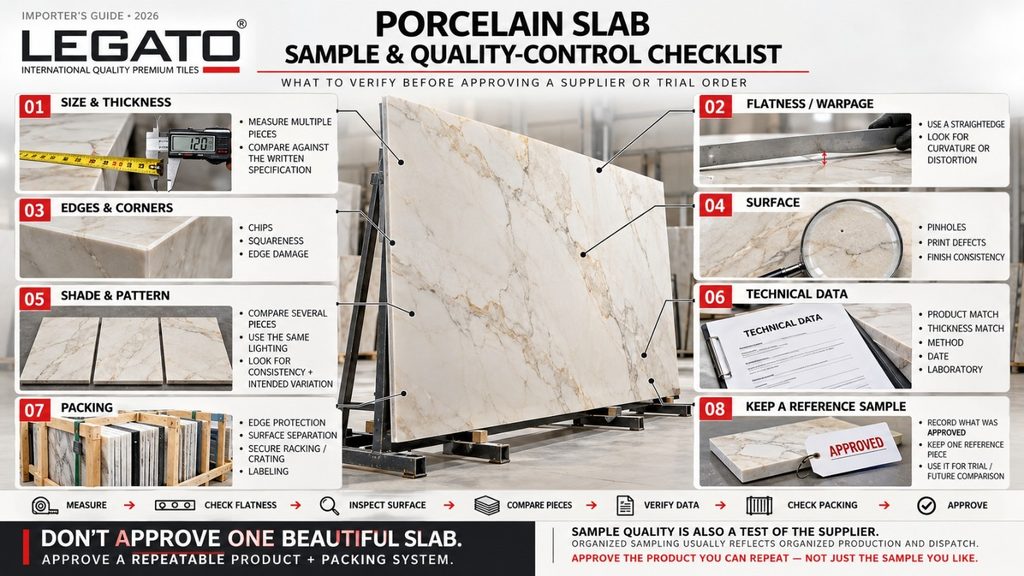
Short answer: Porcelain slab quality control evidence should show checks at the stages where slab defects begin, recorded results and a clear way of handling nonconforming material.
Slabs raise the stakes of each production stage. When you review a supplier’s quality system, look for evidence at these points:
| Stage | Slab-specific focus | Evidence to request |
|---|---|---|
| Body preparation | Consistency across a large pressed area | Description of checks and records |
| Pressing | Uniform density and thickness across the panel | Check records |
| Firing | Control of warpage, shrinkage and shade | Description of controls and results |
| Sorting | Flatness, size, surface defects and shade grading | Sorting criteria and grading definitions |
| Packing | Edge protection and secure racking or crating | Packing method and photographs |
| Records | Batch-linked results that can be traced | An example of a traceable record |
Porcelain slab quality control evidence should also show how nonconforming material is identified, set aside and kept out of an approved shipment.
Buyer decision: Prefer suppliers who can show how quality control works for slabs specifically, with records you can inspect, over those who describe it in general terms.
Stage 5: How Do You Verify Samples and Full-Format Slabs?
Short answer: Use samples to judge surface, colour, pattern, finish and fabrication behaviour, and verify full-format characteristics such as dimensions, flatness, warpage and edge condition on representative full-size slabs.
A small or cut sample and a full-size slab answer different questions.
| What you want to know | Sample suitable? | What to use |
|---|---|---|
| Colour, pattern and finish | Yes | Representative samples under consistent lighting |
| Fabrication behaviour | Partly | A fabricator test on a representative piece |
| Full-size flatness and warpage | No | Representative full-size slabs |
| Edge condition and squareness | Limited | Full-size slabs |
| Packing quality | No | Evidence from comparable packed slabs |
| Technical properties | Not by inspection | A report for the relevant product or independent testing |
Sample protocol:
- Request representative surface samples for colour, pattern and finish.
- Record product identification, such as the product reference and any production identification supplied.
- Measure sample thickness for comparison with the specification where useful.
- Verify full-format production separately on representative full-size slabs.
- Compare shade and pattern between pieces under the same light.
- Review how comparable full slabs are protected, racked or crated.
- Use laboratory testing where independently verified properties are required.
- Record the approved reference and the written specification for later comparison.
Fabricator trial. Ask your fabricator or installer to cut, edge and handle a representative piece the way they would on a real job. For countertops, include a cut-out. Inside corners of cut-outs are generally rounded to reduce stress, so confirm good practice with your fabricator. A slab that passes inspection but fails in fabrication is a failed slab for your business.
Buyer decision: Approve a design on a sample, but approve the supplier only after full-format slabs and a fabrication trial have been checked.
How Do You Manage Shade, Pattern Matching and Batch Control?
Short answer: State in the specification whether your project needs a single batch or matched sets, and request evidence of how the supplier numbers, keeps together and packs those slabs.
Large surfaces show shade and pattern differences more than small tiles do.
- Shade across slabs. Slabs from different batches can differ slightly. For one project area, specify a single batch and request an example of how batches are labelled.
- Pattern or vein continuity. Where a design is meant to flow across adjoining slabs or form matched sets, ask whether matched sets are offered, how they are numbered and how they are packed in sequence.
After delivery, keep batch and set numbers with the slabs through storage and fabrication so adjoining pieces stay together.
Buyer decision: If the design depends on continuity, make matching a written requirement before ordering, not a hope.
Why Compare Landed Cost per Usable Square Metre?
Short answer: Landed cost adds everything needed to get usable slabs to your site and divides it by the area you can actually use. It can reverse a decision made on ex-factory price.
Landed cost per usable m² = (product + packing + freight + insurance + duty and taxes + clearance and local handling) ÷ usable m²
Usable m² = ordered m² × (1 − breakage allowance − fabrication wastage)
| Cost element | What to include |
|---|---|
| Product | Price for the agreed grade, size, thickness and finish |
| Packing | Crating, racking or pallet costs if charged separately |
| Freight and insurance | Transport to destination and cargo cover, influenced by weight |
| Duty and taxes | Import duty and local taxes for your country |
| Clearance and handling | Customs clearance, unloading, storage and inland transport |
| Breakage allowance | An allowance based on format, packing method, route and shipment history |
| Fabrication wastage | Especially for countertops and cladding layouts |
| Claim handling | Time and cost of resolving a problem |
Customs classification for ceramic tiles and slabs generally falls under heading 6907 of the Harmonised System, but sub-classification and duty vary by country, so confirm with your customs broker. When two quotations differ, check that grade, packing and delivery terms are equivalent before concluding that one is cheaper.
When you source porcelain slabs from India for a project, use one comparison sheet with a column for each supplier and the same cost rows for every quotation.
Buyer decision: Choose between suppliers on landed cost per usable square metre, using equivalent grade, packing and delivery terms.
How Do Shipping Terms Affect Risk and Cost?
Short answer: Incoterms define agreed delivery obligations, the allocation of specified transport costs and the point at which transport risk passes between seller and buyer. They do not settle every contract question, such as ownership or payment terms.
The Incoterms 2020 rules published by the International Chamber of Commerce define standard delivery responsibilities through rules such as FCA, FOB and CIF. The correct rule depends on how and where goods are delivered. For containerised cargo handed to a carrier or terminal before it is loaded on board, FCA may be more appropriate than FOB in some transactions. Choose the rule that matches the actual transport arrangement, not the one that is most familiar.
- Agree the Incoterm and the named place of delivery in writing.
- Compare quotations only when delivery terms cover comparable responsibilities.
- Confirm how heavy slabs are loaded and secured.
- Decide who arranges cargo insurance where the selected rule does not allocate it as you expect.
Commercial terms for your specific order are best discussed directly with the supplier’s export team and your logistics advisers.
Buyer decision: Select the delivery rule with your freight adviser, write it into the order and compare offers only on equivalent terms.
What Should You Confirm in Writing Before Placing an Order?
Short answer: Confirm product specification, grade, packing, delivery terms, destination import requirements and the claims process in writing before any payment is made.
- The exact product reference, size, thickness, finish and grade
- Batch, shade and matching handling for your project
- Packing method and labelling
- Delivery rule and responsibilities
- Import requirements for your destination, checked with your customs adviser
- How defects and claims are reported and what evidence is needed
A written order confirmation gives both sides a reference for the agreed product and process, especially when you buy porcelain slabs from India for a project with a fixed installation date.
Buyer decision: Place the order only when the written confirmation matches your specification line for line.
What Is Special About Packing and Transport for Slabs?
Short answer: Large-format slabs are sensitive to edge damage, movement and handling when packing or securing is inadequate, so the packing method should be verified before shipment.
- Method. Request how slabs are racked, crated or bundled and what protects edges and corners.
- Separation. Check what prevents surface-to-surface scratching.
- Securing. Slabs should be restrained so movement during transport is controlled.
- Labelling. Racks or crates should identify product, size, thickness, batch and shade where relevant.
- Wooden packaging. Where raw-wood crates, pallets or dunnage are used, verify the ISPM 15 treatment and marking requirements of the destination market.
- Photographs. Request current photographs or video of comparable packed and loaded slabs.
A porcelain slab exporter in India should be able to explain its packing method and support it with current evidence.
Buyer decision: Approve the packing method in writing before shipment, and compare it with the packing evidence you received during qualification.
How Do You Protect Yourself From Payment Fraud?
Short answer: Verify the company’s legal identity, confirm that the bank account name matches the legal entity, and treat any emailed change of bank details as a fraud risk until confirmed through a trusted channel.
- Check that the beneficiary name matches the verified legal name.
- Confirm bank details through a channel you already trust, such as a call to a number from the company’s verified website.
- Be cautious about late changes to bank details or pressure to pay quickly.
- Keep the written order confirmation and specification linked to each payment.
- Ask your bank which payment methods it recommends for new supplier relationships.
When you buy porcelain slabs from India for the first time, treat these checks as part of supplier qualification.
Buyer decision: Release a payment only after the beneficiary details have been verified through a channel you trust.
How Should You Receive, Store and Handle Slabs on Arrival?
Short answer: Inspect the shipment before final acceptance where practical, document visible damage, and store and handle slabs following the manufacturer’s instructions with equipment suited to the slab format.
Handling errors after arrival can damage slabs and make the source of later defects harder to establish.
- Inspect before sign-off. Check the container seal and condition where relevant, the number of crates or bundles, labelling, batch and shade markings, and visible damage.
- Photograph everything before and during unloading.
- Use suitable equipment. Slabs are heavy and need appropriate lifting equipment and trained handlers.
- Store correctly. Follow the manufacturer’s storage instructions, commonly using supported upright A-frames or racks designed for the format.
- Keep batches and sets together.
- Check before cutting. Inspect each slab before fabrication, because cutting can make it harder to show whether a defect existed beforehand.
- Report promptly with photographs, product identification and batch information.
Obtain handling and storage instructions before unloading so the receiving team can use suitable methods.
Buyer decision: Accept the shipment only after you have documented its condition against the packing information and the order.
Stage 6 and 7: How Do You Run a Trial Order and Scale Safely?
Short answer: Place a small first order against a written specification and approved reference, consider third-party inspection, inspect on arrival, and scale only when defined decision gates are met.
Trial order steps:
- Confirm the specification and approved reference in writing.
- Order a quantity you can afford to evaluate.
- Consider third-party inspection during production or before loading where the risk justifies it.
- Inspect on arrival: quantity, labelling, batch, shade, full-format condition, breakage and edge damage.
- Record issues with photographs, product identification and batch information.
- Compare the delivered product with the approved reference and specification.
Decision gates before scaling. Increase volume only if flatness and size meet the agreed requirement, shade and matching meet your project need, breakage falls within your allowance, fabrication or installation performs as in the fabricator trial, and the supplier investigated and documented any deviation clearly.
After scaling, reuse the same specification and reference, keep batch records for every shipment, compare each delivery with previously approved production, review quality and claims regularly with the supplier, and keep a second qualified supplier in reserve where continuity matters. When you source porcelain slabs from India repeatedly, use inspection results and claim history to refine your specification.
Buyer decision: Move to larger volume only when every decision gate has been met and recorded.
How Do You Evaluate Exporters and “Top Exporter” Lists Fairly?
Short answer: Judge an exporter on verified identity, transparent sourcing, evidence of quality and clear communication, and treat lists that rank companies without a visible method with caution.
Importers often search for “top exporters”. Lists can be a starting point, but they are only as useful as their method. Check who compiled the list, which criteria were applied and whether commercial inclusion influenced the ranking.
A fair evaluation of porcelain slab exporters in India looks at verified identity and registration, whether the exporter manufactures or sources from other facilities, evidence of testing and quality control, packing and loading practice, clarity of communication and references where available. For the shipment-level checks, use our checklist for evaluating a porcelain tile exporter.
Buyer decision: Use rankings only to find names. Decide on evidence you collect yourself.
What Red Flags Should Importers Watch For?
Short answer: Red flags are signals that evidence is missing or that responsibility is unclear. They justify more verification before commitment.
| What you see | Why it matters |
|---|---|
| Declines reasonable live verification or a visit | Production source or control may remain unclear |
| Cannot show how quality control or testing works | Processes may not be documented |
| Grades not defined | Room for specification disputes |
| Price far below comparable quotations | May reflect a different grade, specification, packing or commercial condition |
| Certificate name differs from company | The certificate may not cover the company or site being evaluated |
| Superlatives without evidence | A marketing claim, not verification |
| Sample differs from quotation | The sample may not represent the quoted product |
| Pressure to pay before key issues are resolved | Commitment requested before due diligence is complete |
Several unresolved red flags should increase the level of verification before you commit.
Buyer decision: Pause the order and ask for evidence on each unresolved item before proceeding.
What Mistakes Do Importers Commonly Make?
Short answer: Common mistakes include comparing ex-factory prices alone, skipping the written specification, approving an unrepresentative sample and scaling before a trial order.
- Comparing price only. Landed cost per usable square metre is the more useful comparison.
- No written specification. Quotations become incomparable and disputes harder to settle.
- Treating claims as facts. A statement becomes useful when evidence supports it.
- Approving an unrepresentative sample. A small sample does not prove full-format flatness, warpage or production consistency.
- Accepting a standard’s name as proof. Ask for the report behind it.
- Treating all supplier types alike. Manufacturers, exporters and traders carry different responsibilities.
- Ignoring packing. Good production can still arrive damaged if packing is inadequate.
- Skipping the trial order. Scaling before testing the supply process increases exposure.
- Not checking destination requirements. Import and conformity requirements differ by country.
Buyer decision: Review this list against your plan before you issue the first purchase order.
How Does Legato Porcelano Support Importers?
Short answer: Legato Porcelano LLP is a manufacturer based in Morbi, Gujarat, and can be evaluated using the same sourcing and verification criteria described in this guide.
Legato Porcelano manufactures porcelain tiles and slabs and serves international buyers. Importers who want to buy porcelain slabs from India can review the range on the porcelain tiles collection page and learn more about the company on the Legato Porcelano website. Its export page displays ISO 9001:2015 certification, CE-related compliance documentation and Government of India Export House recognition.
If you plan to source porcelain slabs from India, apply the stages and evidence requests in this guide to every supplier on your list, including Legato. Collect relevant evidence, verify applicable certificates or compliance documentation, and evaluate communication from the first interaction.
Buyer decision: Include Legato in your shortlist only if its evidence meets your specification, using the same scoring as every other supplier.
Frequently Asked Questions (FAQ’s)
Specify the application, dimensions, thickness, finish, design, grade, technical requirements, shade expectations, and packing. Sending identical specifications to every supplier makes quotations easier to compare and reduces misunderstandings.
Check the company’s legal identity, request a live factory tour, and ask how products are traced to production batches. If it outsources manufacturing, request details about the actual producing factory.
Inspect samples for warpage, inconsistent thickness, chipped edges, surface pinholes, printing defects, shade variation, and finish inconsistencies. Measure several pieces and retain an approved reference sample for comparison with delivered goods.
Include product price, packaging, freight, insurance, customs duties, clearance, inland transport, breakage, and fabrication wastage. Compare suppliers using identical specifications and shipping terms rather than relying on ex-factory prices alone.
Request water absorption, breaking strength, dimensional accuracy, and flatness results, plus application-specific abrasion, slip, stain, or chemical resistance data. Verify the test method, laboratory, report date, and product identification.
Ask suppliers about crate or rack design, edge protection, surface separation, container securing, and loading procedures. Request photographs of actual packed shipments and confirm who handles cargo insurance and damage claims.
Verify company registration, manufacturing or sourcing arrangements, product-specific test reports, certificate validity, packing procedures, and communication quality. Legato Porcelano is one supplier buyers can assess using these same evidence-based criteria.
A trial order reveals whether delivered slabs match approved samples and written specifications. Inspect shade, flatness, dimensions, packaging, and damage on arrival before increasing order volumes. Legato Porcelano should undergo the same evaluation.
Conclusion
Importing porcelain slabs rewards a structured, evidence-based process. Write a precise specification, understand which role each supplier plays, request evidence instead of reassurance, verify samples and full-format slabs separately, compare landed cost per usable square metre, agree delivery responsibilities in writing and use a trial order before increasing volume.
Apply the same process to every supplier you shortlist. A dependable porcelain slab supplier in India will be easier to identify once every candidate is measured against the same evidence, and the differences in capability, quality control, packing and commercial execution become visible before larger production and freight commitments are made.
