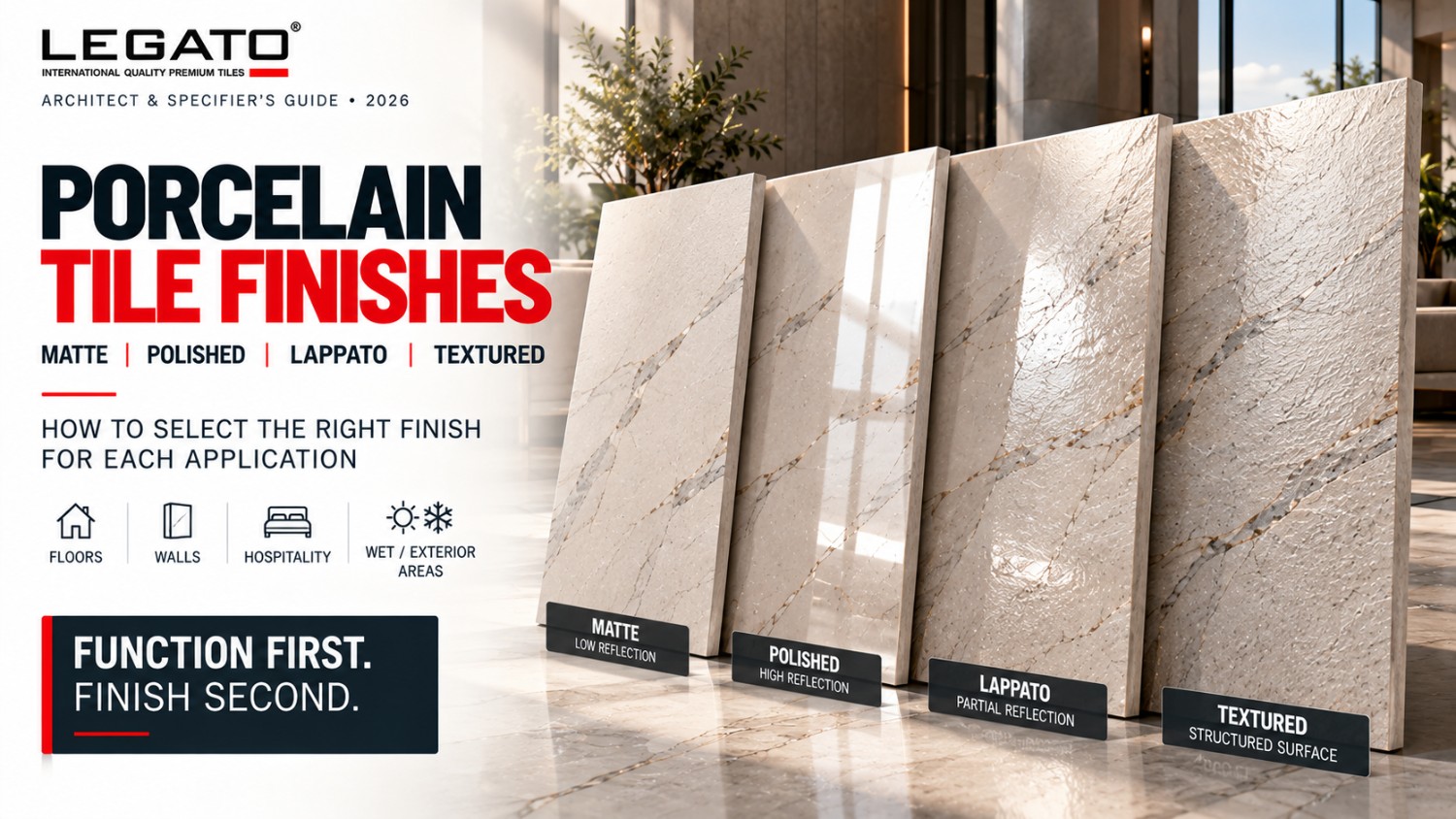
Quick answer: Select porcelain tile finishes by defining the application requirements before choosing the appearance. For flooring, review the applicable slip-performance classification, expected traffic, abrasion performance, maintenance conditions and environmental exposure. Different porcelain tile finish types can perform differently from product to product, so finish names alone should not be used to predict slip or wear performance. Confirm the exact product’s declared technical performance and intended area of use before finalising the specification. The key specification question is whether the selected finish has suitable performance characteristics for its intended application.
Why Porcelain Tile Finish Selection Is a Performance Decision, Not Just a Design One
Porcelain tile finishes influence surface appearance, reflectivity, cleaning characteristics and, depending on the product, underfoot traction. These factors matter differently across dry floors, wet areas, walls, exterior surfaces and façade applications.
Porcelain tile finish selection can create specification problems when appearance is prioritised without confirming performance and maintenance requirements for the intended location.
A polished product selected for a wet floor without suitable wet-use performance data, or a heavily structured surface selected for a frequently cleaned corridor without considering cleanability, can create avoidable specification problems.
What Are the Main Porcelain Tile Finish Types?
Finish terminology varies by manufacturer. These porcelain tile finish types are commonly specified, although terms such as satin, honed, grip and other proprietary finishes may also be used.
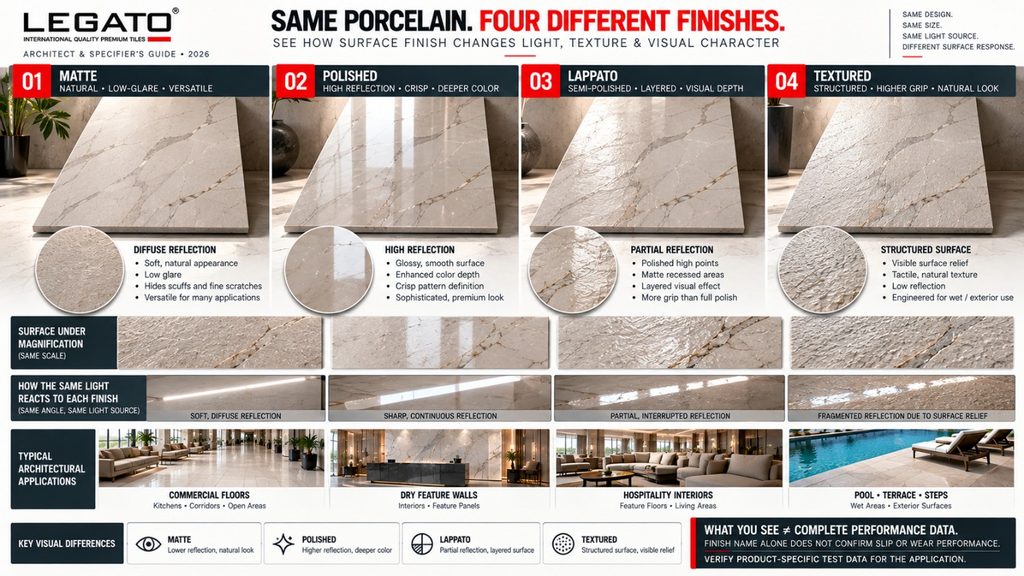
Matte Porcelain Tiles (Natural Finish)
Matte porcelain tiles have a lower-reflectivity appearance than polished surfaces and are widely used for stone-, concrete- and wood-look designs. They can also make minor scuffs or surface marks less visually prominent than highly reflective finishes. Slip performance, however, varies by product and surface structure, so buyers should confirm the tested or declared performance of the exact tile rather than assuming it from the word “matte.”
Common applications include:
residential and commercial floors, kitchens, corridors and large open areas, provided the selected product meets the required slip, abrasion and maintenance criteria for the project.
Polished Porcelain Tiles
Polished porcelain tiles are mechanically ground and polished after firing to create a smooth, highly reflective surface that can emphasise colour depth, veining and pattern. Depending on the product, polishing can also affect slip performance and make certain surface marks more visible, so floor suitability should be confirmed using the manufacturer’s declared area of use and applicable technical data.
Common applications include:
interior walls, feature surfaces and selected interior floors where the exact product’s declared performance and maintenance requirements suit the intended use.
Lappato Porcelain Tiles (Semi-Polished Finish)
A lappato finish, also described as semi-polished, combines areas of higher and lower reflectivity, creating a more varied visual effect than a uniformly polished surface.
Slip and abrasion performance can vary significantly between products, so lappato should not automatically be assumed to provide performance between matte and polished finishes. Confirm the exact product’s technical data for the intended application.
Common applications include:
feature floors, walls and hospitality interiors where the selected product’s declared slip, abrasion and maintenance characteristics suit the intended use.
Textured / Structured Finish
Structured or textured finishes use a more pronounced surface profile and are commonly considered for applications where additional traction may be required. However, texture alone does not establish suitability for wet, exterior or inclined surfaces. Confirm the applicable slip-performance classification, drainage conditions, maintenance requirements and manufacturer guidance for the exact product.
Common applications may include:
wet, exterior or higher-traction environments, provided the exact product meets the applicable slip-performance, drainage, maintenance and project requirements.
Which Slip-Resistance Standards Apply to Porcelain Tile Finishes?
Slip-performance requirements can differ by market, test method and application. Understanding which system applies helps project teams evaluate technical data correctly during specification and sourcing.
EN 16165 Slip-Resistance Methods
EN 16165 provides European test methods for determining the slip resistance of pedestrian surfaces. Annex B contains the shod-foot ramp method based on the earlier DIN 51130 procedure, while Annex A covers the wet-barefoot ramp method based on the earlier DIN 51097 procedure. In Germany, R9–R13 and A–C classifications continue through national provisions, but these classifications should not be treated as universal application rules across Europe.
| Method | What it evaluates | Relevant context |
| EN 16165 Annex A | Wet-barefoot ramp performance | Pool areas, communal showers and similar barefoot environments |
| EN 16165 Annex B | Shod-foot ramp performance | Flooring evaluated for use with footwear |
| ANSI A326.3 | DCOF and product-use classification | North American hard-surface flooring |
A higher R-number is not automatically “better.” It represents a higher slip-resistance classification under defined ramp-test conditions and should not be treated as a general quality score.
A higher slip-resistance classification is not automatically better for every project. Surface profile, cleaning requirements, contaminants and intended use should be considered together when selecting flooring.
ANSI A326.3: DCOF and Product-Use Classification
ANSI A326.3 provides a standardized method for measuring the dynamic coefficient of friction (DCOF) of hard-surface flooring and includes product-use classifications that help communicate intended areas of use.
| Classification | Code | Criterion |
| Interior, Dry | ID | ≥ 0.42 dry DCOF |
| Interior, Wet | IW | ≥ 0.42 wet DCOF, or manufacturer-declared |
| Interior, Wet Plus | IW+ | Manufacturer-declared (higher-traction wet interiors) |
| Exterior, Wet | EW | Manufacturer-declared |
| Oils/Greases | O/G | Manufacturer-declared |
Meeting a 0.42 DCOF criterion alone does not establish that a surface is suitable for every application. Project conditions such as traffic, contaminants, maintenance, drainage and manufacturer guidance should also be considered. In addition, ANSI A326.3’s five product-use classifications do not address ramps or inclined surfaces.
Why this matters for cross-border sourcing
R-classifications and DCOF results come from different test methods and should not be treated as directly equivalent or converted into one another for specification purposes. For cross-border projects, request the test information and classification required by the relevant project specification or destination market rather than assuming that one system satisfies another.
How Should Abrasion Resistance Be Evaluated?
Abrasion performance should be evaluated according to the tile surface and intended traffic. Within the ANSI A137.1 framework for glazed floor tile, visible-abrasion classes indicate the maximum recommended level of use. These classes are sometimes referred to commercially as “PEI ratings.” Unglazed products use different abrasion evaluation methods, so this classification should not be applied universally to every porcelain product.
| Visible Abrasion Class | Maximum Recommended Use |
| Class 0 | Not recommended for floors |
| Class I | Light residential |
| Class II | Residential |
| Class III | Heavy residential or light commercial |
| Class IV | Commercial |
| Class V | Heavy commercial |
Slip performance and abrasion resistance address different aspects of floor performance. A product may meet the required slip classification but still be unsuitable for the expected traffic level. For glazed floor tile, confirm the applicable visible-abrasion class; for other surface types, review the relevant abrasion data provided for the product.
Does Water Absorption Determine Finish Suitability?
Water absorption is an important product-classification characteristic. Porcelain tile is generally defined by water absorption of 0.5% or less. However, water absorption alone should not be used to determine frost resistance, exterior suitability or wet-area suitability. Confirm the manufacturer’s declared area of use and the applicable performance requirements for the exact product and project conditions.
How Does Shade Variation Affect Porcelain Tile Finish Selection?
ANSI A137.1 uses aesthetic classes V0–V4 to communicate visual variation. Manufacturers may also use other shade-variation terminology, so confirm the classification system used in the product documentation.
| V-Rating | Shade Variation | Design Consideration |
| V0 | Very uniform | Monochromatic or highly consistent appearance |
| V1 | Minimal | Near-uniform appearance |
| V2 | Slight | Controlled variation between pieces |
| V3 | Moderate | Clearly visible variation between individual pieces |
| V4 | Substantial / Random | Strong intentional variation between individual pieces |
On large-format products, visual variation can become more noticeable because fewer joints interrupt the surface. For stone-look or visually varied large-format products, review full-panel samples where practical and confirm relevant batch or shade-variation information before approval.
When specifying visually varied large-format products, review the declared V-rating or equivalent shade-variation information where available, and view full-panel samples where practical.
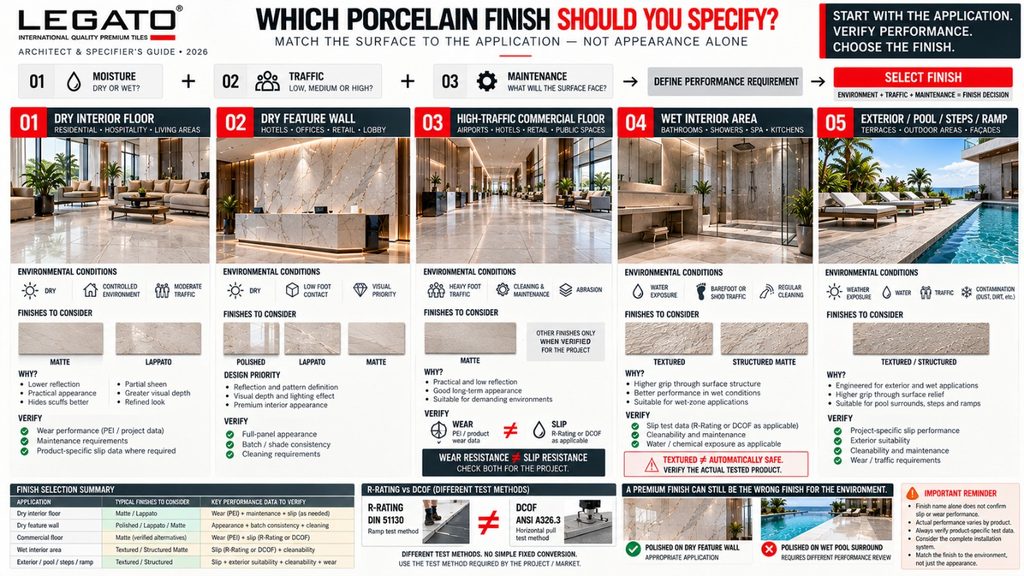
Which Porcelain Tile Finishes Should You Choose by Application?
| Application | Finish Options to Consider | Performance Check |
| Dry residential floors | Matte porcelain tiles, lappato porcelain tiles or other suitable floor finishes | Confirm manufacturer floor suitability and abrasion performance |
| Kitchens | Matte porcelain tiles or other suitable floor finishes | Confirm slip, abrasion, contaminants and cleaning requirements |
| Bathrooms | Products suitable for the specific wet-floor condition | Confirm applicable wet-use slip classification and maintenance requirements |
| Shower / barefoot wet zones | Products with documented suitability for the specific barefoot wet condition | Confirm applicable wet-barefoot classification and project requirements |
| Feature walls / dry interior cladding | Polished porcelain tiles, lappato porcelain tiles, matte finishes or textured products | Focus on appearance, maintenance and installation requirements |
| Large-format façade panels | Finish according to design and façade system | Confirm exposure, façade-system requirements and product suitability |
| Pool surrounds / exterior wet areas | Products approved for the specific wet/exterior condition | Confirm applicable wet/exterior performance, drainage and project requirements |
Do not treat R-classifications and ANSI A326.3 product-use classifications as direct equivalents. They come from different test and classification systems.
How Does Large Format Affect Porcelain Tile Finish Selection?
Where a project specifies large-format porcelain slabs rather than smaller-format tile, finish selection interacts with panel size and joint density. With fewer grout joints interrupting the visual field, differences in gloss, texture or shade may become more noticeable across large-format installations.
For large-format projects, review the manufacturer’s available finish-consistency, shade and batch information. Where gloss or texture consistency is visually critical, review full-panel samples or representative production material where practical before final approval.
A Specifier’s Checklist Before Finalising Porcelain Tile Finishes
Before selecting among porcelain tile finish types for a project specification, confirm all six of the following are documented, not assumed:
Slip performance — Confirm the applicable slip-performance test or product-use classification for the actual project conditions. Do not treat R-classifications and ANSI A326.3 product-use classifications as interchangeable.
Abrasion performance — For glazed floor tile, review the visible-abrasion classification; for other products, confirm the applicable abrasion data for the surface and expected traffic.
Water absorption and area of use — Verify the declared water-absorption value and confirm that the exact product is approved for the intended interior, exterior, wet or freeze-thaw application.
Shade and visual variation — Review the declared variation and representative samples, particularly for large-format or continuous installations.
Edge and dimensional characteristics — Confirm rectification, dimensions, joint requirements and installation pattern using the product’s technical documentation and project specification.
Test documentation — Confirm that the submitted technical data and test methods are accepted by the project specification and destination market. Where standards have changed, verify whether the available reports remain acceptable for the project.
Together, these checks help ensure that porcelain tile finish selection reflects both the design intent and the technical requirements of the application.
Common Specification Mistakes
Selecting a finish from appearance alone without confirming the exact product’s declared performance and area of use.
Treating R-classifications and ANSI A326.3 product-use classifications as directly interchangeable.
Using a shod-foot R-rating as the only basis for a barefoot wet-area specification.
Assuming low water absorption alone confirms exterior, frost or wet-area suitability.
Treating finish names such as matte, polished or textured as substitutes for actual slip or abrasion data.
Assuming a manufacturer-declared classification automatically represents independent third-party testing without checking the basis of the declaration.
Frequently Asked Questions (FAQs)
What should architects consider when selecting a finish for commercial flooring?
Start with the required slip performance, abrasion resistance, expected traffic, contaminants, cleaning regime and manufacturer-declared area of use. Matte finishes are common in commercial projects, but suitability should be confirmed for the exact product rather than assumed from finish name alone.
How should architects choose between matte porcelain tiles, polished porcelain tiles and lappato porcelain tiles?
The decision should start with traffic, moisture exposure and maintenance requirements. Once slip resistance and wear performance are verified, the finish can be selected based on the project’s aesthetic objectives.
Why do finish-related specification errors occur on large projects?
Finish-related specification errors can occur when appearance is prioritized without first confirming the performance requirements of the intended application. A finish that looks appropriate in a showroom may not satisfy slip-resistance, maintenance, or durability requirements once installed in the intended environment.
Does tile size affect finish selection?
It can. On large-format porcelain slabs, fewer grout joints may make differences in surface texture, gloss and reflected light more visually noticeable.
5: What finish is typically recommended for wet architectural applications?
Wet architectural applications require products with suitable slip performance for the actual use condition. Structured or textured surfaces may be appropriate, but selection should also consider footwear or barefoot use, drainage, contaminants, maintenance requirements and the applicable project classification.
Why should buyers request both slip-resistance and wear-performance data?
Slip ratings and wear ratings measure different properties. A finish can provide excellent traction but insufficient abrasion resistance, or vice versa. For flooring applications where both traction and wear are relevant, slip-performance and abrasion data should be reviewed separately before approving the specification.
What should procurement teams evaluate before selecting a porcelain tile finish supplier?
Beyond finish appearance, buyers should verify slip-resistance testing, wear ratings, water absorption data, shade variation classifications, and technical documentation. Legato Porcelano supports procurement teams with application-specific finish recommendations and documented performance data for international projects.
How can architects reduce finish-selection risks on large-format porcelain projects?
Reviewing full-panel samples, technical test reports, and project-specific performance requirements before specification helps prevent costly revisions later. Legato Porcelano’s technical team assists architects in matching finish characteristics to application, traffic conditions, and regional compliance requirements.
Key takeaway:
Porcelain tile finish types such as matte, polished, lappato and textured describe surface character. These porcelain tile finishes do not independently determine slip performance, abrasion resistance or application suitability. Select the finish after confirming the performance requirements and technical data for the exact product and intended use.
Conclusion
Porcelain tile finishes should not be selected on appearance alone. Start by defining the performance requirements for the application, then compare matte, polished, lappato and textured products that meet those requirements. Slip performance, abrasion resistance, maintenance, environmental exposure and manufacturer-declared area of use should be reviewed independently rather than inferred from a finish name.
For international projects, confirm the test methods and classifications required by the destination market instead of treating R-classifications and ANSI A326.3 product-use classifications as direct equivalents.
