Nairobi’s skyline has changed faster than its building-materials supply chain has caught up. Apartment towers in Kilimani and Kileleshwa now specify large-format porcelain where 600×600mm ceramic was standard a decade ago. Mombasa’s hotel pipeline demands slip-rated outdoor tile that can survive salt air and daily pool traffic. Kampala, Dar es Salaam, and Kigali are following the same trajectory, a few years behind.
None of this supply comes from within the region. Kenya, Tanzania, and Uganda import nearly all of their porcelain tile, and the sourcing decision — India, China, or Spain — shapes a project’s cost, timeline, and finish quality more than almost any other single choice a developer makes.
Legato Porcelano works as a porcelain tiles exporter to Kenya and the wider East African region, manufacturing from Morbi, Gujarat. This guide reflects what that export experience has surfaced: which sizes actually move, what KEBS clearance really requires, and where importers lose money without realizing it.
Quick Summary
This guide covers:
- Why East Africa’s porcelain demand is shifting toward large-format tile faster than most suppliers expect.
- How India, China, and Spain compare as sourcing origins for Kenya and East Africa specifically.
- Which sizes and designs Kenyan, Tanzanian, and Ugandan projects specify most.
- What KEBS certification actually requires, and where shipments get stuck at customs.
- What East African Community tariff rules mean for a multi-country distributor.
- What separates a reliable exporter from a risky one, beyond price per square metre.
- What shipping to Mombasa and Dar es Salaam involves, port to site.
Why East African Porcelain Demand Is Shifting Toward Large-Format Tile
Nairobi’s Mid-Rise Boom Rewards Cost-Efficient Premium Finishes
Nairobi’s residential construction has grown at a pace few East African cities match, driven by a growing middle class buying into apartment developments rather than standalone houses. Developers compete on finish quality within a fixed unit price, and porcelain tile gives them a stone-like look without stone’s cost or weight.
Coastal Humidity Makes Water Absorption a Real Performance Issue, Not a Spec Sheet Number
Mombasa’s coastal humidity and salt-air exposure punish lower-fired ceramic and cement tile within a few years — cracking, efflorescence, and colour fade show up fast. Porcelain’s sub-0.5% water absorption isn’t a marketing figure here; it’s the difference between a floor that lasts and one that needs replacing within five years.
Kenya Functions as a Distribution Hub, Not Just an End Market
A container landing at Mombasa rarely stays in Kenya alone. Nairobi-based distributors routinely re-sell into Uganda, Tanzania, Rwanda, and South Sudan, which means the buyer evaluating a supplier in Nairobi is really evaluating a regional supply chain, not a single national market.
Hospitality Development Sets the Design Ceiling for the Region
Coastal resorts and Nairobi’s expanding hotel sector specify the highest design tier in the market — large-format marble-look tile, rectified edges, documented slip ratings. What hospitality projects specify this year tends to filter down into premium residential specification within two to three years, which makes the hospitality segment worth watching even for a distributor who mainly sells volume residential tile.
Industry insight
The single biggest cost lever in East African tile sourcing isn’t the factory price — it’s wastage from poor dimensional tolerance. A tile priced 8% cheaper but running ±1.5mm out of caliber tolerance can cost more once you count the extra cutting, the extra boxes ordered to cover breakage, and the labour hours lost to fitting mismatched pieces.
Sourcing Comparison: India, China, and Spain for East Africa
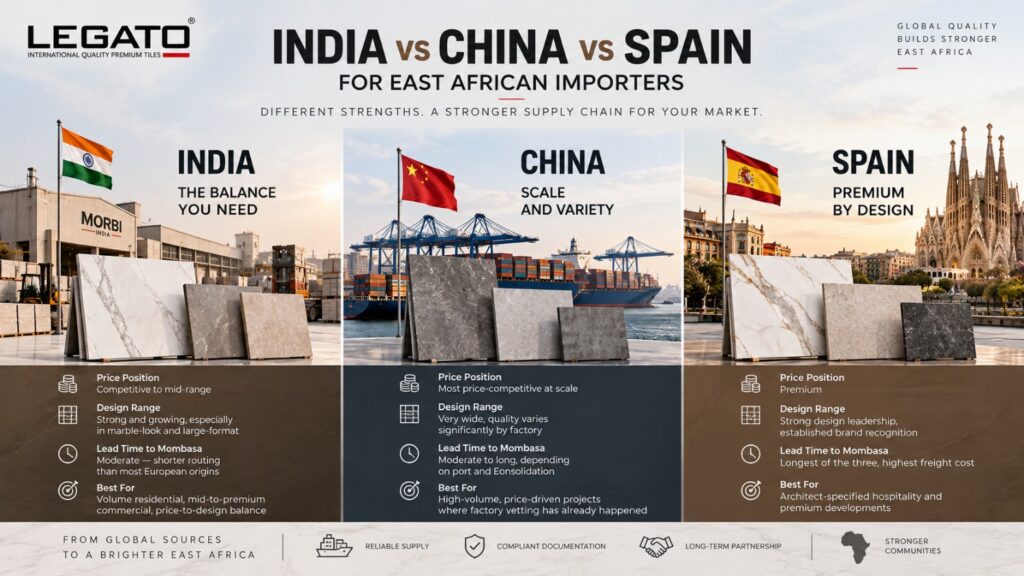
| Origin | Price Position | Design Range | Typical Lead Time to Mombasa | Where It Fits Best |
|---|---|---|---|---|
| India | Competitive to mid-range | Strong and growing, particularly in marble-look and large-format | Moderate — shorter routing than most European origins | Volume residential, mid-to-premium commercial, distributors wanting price-to-design balance |
| China | Most price-competitive at scale | Very wide, quality varies significantly by factory | Moderate to long, depending on port and consolidation | High-volume, price-driven residential projects where factory vetting has already happened |
| Spain | Premium | Strong design leadership, established brand recognition | Longest of the three, highest freight cost per container | Architect-specified hospitality and premium developments where design pedigree justifies the cost |
The sourcing decision should follow the project brief, not a blanket preference for one country. A distributor stocking for the volume residential market and a hotel group specifying a signature lobby floor are solving different problems, and the right origin country differs accordingly. What stays constant across all three origins: verify KEBS-aligned documentation and confirm actual production capability before committing to a container, regardless of which country the factory sits in.
Which Porcelain Tile Sizes Do East African Projects Specify?
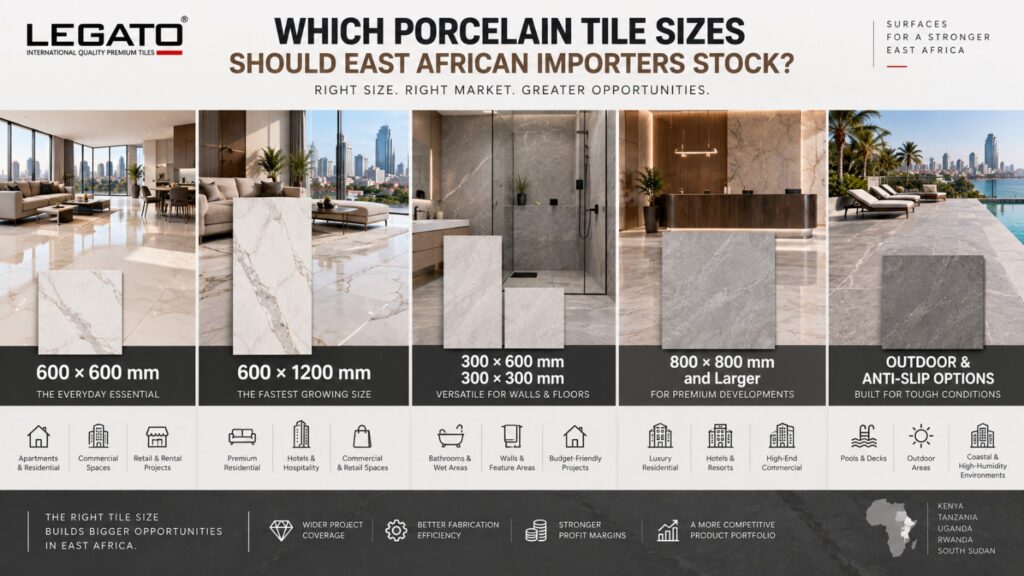
| Size | Best For | Why It’s Specified |
|---|---|---|
| 600×600mm | Mid-range residential, general commercial | Cost-effective, easy to handle and install |
| 600×1200mm | Premium residential, contemporary commercial | Large-format look, fewer grout lines |
| 300×600mm / 300×300mm | Bathroom walls, kitchen splashbacks | Standard budget-tier wall application |
| 800×800mm+ | Hotels, malls, feature floors | Premium visual statement, highest margin segment |
600×600 mm Porcelain Tiles
Still the volume standard across Kenya, Tanzania, and Uganda. Mid-range residential and commercial fitouts default to this size for a straightforward reason: it balances cost, easy handling, and installation speed for local labour teams who may not have extensive large-format training yet.
600×1200 mm Porcelain Tiles
Demand for this size has grown quickly in Nairobi’s premium residential and commercial segment over the past few years, tracking design trends imported from Gulf and South Asian markets through architects and interior designers who train or work across those regions.
300×600 mm and 300×300 mm Porcelain Tiles
Standard for bathroom walls, kitchen splashbacks, and budget-tier residential projects across the region — a stable, low-drama segment of demand that doesn’t shift much with design trends.
800×800 mm and Larger Formats
Hotels, malls, and premium commercial developments increasingly specify these sizes for lobbies and feature floors. This remains a smaller volume segment than 600×600mm or 600×1200mm, but it commands the highest margin and the most demanding technical requirements — flatter subfloors, trained installation crews, and documented slip ratings.
Common Mistake
ordering a container based on price per square metre alone, without checking dimensional tolerance and rectification quality. Lower-grade porcelain often runs wider tolerance, which increases cutting waste, slows installation, and creates visible lippage between tiles that a client will notice on day one.
Popular Porcelain Tile Designs for East Africa
Marble-Look and Stone-Look Designs Lead Premium Projects
Calacatta and Carrara-style marble-look tile dominates the premium residential and hospitality segment across Nairobi and Mombasa. Stone-look and travertine-look designs suit outdoor pool decks and hotel courtyards common along the coast, where the aesthetic needs to read as natural stone under bright equatorial light.
Wood-Look and Solid Colours Serve the Volume Market
Wood-look porcelain appears frequently in mid-range residential flooring, giving a warmer look than plain ceramic at a comparable price point. Solid beige, grey, and cream tones remain the default choice for cost-driven commercial and residential projects, where the tile needs to disappear into the background rather than compete with furnishings.
Legato Porcelano supplies its large-format porcelain slabs in marble-look, wood-look, and stone-look designs across both premium and volume segments, produced to the same body specification regardless of size.
Finish Selection for East Africa’s Climate
East Africa splits broadly into humid coastal zones and drier highland regions like Nairobi, and finish choice should follow that split rather than a single regional default.
| Finish | Recommended Areas | Note |
|---|---|---|
| Glossy / polished | Indoor living areas, retail interiors | Common in showroom-driven markets; avoid in wet or outdoor zones |
| Matt | General residential and commercial floors | Lower maintenance, safer underfoot in everyday use |
| Textured / anti-slip | Pool decks, hotel courtyards, outdoor coastal areas | Non-negotiable for coastal hospitality given pool and monsoon-season exposure |
| Structured stone-look | Hotel exteriors, feature walls | Holds colour well under strong, sustained equatorial sun |
Common mistake: specifying a glossy finish for a coastal hotel pool deck because it photographed well in a catalogue. Wet, glossy porcelain becomes a genuine liability around pools and outdoor showers, and it’s one of the more common post-installation complaints in coastal hospitality projects.
What Compliance Standards Matter for Kenya and East Africa?
KEBS Certification Governs the Kenyan Market
The Kenya Bureau of Standards (KEBS) requires imported ceramic and porcelain tiles to carry a Standardization Mark or comply with the Pre-Export Verification of Conformity (PVoC) programme before customs clearance. KEBS references international ceramic tile standards for water absorption, breaking strength, and dimensional tolerance, closely aligned with ISO 13006.
Confirm your exporter can supply KEBS-compliant test documentation and, where required, a Certificate of Conformity issued before shipment. Missing this paperwork is the single most common cause of customs delays for tile shipments arriving at Mombasa — and it’s entirely avoidable if confirmed before the container leaves the origin port.
EAC Common External Tariff Applies Across the Region
Kenya, Tanzania, Uganda, Rwanda, Burundi, and South Sudan operate under the East African Community’s Common External Tariff. Ceramic and porcelain tiles typically fall under Harmonized System code 6907. Confirm current duty rates with a licensed clearing agent, since EAC tariff schedules and exemptions shift periodically.
Tanzania and Uganda Apply Separate National Verification Requirements
Tanzania requires goods to comply with the Tanzania Bureau of Standards PVoC programme, structured similarly to Kenya’s KEBS system. Uganda applies its own standards through the Uganda National Bureau of Standards. A distributor selling across multiple East African countries needs sign-off from each destination’s standards body — Kenyan clearance does not carry over to Tanzania or Uganda.
What Separates a Reliable Exporter From a Risky One
Price per square metre tells you almost nothing about whether a shipment will clear customs on schedule or arrive intact. These are the checks that actually predict a smooth import:
- KEBS or relevant national test documentation, confirmed and in hand before the shipment leaves origin, not promised for “after arrival.”
- Batch consistency across shade and caliber — ask how the factory manages this at scale, not just whether it does.
- MOQ terms that match your real order volume, so you’re not carrying excess stock to hit a discount tier.
- Physical sample approval, since fired porcelain colour reliably differs from a digital catalogue image, sometimes significantly.
- Packaging built for the specific route, since Mombasa and Dar es Salaam handling conditions differ from a European or Gulf port.
- Manufacturer status, not a trading company — a direct manufacturer gives you pricing transparency and a factory you can actually hold accountable for a quality issue.
A supplier who answers all six of these without hesitation is worth a real relationship. A supplier who deflects on documentation or batch consistency is a red flag worth acting on before signing, not after the container ships.
Shipping Porcelain Tiles to Mombasa and Dar es Salaam
Ports and Routing
Mombasa serves as Kenya’s primary import port and the main entry point for tile distributed across much of East Africa. Dar es Salaam serves Tanzania directly and provides an alternate route into landlocked Uganda, Rwanda, and Burundi through inland transport corridors.
Transit Times and Container Planning
Sea freight from Indian ports like Mundra or Nhava Sheva to Mombasa generally takes a few weeks, with exact timing depending on the shipping line and any transshipment stops en route. Get a current transit estimate directly from your freight forwarder — general industry figures shift with fuel costs and route congestion more than buyers expect.
Packaging and Documentation
Reinforced cartons on wooden pallets remain standard, with extra corner protection worth requesting given handling conditions at some regional ports. Every shipment needs a complete commercial invoice, packing list, certificate of origin, and KEBS or relevant national conformity documentation before departure — not after the container is already at sea.
Incoterms and Customs Clearance
FOB and CIF remain the most common terms in East African tile export contracts. This choice decides who arranges and insures the sea-freight leg, so clarify it before agreeing on price, not after a dispute over a damaged shipment. A good clearing agent at Mombasa or Dar es Salaam will flag documentation gaps before the ship even docks, which is worth paying for over a cheaper agent who only reacts once cargo is stuck.
Why Legato Porcelano for a Kenya or East Africa Project
Legato Porcelano manufactures from Morbi, Gujarat, a global porcelain tile hub with established export routes into East Africa. That matters for buyers who need consistent supply across multiple markets in the region, not just a single one-off shipment.
What to Verify Against Any Supplier, Including Legato
- Manufacturer status, not a trading company, for direct pricing and production control.
- KEBS-aligned test documentation, including water absorption and breaking strength data available on request.
- Production range covering both 600×600mm volume sizes and 600×1200mm large-format tile from the same facility.
- Export packaging suited to the Mombasa and Dar es Salaam routes, with reinforced protection matched to the transit distance involved.
Legato’s export team works directly with Kenyan, Tanzanian, and Ugandan importers on documentation, sizing, and shipment timing before a container gets committed.
FAQ’s
600×600 mm remains the volume leader across Kenya, Tanzania, and Uganda, while 600×1200 mm continues gaining market share in premium residential, hospitality, and commercial developments.
Developers increasingly prefer large-format tiles because they create a more premium appearance, reduce grout lines, and help residential and commercial projects compete with higher-end developments.
Many buyers focus on factory pricing while overlooking dimensional consistency, compliance documentation, and packaging quality, which often have a greater impact on project costs and customer satisfaction.
Matt and anti-slip finishes perform well in everyday residential and commercial applications, while textured finishes are preferred for coastal hospitality projects exposed to moisture and heavy foot traffic.
Consistent sizing and rectification reduce installation issues, minimize material wastage, and improve project outcomes. Poor dimensional tolerance often leads to lippage, additional cutting, and installer complaints.
Importers should confirm KEBS-related conformity documentation, commercial invoices, packing lists, certificates of origin, and relevant technical test reports before the shipment leaves the origin port.
Reliable exporters demonstrate manufacturing capability, documentation readiness, batch consistency, and export experience. Legato Porcelano supports East African buyers with product selection, compliance documentation, and shipment planning before container booking.
Product selection should balance regional demand, inventory turnover, and compliance requirements. Legato Porcelano’s export team helps distributors choose suitable sizes, finishes, and collections for Kenya, Tanzania, Uganda, and neighboring markets.
Final Thoughts
Sourcing porcelain tile for Kenya and East Africa comes down to three decisions, not one. Pick the right origin country for the specific project, not a default habit. Confirm the exporter can supply KEBS or relevant national documentation before the container leaves origin. Match the size and design range to what the local market — from 600×600mm volume tile to 600×1200mm large-format — actually specifies right now, not what it specified five years ago.
Buyers who lock down these three decisions upfront avoid the failures that repeat across the region: containers stuck at Mombasa over missing paperwork, and floors that need replacing years early because the tile never suited the climate it landed in.
Legato Porcelano’s export team can help you work through sourcing, sizing, and documentation for a Kenya or East Africa project before you commit to an order.
