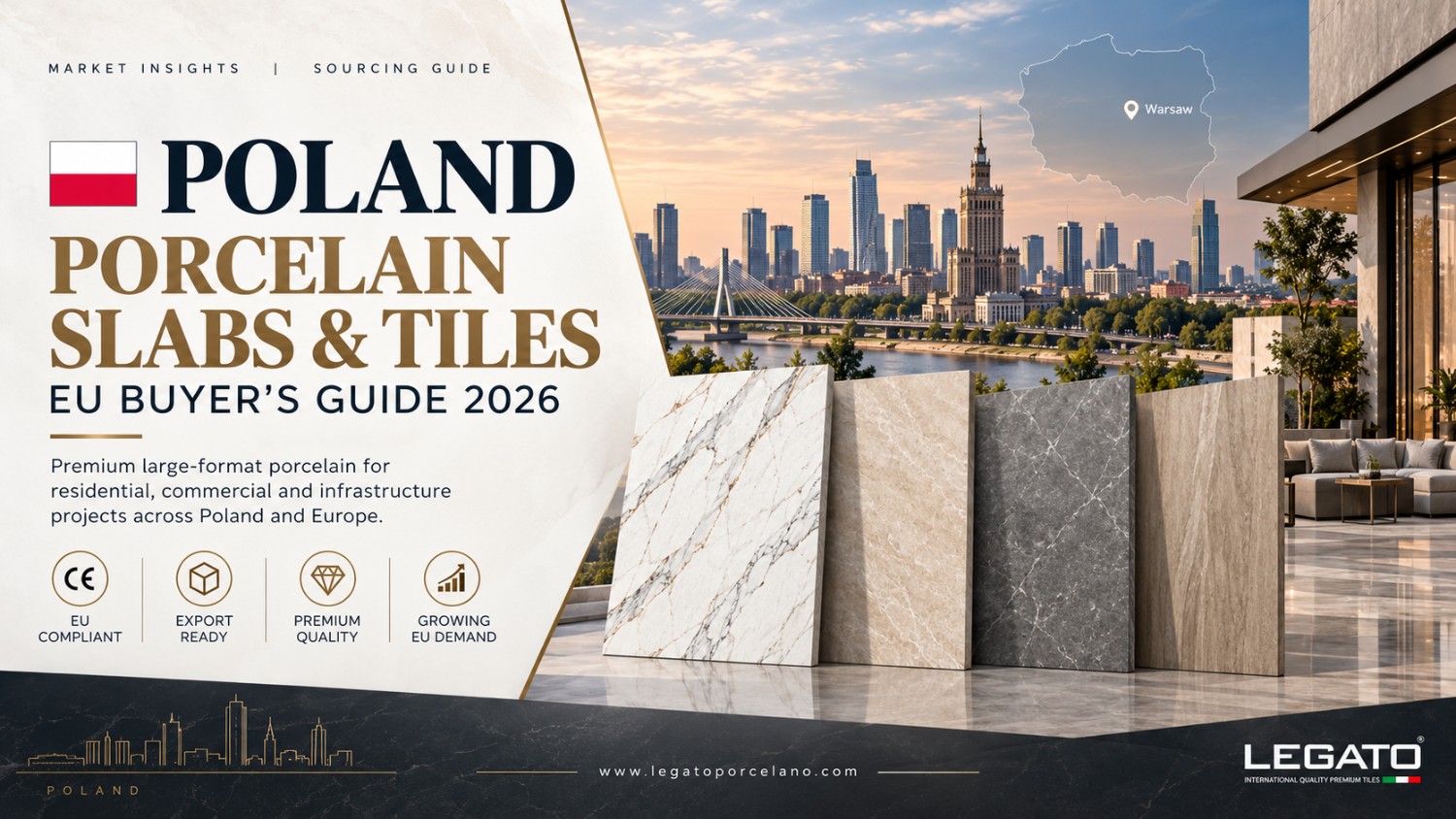
Poland’s construction sector keeps expanding. Warsaw’s office towers, Kraków’s residential boom, and Gdańsk’s logistics hubs all need durable, modern surface materials. Porcelain slabs and large-format tiles fit that need. They give architects a seamless look, and they give developers a material that survives Poland’s cold winters and heavy foot traffic.
But Poland sits inside the European Union, and EU sourcing works differently than sourcing for most other regions. Buyers must check CE marking, REACH compliance, and EU customs codes before a single container leaves India. Skip this step, and shipments stall at the port of Gdynia or Hamburg for weeks.
This guide breaks down what Polish importers, distributors, and contractors need to verify before choosing a porcelain slabs and tiles exporter.
Poland also occupies a unique position within the EU supply chain. It borders Germany, sits close to the Baltic shipping lanes, and connects to Western Europe by rail and road. Many importers based in Warsaw or Poznań don’t just supply local projects — they redistribute material across Czechia, Slovakia, and the Baltic states. That means a Polish buyer’s sourcing decision often affects three or four downstream markets at once, which raises the stakes on getting compliance and quality right the first time.
Quick Summary
Sourcing porcelain slabs for Poland involves more than picking a design. Buyers need to confirm EU compliance, evaluate manufacturing standards, and plan logistics through Baltic or North Sea ports.
In this guide, you’ll learn:
- Why Polish developers increasingly specify large-format porcelain over ceramic or natural stone.
- Which sizes work best for Polish residential, commercial, and hospitality projects.
- What CE marking and EN 14411 compliance actually require from a manufacturer.
- How EU customs duty, VAT, and REACH documentation affect landed cost.
- A framework for comparing exporters before you commit to an order.
Why Porcelain Slabs Are Gaining Ground in Poland
Poland’s building sector grew steadily through 2025, driven by residential construction in Warsaw, Wrocław, and Poznań, plus a wave of logistics and warehouse development near the German border. Developers now favor materials that reduce installation time and long-term maintenance costs.
Porcelain slabs answer both needs. A single 1200 × 2400 mm slab covers ground that would need four or five standard tiles. Fewer joints mean less grout to clean and fewer weak points where Poland’s freeze-thaw cycles could cause damage.
Natural stone still holds prestige value in some Polish markets, but it costs more, needs sealing, and varies from batch to batch. Porcelain slabs replicate marble and stone finishes at a lower price point, with far more dimensional consistency.
Residential Developments: Kraków and Wrocław apartment builders specify large-format porcelain for kitchens, bathrooms, and open-plan living areas. Buyers want a contemporary finish that photographs well for resale listings.
Hospitality: Poland’s tourism recovery has pushed hotel groups in Gdańsk and Warsaw toward premium finishes for lobbies and guest bathrooms. Fewer grout lines create a cleaner, more upscale appearance.
Commercial and Office Space: Warsaw’s Mokotów and Wola business districts continue adding office towers. Property managers choose porcelain for lobbies and corridors because it resists wear under constant foot traffic.
Logistics and Retail: Poland’s position as an EU logistics hub means new warehouses and retail parks near Łódź and Poznań. These projects prioritize durability and fast installation over decorative finish.
How Porcelain Slabs Are Manufactured
Understanding the production process helps buyers ask better questions during supplier evaluation. Each stage affects whether a slab arrives flat, consistent, and strong enough to survive a six-week sea journey.
- Raw material blending — clay, feldspar, and quartz get milled into a uniform porcelain body. Poor blending here shows up later as shade inconsistency.
- High-tonnage pressing — large slabs need presses rated well above standard tile capacity. Uneven pressure distribution causes warping that only becomes visible after firing.
- Digital surface printing — high-resolution inkjet technology applies marble, stone, wood, or solid-color finishes with sharp detail and no repeating pattern.
- Kiln firing — porcelain fires above 1,200°C to reach the low porosity that separates true porcelain from standard ceramic under ISO 13006.
- Rectification — precision edge-cutting enables the tight 1.5–2mm grout joints that give large-format installations their seamless appearance.
- Calibration and shade sorting — every slab gets checked for size accuracy and grouped by shade batch, since even small variation becomes visible across a large floor.
- Export packaging — large slabs need reinforced crating and edge protection built specifically for oversized panels, not standard tile boxes.
A manufacturer that controls each of these steps consistently will deliver batches that match from container to container — something Polish contractors need when a project spans multiple phases or floors.
Porcelain Slabs vs. Ceramic Tiles vs. Natural Stone
| Feature | Ceramic Tiles | Natural Stone | Porcelain Slabs |
|---|---|---|---|
| Water Absorption | Higher | Variable | Below 0.5% |
| Grout Joints | More visible | Moderate | Minimal, seamless |
| Freeze-Thaw Resistance | Limited | Variable | Strong |
| Maintenance | Regular sealing needed for some stones | High | Low |
| Batch Consistency | Moderate | Low | High |
| EU Compliance Path | EN 14411 | Varies by quarry | EN 14411 + CE marking |
Polish buyers increasingly choose porcelain slabs because they combine the visual appeal of stone with the durability and consistency that EU building codes reward.
Choosing the Right Size for Polish Projects
Size selection depends on room dimensions, installation crew experience, and project type. The table below reflects sizes commonly specified across Polish residential and commercial projects.
| Tile/Slab Size | Best For | Floor | Wall | Common Projects |
|---|---|---|---|---|
| 600 × 1200 mm | General versatility | ✅ | ✅ | Apartments, offices, retail |
| 800 × 1600 mm | Premium interiors | ✅ | ✅ | Hotels, executive offices |
| 1200 × 1200 mm | Large open floors | ✅ | Limited | Malls, logistics hubs, airports |
| 1200 × 2400 mm | Feature walls, countertops | Limited | ✅ | Hotel lobbies, kitchen worktops |
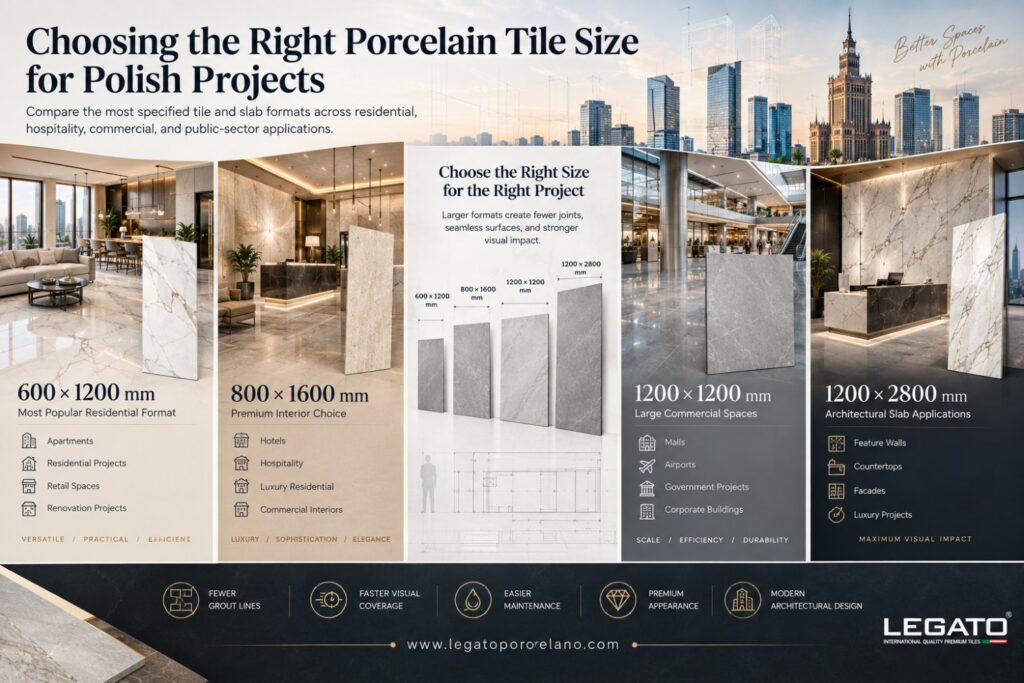
600 × 1200 mm — The Practical Standard
This size handles most Polish residential and commercial jobs without complicating transport or installation. It fits well in apartment renovations, where crews often work in tight stairwells and elevators common in older Kraków or Poznań buildings. A single crate typically holds enough pieces for a full room, which keeps site logistics simple on multi-unit residential builds. Most standard tile cutters and adhesive systems already used across Polish contracting crews work with this size without extra training or equipment.
800 × 1600 mm — Premium Without Complexity
Hotels and executive offices choose this size when they want a high-end look but still need manageable handling logistics. It works well in lobbies and boardrooms. Two installers can lift and set this size without mechanical aids, which keeps installation timelines closer to standard tile projects than to oversized slab work. Warsaw’s boutique hotel renovations have leaned on this format specifically because it delivers a premium finish without extending the construction schedule.
1200 × 1200 mm — Built for Open Floors
Shopping centers and logistics facilities near Poznań and Łódź specify this size for large open floors. The square format reduces cut waste in symmetrical layouts. Its balanced proportions also simplify layout planning for large floor plates, since the tile grid aligns evenly against most standard column spacing used in commercial construction. Facility managers favor this size for warehouse and retail-park floors because fewer joints translate directly into lower long-term cleaning costs across large square footage.
1200 × 2400 mm — For Statement Surfaces
Slabs at this size work best on feature walls, reception counters, and kitchen worktops. Installers need suction lifters and a flatter substrate, so confirm crew experience before ordering. Because a single slab this size can replace an entire wall’s worth of tiles, it eliminates grout lines almost completely, which matters most in luxury bathrooms and hotel reception walls where a seamless look drives the design brief. Transport also needs planning at this scale, since these panels require flat-bed handling and careful crating to prevent flexing during the road leg from a Baltic port to the job site.
CE Marking and EU Compliance: What Polish Buyers Must Verify
The EU treats ceramic and porcelain tiles as construction products under the Construction Products Regulation (CPR). This means every batch entering Poland needs a Declaration of Performance (DoP) and CE marking, tied to the EN 14411 standard for ceramic tiles.
According to the European Commission’s construction products database, manufacturers must test and declare specific performance characteristics before a product carries the CE mark, including water absorption, breaking strength, and slip resistance.
Buyers should ask suppliers for:
- A valid Declaration of Performance referencing EN 14411.
- Test reports for water absorption, PEI rating, and slip resistance.
- REACH compliance documentation confirming no restricted substances in glazes or finishes.
- Confirmation that packaging meets EU labeling requirements.
Skipping this check creates real risk. Polish customs and building inspectors can reject shipments lacking valid CE documentation, and contractors risk fines if uncertified material ends up in a certified building.
Legato Porcelano prepares CE documentation and EN 14411 test reports before shipment, so Polish importers clear customs without last-minute paperwork delays.
Surface Finish Guide for Polish Climate and Use Cases
| Finish | Recommended Areas |
|---|---|
| Matt | Offices, residential floors, retail |
| Polished | Hotel lobbies, luxury residences |
| Anti-Slip (R10/R11) | Entrances, wet areas, exterior terraces |
| Satin | Restaurants, executive spaces |
| Structured/Carving | Feature walls, accent panels |
Poland’s wet winters make slip resistance a real consideration for entrances and outdoor terraces. Confirm the DCOF or R-rating before specifying a finish for exterior or wet-area use.
Factors to Consider Before Placing an Order
Project Scale and Installation
Large slabs create a seamless look but require skilled installers and specialized handling equipment. Site conditions such as doorways, elevators, and access routes should be evaluated before selecting slab sizes.
Long-Term Maintenance
Choose sizes and finishes with long-term production availability, especially for phased developments. This makes future replacements and project expansions easier while maintaining a consistent appearance.
Total Landed Cost
Look beyond the unit price. Freight, insurance, customs duties, VAT, and inland transport all impact the final cost. Reliable packaging, complete documentation, and optimized container loading often provide better overall value than the lowest ex-factory price.
Evaluating a Porcelain Slabs and Tiles Exporter for the Polish Market
Choosing an exporter based on price alone creates problems later. Polish importers should compare suppliers against measurable criteria before requesting quotations.
| Evaluation Area | Question to Ask | Why It Matters |
|---|---|---|
| CE & EN 14411 Compliance | Can they provide a valid DoP for every batch? | Prevents customs rejection at Polish ports |
| Manufacturing Precision | What rectification and calibration process do they use? | Affects grout-joint width and installation quality |
| Export Documentation | Do they handle EORI-linked invoices and certificates of origin? | Speeds EU customs clearance |
| Packaging for Sea Freight | Is packaging rated for the Gdynia or Hamburg-to-Poland route? | Reduces breakage during long transit |
| Communication | Is there a dedicated EU export contact? | Improves coordination across time zones |
Manufacturing Precision
Large-format slabs require strict quality control. Verify the factory’s press technology, kiln process, flatness, and edge accuracy standards. Manufacturers that provide quality-control data are generally more reliable for large-volume orders.
Export Documentation
Accurate HS codes, commercial invoices, certificates of origin, and EN 14411 test reports help avoid customs delays. Suppliers that prepare complete documentation before shipment can significantly reduce clearance issues.
Packaging for Sea Freight
Large-format porcelain slabs travel long distances from India to Poland, making secure packaging essential. Reinforced crates, edge protection, and proper slab securing reduce the risk of damage during sea and inland transport.
Legato Porcelano prepares export documentation in advance and packages large-format slabs specifically for India-to-Europe shipments.
Technical Specifications Polish Buyers Should Confirm
Before finalizing a supplier, verify these specifications against project requirements and EN 14411 thresholds:
- Water Absorption (EN ISO 10545-3): Below 0.5% qualifies as true porcelain under EU standards.
- PEI Rating: Determines wear resistance for residential versus commercial floors.
- Slip Resistance (R9–R11, DCOF): Critical for entrances and outdoor terraces in wet Polish winters.
- Breaking Strength: Matters for high-traffic commercial and logistics installations.
- Thickness Options: Commonly 9mm, 12mm, and 20mm depending on application.
- Frost Resistance: Essential for any exterior application given Poland’s climate.
Logistics: From Morbi to Poland
Most shipments follow a sea-freight route through an Indian port, then a European gateway port, then inland transport by truck or rail. Buyers should ask their exporter to confirm:
- Estimated transit time (commonly six to eight weeks door to door).
- Whether the exporter offers FOB, CIF, or DDP terms.
- Container load optimization to reduce cost per square meter.
- Insurance coverage for the full transit route.
Poland’s inland rail network connects well from Gdańsk and Gdynia, which makes northern port routing efficient for buyers based near Warsaw or central Poland.
Ready to Source Porcelain Slabs for Your Poland Project?
Choosing the right porcelain slabs and tiles exporter means more than comparing a price list. It means confirming CE compliance, checking manufacturing consistency, and planning logistics that survive the India-to-EU journey without damage or delay.
Legato Porcelano works directly with Polish importers, distributors, and contractors, supplying CE-compliant porcelain slabs and large-format tiles backed by EN 14411 test documentation and export packaging built for long sea transit.
Our team can help you:
- Select sizes and finishes suited to your specific Polish project.
- Review CE marking, DoP, and REACH documentation before you order.
- Plan container loads and shipping routes through Gdynia, Rotterdam, or Hamburg.
- Prepare export paperwork that clears Polish customs without delay.
Request a quotation or speak with our export team to discuss your upcoming project in Poland.
Frequently Asked Questions (FAQs)
Gdynia and Gdańsk handle northern Poland directly, while Rotterdam and Hamburg serve as common transshipment points for buyers in Warsaw, Kraków, or Wrocław.
Yes, when packed in reinforced crating designed for oversized panels. Standard tile packaging isn’t sufficient for slabs above 1600mm on a six-to-eight-week transit.
Transit generally runs six to eight weeks door to door, depending on the Indian departure port, the chosen European gateway, and inland transport to the final site.
Proper export packaging is critical for large-format porcelain slabs. Manufacturers such as Legato Porcelano use reinforced export crating, edge protection systems, and container-loading procedures designed specifically for long-distance Europe-bound shipments, helping minimize transit damage.
Yes. Experienced exporters often support buyers throughout the sourcing process, from selecting the right sizes and finishes to preparing technical documentation. Legato Porcelano works with importers, distributors, and project teams by providing guidance on product selection, export documentation, and EU market requirements before shipment.
The most commonly specified sizes are 600×1200 mm, 800×1600 mm, and 1200×2400 mm. The ideal format depends on the project type, installation conditions, and the visual effect architects or developers want to achieve.
Final Thoughts
Poland’s construction sector rewards materials that combine modern design with long-term durability, and porcelain slabs deliver on both counts. But EU sourcing carries a compliance layer that most other export markets don’t require. CE marking, EN 14411 testing, and REACH documentation aren’t optional extras — they determine whether a shipment clears customs or sits at a port.
Buyers who confirm compliance documentation before production begins, evaluate manufacturers against clear technical criteria, and plan logistics for the full India-to-EU journey consistently avoid the delays that catch less-prepared importers off guard.
For Polish importers and contractors sourcing from India, the opportunity is strong. It rewards buyers who treat compliance and manufacturer selection as seriously as design.
