Brand: Legato Porcelano
Category: Bathroom Porcelain Tiles
Reading Time: ~8 Minutes
→ Part of the: Porcelain Tiles for Bathroom — Complete Guide › Modern Bathroom Ideas & Trends › Luxury Bathroom Trends
📌 Part of the Porcelain Tiles for Bathroom Pillar | Related: Spa-Inspired Bathroom Design | Marble Look Bathroom Tiles
Introducation
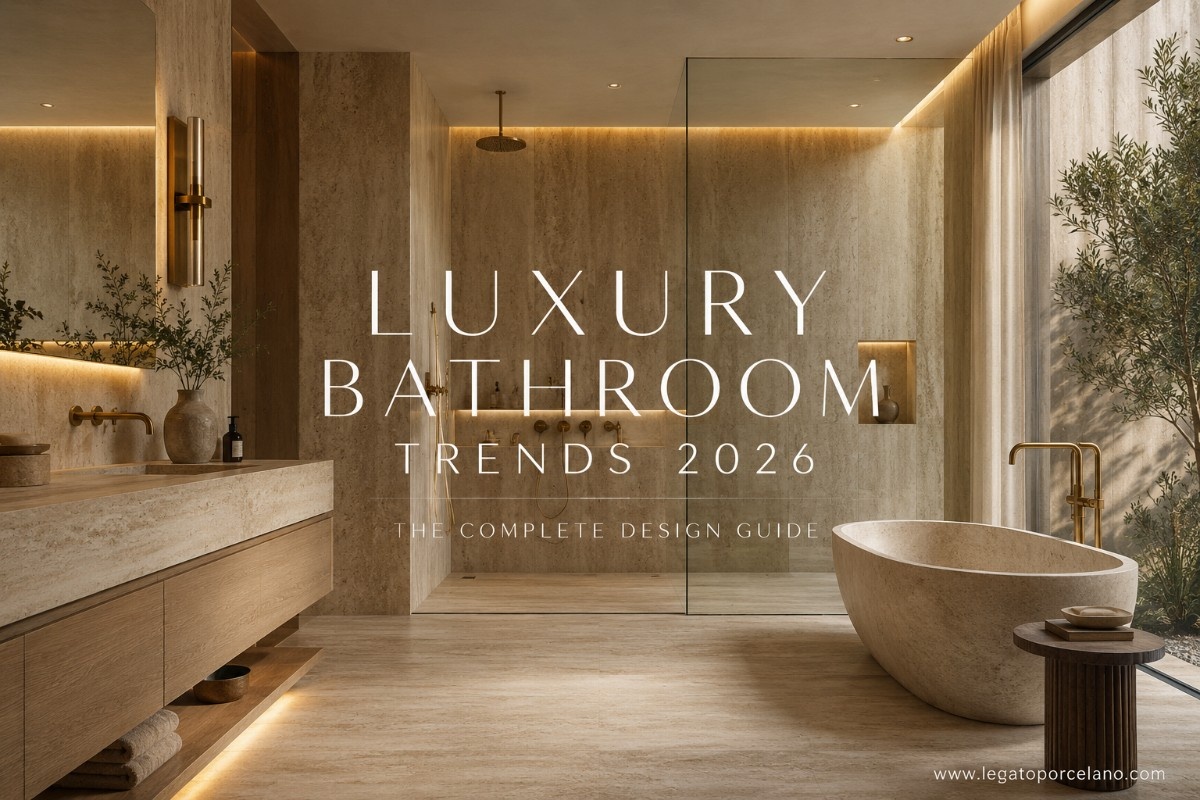
Luxury bathroom trends in 2025–2026 are defined by timeless materials, architectural calm, and refined surface continuity. Premium bathrooms now prioritise large-format porcelain tiles, slab showers, warm metallic finishes, and tactile textures that combine durability with understated luxury.
Instead of trend-driven decoration, modern luxury bathroom design focuses on permanence — spaces designed to feel elegant, functional, and visually relevant for years to come. From sculptural stone-inspired surfaces to seamless spa-like layouts, the new direction of luxury is quieter, warmer, and more materially sophisticated.
THE LUXURY SPECIFICATION IN 2026 — SUMMARISED
Quiet luxury over decorative excess. Stone-look and travertine-look large-format porcelain as the dominant surface. Sculptural fixtures as functional art. Slab showers — seamless, fully tiled, zero grout interruption. Warm unlacquered brass, brushed nickel, or champagne bronze hardware in a single consistent finish. Fluted texture as the primary tactile detail. Indirect layered lighting. Radiant floor heating as baseline expectation.
The New Definition of Luxury: Permanence Over Spectacle
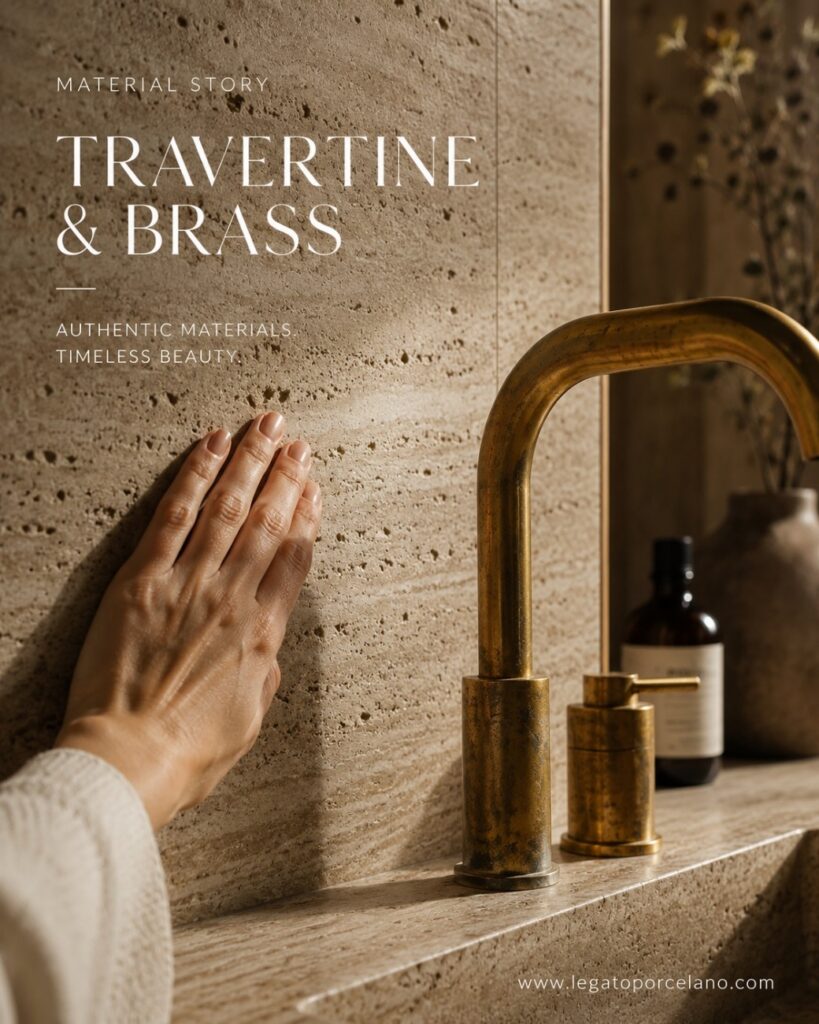
The most consequential shift in luxury bathroom design between 2020 and 2026 is the redefinition of what luxury means at the material level. The previous definition — statement surfaces, bold colour, maximum visual contrast, conspicuous premium materials — has been replaced by a more sophisticated standard: permanence, restraint, and tactile quality.
Per Archi & Interiors’ 2026 market analysis — drawing on professional design consultancy briefings — clients in 2025 and 2026 are not asking for the “cover bathroom.” They are asking for easy life, order, and efficiency. An environment designed to last fifteen to twenty years without looking dated. This is a materially demanding standard. It requires surfaces that age with dignity, finishes that do not follow trend cycles, and a spatial logic that rewards daily use rather than performing for occasional guests.
“Clients no longer ask for the ‘cover bathroom.’ They ask for an easy life, order, efficiency — an environment designed to last 15–20 years without looking dated.”
External References: Archi & Interiors — 2026 Bathroom Trends: Data, Market, Designers | 2025 U.S. Houzz Bathroom Trends Study | Fixr — 2026 Bathroom Design Trends Report (101 Expert Survey)
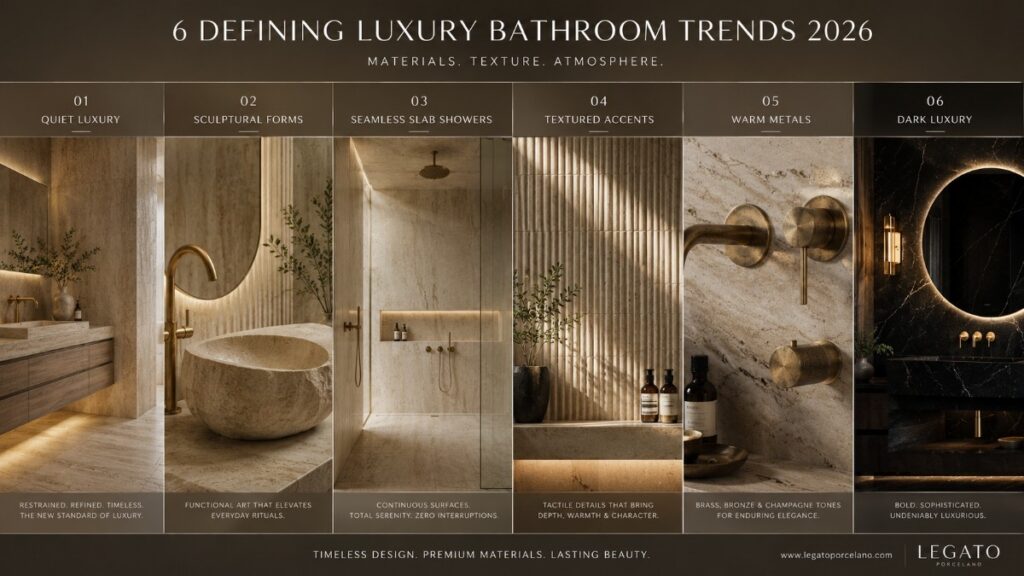
The 6 Luxury Bathroom Trends Defining 2025–2026
Luxury bathroom design in 2025–2026 focuses on timeless materials, architectural calm, and long-term durability rather than trend-driven decoration. Reports from Houzz, Fixr, and Decorilla highlight growing demand for slab showers, fluted textures, sculptural forms, and warm metallic finishes in premium bathroom spaces.
01 · Quiet Luxury — The New Premium Standard
Quiet luxury remains the dominant design direction in high-end bathrooms. Instead of dramatic colour contrasts or ornate detailing, the focus shifts to texture, proportion, and material quality. Warm stone-look porcelain, pale oak cabinetry, brushed brass, and soft indirect lighting create a bathroom that feels calm and deeply considered.
This approach works because every surface contributes to the overall atmosphere. Honed finishes reduce visual noise, while layered textures add depth without overwhelming the space. As a result, bathrooms feel more architectural and less decorative.
Designers also prefer quiet luxury because it ages exceptionally well. Neutral stone palettes and restrained detailing rarely feel outdated after a few years. For that reason, many premium residential projects now follow the same design language seen in boutique hotels and luxury wellness retreats.
→ Internal Link: Spa-Inspired Bathroom Design — The Quiet Luxury Blueprint
→ External Reference: Houzz Bathroom Trends Study
02 · Sculptural Stone — Bathrooms as Architecture
Luxury bathrooms no longer treat stone as background material. Instead, stone becomes the architectural focal point of the room. Sculptural basins, monolithic vanities, and oversized slab-style walls now define premium bathroom design.
Large-format travertine-look and marble-look porcelain help achieve this effect while maintaining long-term durability. Because the veining flows across wider surfaces, the room feels visually continuous and significantly more luxurious.
Moreover, curved forms are replacing sharp geometric edges. Rounded basins, soft organic tubs, and thick stone-inspired counters create a more tactile and emotionally warm environment. Consequently, bathrooms feel less clinical and more restorative.
→ Internal Link: Marble Look Bathroom Tiles — Design & Selection Guide
→ External Reference: Decorilla Bathroom Trends 2026
03 · Slab Showers — Seamless Luxury Surfaces
Slab showers are now considered one of the clearest indicators of premium bathroom specification. Designers increasingly use large-format rectified porcelain tiles to minimise grout lines and create uninterrupted surfaces.
As fewer visual breaks appear across the walls and floor, the shower enclosure feels larger, cleaner, and more sophisticated. In addition, narrow grout joints improve visual continuity and strengthen the spa-like atmosphere homeowners want in 2026.
Many luxury bathrooms now extend the same tile across the shower walls, floor, and adjacent vanity area. This strategy creates a unified architectural envelope rather than separate visual zones.
Built-in benches, recessed niches, and ceiling-mounted rainfall showers further elevate the experience. Together, these elements transform the shower into a wellness-focused retreat instead of a purely functional area.
→ Internal Link: Large Format Bathroom Tiles — Installation & Design Guide
→ External Reference: Fixr Bathroom Design Trends Report
04 · Fluted Texture and Layered Detail
Flat minimalist surfaces are gradually giving way to tactile detailing. Fluted wall panels, relief porcelain, and textured stone-look finishes introduce depth while preserving the calm visual language associated with luxury interiors.
Fluting works particularly well because it interacts beautifully with directional lighting. Wall sconces and concealed LED strips create soft shadow lines that shift throughout the day, making the bathroom feel richer and more dimensional.
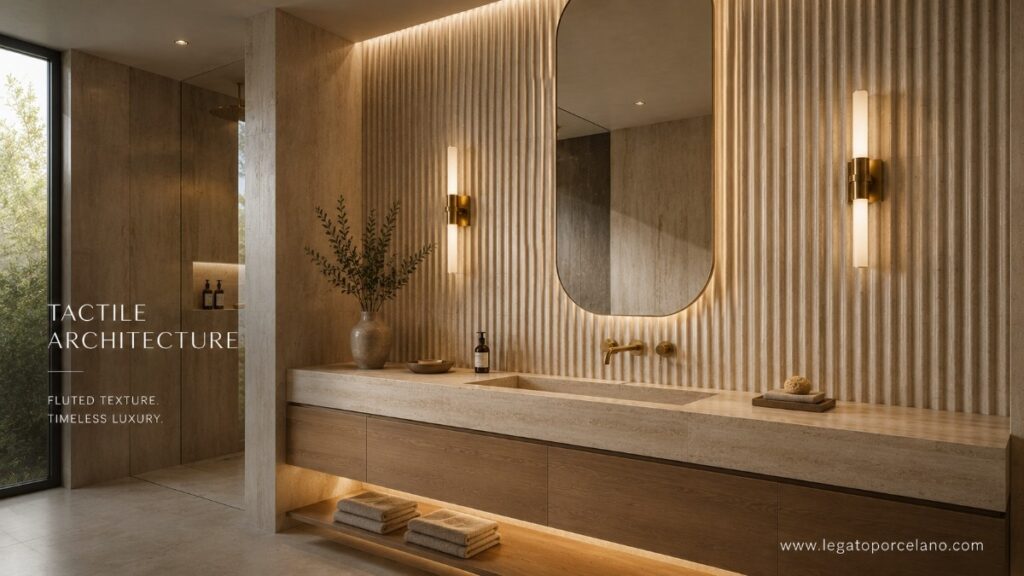
Importantly, this trend does not rely on excessive colour or decoration. Instead, it uses texture to create visual sophistication. Therefore, fluted porcelain becomes an ideal solution for homeowners seeking subtle luxury rather than dramatic statement design.
Designers frequently apply fluted textures to vanity walls, shower feature panels, and niche surrounds to create controlled focal points without overwhelming the space.
→ Internal Link: Fluted Tile Bathroom Design — Feature Wall Guide
→ External Reference: Concept Virtual Design Luxury Tile Trends
05 · Warm Metallic Finishes Replace Stark Contrast
Bathroom hardware is becoming warmer, softer, and more refined. While matte black dominated previous years, 2025–2026 trends strongly favour brushed brass, champagne bronze, warm nickel, and unlacquered brass.
These finishes complement natural stone tones more effectively than colder metals. They also create a softer visual transition between fixtures and surrounding materials. As a result, bathrooms feel more cohesive and inviting.
Unlacquered brass is especially valued in luxury interiors because it develops a natural patina over time. This ageing process adds character and reinforces the idea that premium materials should evolve gracefully rather than remain artificially perfect.
Consistency also matters more than ever. Designers increasingly specify matching finishes across taps, shower frames, handles, and accessories to maintain visual continuity throughout the room.
→ Internal Link: Unlacquered Brass Bathroom Fixtures — Design & Care Guide
→ External Reference: Jane At Home Luxury Bathroom Trends
06 · Dark Luxury — The Sophisticated Counter-Direction
Although warm neutral palettes dominate luxury bathrooms, darker schemes continue to grow at the premium end of the market. Deep charcoal, Nero Marquina-inspired porcelain, forest green, and smoked stone finishes create a dramatic yet highly refined atmosphere.
However, successful dark luxury bathrooms depend heavily on lighting strategy. Instead of harsh overhead lighting, designers use indirect illumination, backlit mirrors, and concealed LEDs to create softness and depth.
Dark surfaces also increase the visual impact of brass fixtures and sculptural forms. Consequently, even minimalist bathrooms can feel emotionally rich and highly cinematic.
When executed correctly, dark luxury creates a sense of privacy and retreat that lighter bathrooms often cannot achieve. That emotional quality explains why this trend continues gaining momentum in high-end residential and hospitality projects.
→ Internal Link: Dark Luxury Bathroom Design — Tile & Specification Guide
→ External Reference: Re-Bath Bathroom Trends 2026
External References: Fixr — 2026 Bathroom Design Trends Report | Decorilla — Bathroom Trends 2026 | Concept Virtual Design — Luxurious Tile Finishes 2026 | Re-Bath / Jenny Marrs — Luxury Bathroom Trends 2026
Luxury Bathroom Material Specification: The Complete Reference
Luxury trends translate into material decisions. The table below maps each design direction to its surface, fixture, and finish specification — for both homeowner and professional use.
| Luxury Direction | Primary Tile | Finish | Key Fixture | Metal |
|---|---|---|---|---|
| Quiet Luxury | Honed travertine-look 60×120 cm, mushroom/sand | Honed / matte — no gloss | Floating vanity, pale oak | Brushed brass or warm nickel |
| Sculptural Stone | Stone-look large format, organic variation, warm beige | Honed — emphasises veining depth | Stone basin, freestanding tub | Unlacquered brass ages with room |
| Slab Shower | Rectified 60×120 cm, same as main bathroom tile | Matte floor, satin/honed walls | Ceiling rainfall, built-in bench | Brushed nickel or champagne bronze |
| Fluted Texture | Fluted limestone-look feature wall panel tile | Matte — catches oblique light | Wall sconces beside mirror | Antique brass or aged bronze |
| Warm Metal / Japandi | Stone-look matte large format, clay/sand tone | Matte throughout | Wall-hung fixtures, pale oak | Brushed brass — consistent finish |
| Dark Luxury | Nero Marquina-look, charcoal stone, deep forest green | Polished on walls, matte on floor | Backlit mirror, deep soaking tub | Aged gold or unlacquered brass |
→ Related reading: Matte vs Glossy Porcelain Tiles — Finish Decision Guide | Large Format Bathroom Tiles — Complete Guide | Modern Bathroom Ideas & Trends 2026
Luxury Tile Specification: What Separates Premium from Standard
Rectified Large-Format as the Baseline
In a luxury bathroom, the tile specification begins at 60×60 cm and typically runs to 60×120 cm or 80×80 cm. Rectified tiles — precision-cut after firing to exact dimensions — allow the narrow grout joints (1.5–3 mm) that produce the seamless surface associated with premium installation. Per ANSI A108 and TCNA Handbook standards, substrate flatness must be within 1/8 inch in 10 feet for tiles with any edge over 15 inches. In a luxury bathroom, this substrate preparation is budgeted for explicitly rather than hoped for — it is the foundation of installation quality that tile cost alone cannot compensate for.
Honed and Satin Finishes — The Luxury Surface Standard
High-gloss tile is not the default luxury finish in 2025 or 2026. Per Concept Virtual Design’s luxury specification guide, honed and satin finishes carry the warmth and tactile quality that define premium surfaces — the sensation of natural stone that has been worked and refined. A honed travertine-look or Calacatta-look porcelain reads as more genuinely luxurious than the same design in high gloss, because it references the material more honestly. Gloss is reserved in luxury bathrooms for specific applications: feature walls, shower back panels, and polished stone-look accent surfaces where light drama is the design intent.
LUXURY SPECIFICATION PRINCIPLE
The mark of a genuinely luxury bathroom is not what materials were used — it is how they were specified. The same tile collection in a luxury bathroom has tighter grout joints, better substrate preparation, matched grout colour, consistent fixture finish, and layered indirect lighting. Material quality and installation precision are both non-negotiable at the luxury tier.
Artisan and Tactile Tile — The Rising Premium Category
Beyond large-format stone-look porcelain, a growing tier of luxury bathroom specification focuses on artisan and tactile tile: handcrafted Zellige-look surfaces with irregular glaze depth, fluted limestone-look relief tiles, textured concrete-look porcelain, and 3D ceramic forms. Per Concept Virtual Design’s 2026 luxury analysis, these materials bring mother-of-pearl glazes, hand-chiselled surfaces, and irregular textures that catch light differently throughout the day. The category is growing precisely because it addresses the quality perception gap that large-format smooth porcelain, however excellent, cannot cover: uniqueness, craft, and sensory texture that mass-produced surfaces do not replicate.
Porcelain vs Natural Stone — The Luxury Specification Decision
At the luxury tier, the comparison between natural stone and porcelain stone-look is a performance and longevity question, not a status question. Natural marble and travertine carry inherent authenticity and unique variation. They also carry sealing requirements, etching risk from bathroom acids, and maintenance cycles that premium porcelain resolves entirely. The luxury specification decision is which properties matter most for the specific project. In a residential bathroom used daily, the zero-maintenance argument for porcelain is compelling even at the highest specification tier. In a statement powder room or heritage renovation, natural stone’s authenticity may be the correct choice. Both can be luxury. The specification context determines which is more intelligent.
Conclusion:
The luxury bathroom of 2025 and 2026 is not the luxury bathroom of 2015. The visual language has shifted from declarative to considered, from maximum impact to maximum permanence. The materials that define it — honed stone-look porcelain, large-format slab surfaces, sculptural fixtures, warm artisan metals — are chosen because they age with dignity, not because they are expensive today.
The trends documented here are not seasonal. Quiet luxury, sculptural stone, seamless slab showers, fluted tactile texture, warm unlacquered brass — these are design directions built on material truth rather than colour or trend cycles. A bathroom specified against these principles in 2026 will not need to be reconsidered in 2031. It will simply need to be maintained — which, with porcelain at its core, is a task that requires very little.
“Luxury in 2026 is not about what a bathroom costs. It is about how long it rewards the investment — in daily comfort, in material quality, and in the absence of regret.”
| 🏛 | EXPLORE LEGATO PORCELANO Premium stone-look, travertine-look, honed, and large-format porcelain tile collections — specified for bathrooms where luxury is a permanent standard, not a temporary statement. legatoporcelano.com/blog/ |
↑ Modern Bathroom Ideas & Trends 2026 | ↑ Porcelain Tiles for Bathroom — Complete Pillar | Explore all Legato Porcelano collections
FAQ’s
Luxury bathrooms now prioritise timeless materials, seamless layouts, warm textures, and long-term durability over decorative excess, creating spaces that feel calm, refined, architectural, and designed to age beautifully.
Honed and satin finishes create a softer, more natural appearance than high-gloss surfaces, which is why many designers specify Legato Porcelano collections for premium bathroom projects.
Large-format porcelain delivers the sophisticated appearance of natural stone while offering superior durability, lower maintenance, stain resistance, and long-term practicality for modern luxury bathroom environments.
Slab showers minimise grout lines and create uninterrupted visual continuity, producing a spa-inspired atmosphere that feels larger, cleaner, more architectural, and significantly more luxurious in everyday use.
Unlacquered brass, brushed nickel, and champagne bronze dominate luxury bathroom trends because they introduce warmth, material depth, and timeless sophistication without feeling overly decorative or trend-driven.
Travertine-look, marble-look, and warm stone-inspired porcelain tiles remain the most timeless choices for luxury bathrooms. Collections from Legato Porcelano are especially suited for creating calm, refined spaces with long-lasting visual appeal
