Brand: Legato Porcelano
Category: Bathroom Porcelain Tiles
Reading Time: ~8 Minutes
→ Part of the: Porcelain Tiles for Bathroom — Complete Guide › Large Format Bathroom Tiles
Part of the Porcelain Tiles for Bathroom Pillar | Related: Matte vs Glossy Finish Guide | Marble Look Bathroom Tiles
Introduction
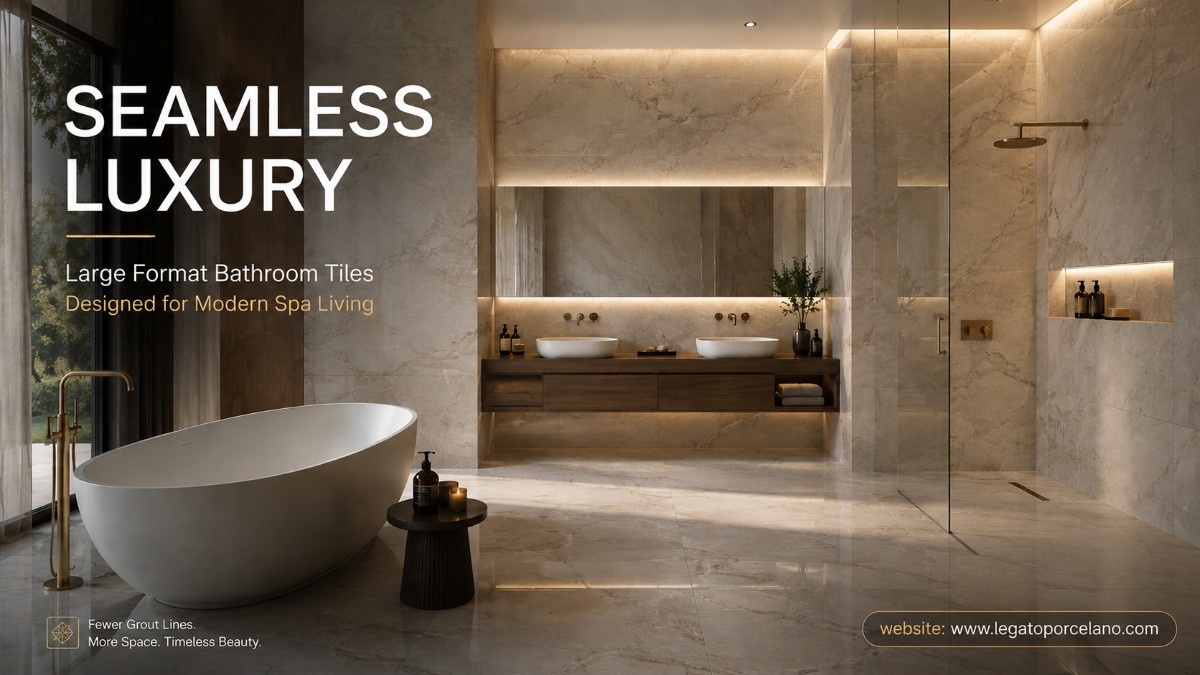
The most consistent visual quality of a luxury hotel bathroom, a five-star spa, or a high-end residential wet room is not the marble — it is the absence of interruption. Unbroken surface. No tile grid fragmenting the floor into a checkerboard of grout lines. The eye moves through the space freely, reading continuous material rather than a mosaic of individual pieces. That quality is produced, almost exclusively, by large format tile.
Large format porcelain tiles — broadly defined as any tile with one edge exceeding 15 inches (38 cm), with the most specified sizes today being 60×60 cm, 60×120 cm, 80×80 cm, and 120×120 cm — are the dominant specification in professional bathroom design for 2025 and 2026. Per Perry Homes’ 2026 bathroom trend report large-format tile continues to lead professional bathroom specifications precisely because it delivers a spatial and aesthetic result that smaller tiles cannot replicate at any level of quality.
This guide covers every dimension of large format tile for bathrooms: the design intelligence behind the format, the technical installation standards that govern it, the application strategies that produce genuinely spa-like results, and the selection criteria that matter most for your project.
ANSWER UPFRONT
Large format tiles (one edge > 15 in / 38 cm) reduce grout lines, visually expand bathrooms, simplify maintenance, and create the seamless surface associated with luxury hotel and spa design. Key requirement: substrate flatness within 1/8″ in 10′ (ANSI/TCNA standard) and 95% mortar coverage. Format guide: 60×60 cm for most bathrooms, 60×120 cm or 80×80 cm for larger spaces, 120×120 cm for statement wet rooms.
Why Large Format Tiles Dominate Modern Bathroom Design
Large format porcelain tiles have become the defining surface choice in modern bathroom design. The reason is not only visual style — it is the combination of spatial perception, reduced grout interruption, and long-term practicality working together. Bathrooms finished with larger tiles feel calmer, cleaner, and more architectural because the eye reads the surface as continuous rather than fragmented.
The Grout Line Geometry
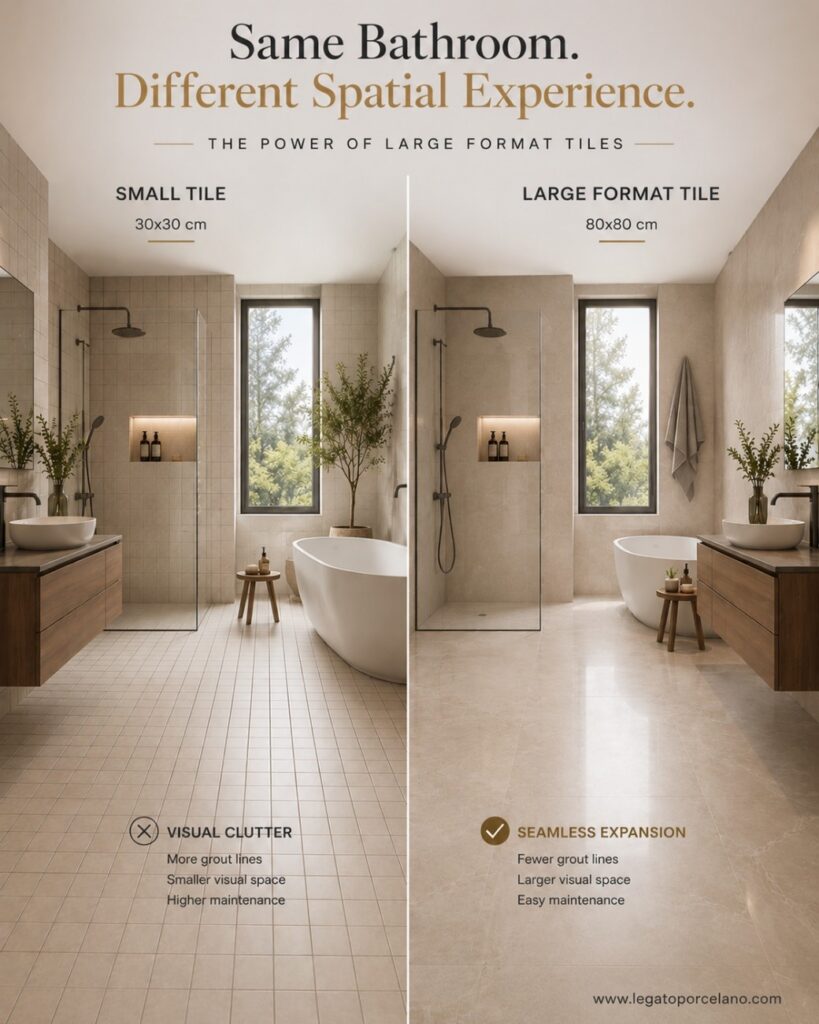
Every grout line acts as a visual boundary. Smaller tiles create a dense grid pattern that breaks the room into multiple sections. Large format tiles reduce those interruptions significantly. For example, a bathroom floor tiled in 30×30 cm formats contains almost double the grout lines of a 60×60 cm layout. As a result, larger tiles create a more open and seamless appearance.
According to Tile Club, fewer grout lines visually expand both small and large bathrooms. This effect becomes especially noticeable in bathrooms under 6 square metres, where visual continuity strongly affects spatial perception.
Spa and Hotel Aesthetic
Additionally, large-format tiles are central to the luxury spa-bathroom trend dominating 2025–2026 interiors. Designers increasingly use continuous floor-to-wall tile applications to create hotel-inspired environments with minimal visual interruption. This immersive approach, often called “tile drenching,” wraps the same material across floors, shower walls, and feature surfaces for a cohesive architectural look.
Maintenance Efficiency
Furthermore, fewer grout joints mean less maintenance over time. Grout is typically where mould, soap residue, mineral deposits, and discoloration accumulate. Large format bathroom tiles reduce the total grout area substantially, making cleaning easier and reducing long-term upkeep.
External References: Perry Homes — Bathroom Tile Trends 2026 | Clé Tile — Bathroom Tile Trends 2026 | Edward Martin — Bathroom Design Trends 2026
“Large-format tile continues to define modern bathrooms. Fewer grout lines create a cleaner, more expansive look that makes both small and large bathrooms feel calmer and more architectural.” — Tile Club, 2026
Large Format Tile Size Guide: Which Format for Which Bathroom
“Large format” covers a wide range of sizes. The right format for your bathroom depends on room scale, design intent, and — for floor applications — installation tolerances. The table below maps the most common formats to their ideal applications.
| Format | Ideal Room Scale | Primary Application | Design Effect |
|---|---|---|---|
| 60×60 cm (24×24 in) | Any bathroom ≥ 4 m² | Floor and walls, all bathrooms | Clean, modern — strong visual improvement over small format |
| 60×120 cm (24×48 in) | Medium to large (6+ m²) | Floor, shower walls, feature walls | Rectangular — draws eye along length, ideal for narrow bathrooms |
| 80×80 cm (32×32 in) | Large bathrooms (8+ m²) | Floor, full-room application | Square slab — monolithic, spa-like ground coverage |
| 120×60 cm (48×24 in) | Large bathrooms, wet rooms | Floor-to-ceiling walls, shower surround | Maximum continuity — hotel-suite aesthetic |
| 120×120 cm (48×48 in) | Statement wet rooms (12+ m²) | Landmark floor and wall slabs | Architecturally definitive — the fewest joints of any standard format |
| Gauged Slabs (>120 cm) | Commercial / high-end residential | Floor-to-ceiling single-panel walls | Near-seamless monolith — minimal installation joins |
SIZE SELECTION RULE
As a general principle: select the largest format your substrate quality and installer competence can support. Substrate flatness tolerances tighten significantly for tiles with any edge over 15 in / 38 cm. A 60×60 cm tile in a properly prepared bathroom will always outperform a 30×30 cm tile aesthetically. A 120×120 cm tile requires near-perfect substrate preparation — but the result is transformative.
Installation Standards: What the Technical Specifications Require
Large format tile is less forgiving than small format in every installation variable. The technical standards are strict — and they exist because the consequences of non-compliance (lippage, hollow spots, cracked tiles) are more visible and more consequential at large format scale.
Substrate Flatness — The Non-Negotiable
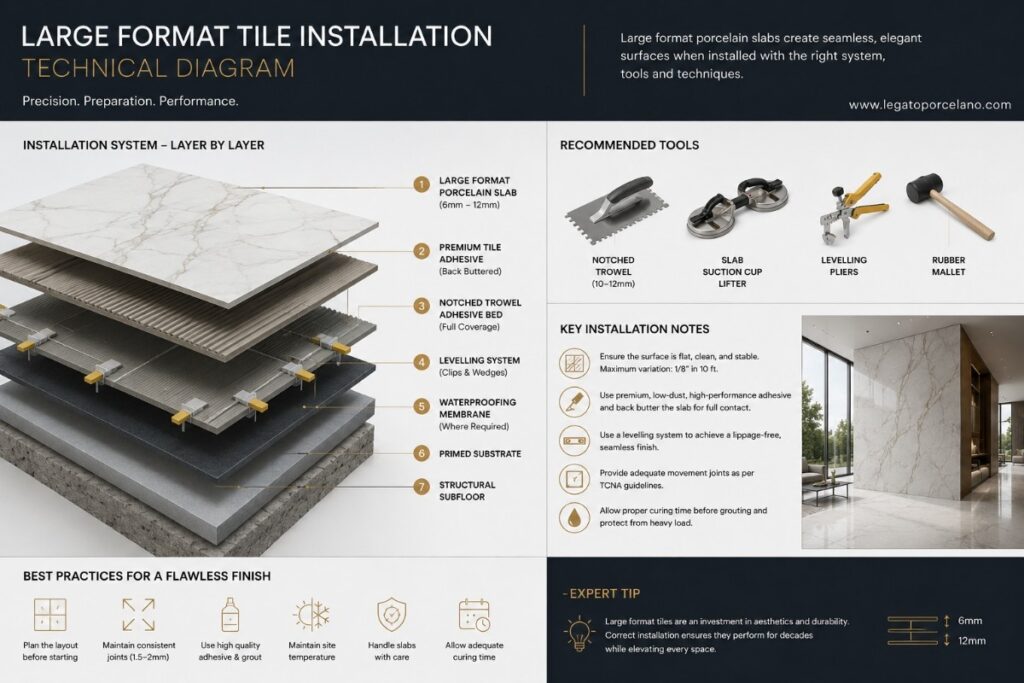
Per ANSI A108 and the TCNA Handbook — the two governing installation standards for tile in the United States, used internationally — the substrate for tiles with any edge greater than 15 inches must be flat within 1/8 inch in 10 feet, with no more than 1/16 inch variation in any 24-inch span. For smaller tiles (all edges under 15 inches), the tolerance is 1/4 inch in 10 feet. The tighter tolerance for large format exists because substrate irregularities that are invisible under small tiles cause visible lippage under large ones.
Any substrate that does not meet this flatness requirement must be corrected before tiling. Self-levelling underlayment compounds and floor grinding are the standard correction methods. Skipping this step is the primary cause of large-format tile installation failures — not the tile, not the grout, and not the installer’s technique.
TCNA / ANSI INSTALLATION REQUIREMENT
For any tile with one edge greater than 15 inches (38 cm): substrate must be flat within 1/8″ in 10′ and 1/16″ in 24″ per ANSI A108 and TCNA Handbook. Minimum mortar coverage: 95% per TCNA standards (double-spreading / back-buttering required). Lippage maximum: 1/32″ per ANSI A108.02. Non-compliance produces visible lippage, hollow spots, and eventual tile failure. Sources: TCNA Handbook / ARC Surfaces Large Format Tile Installation Guide / Mosaicenter TCNA Guide.
Mortar Coverage — 95% Minimum
Standard thin-set mortar applied with a single notched trowel does not provide sufficient coverage for large format tiles. Per TCNA standards, large format tiles require a minimum of 95% mortar coverage — achieved through the double-spreading technique (back-buttering): mortar applied to the substrate with a notched trowel AND additional mortar applied to the back of the tile before setting. This eliminates air pockets and hollow spots beneath the tile, which become stress points that cause cracking under load. Mortar type must meet ANSI A118.4 (large-and-heavy-tile mortar) or higher.
Lippage Control
Lippage — the height difference between adjacent tile faces at the grout joint — is more visible and more consequential with large format tiles than small. ANSI A108.02 limits lippage to 1/32 inch for grout joints narrower than 1/16 inch. Beyond being a visual defect, lippage above 1/8 inch is a documented tripping hazard. Rectified tiles (precision-cut to exact dimensions) allow tighter grout joints and significantly reduce lippage risk compared to non-rectified tiles. For any large-format installation, rectified tile is the correct specification.
Grout Joint Sizing
Per ANSI A137.1, grout joint width for rectified large-format tiles should be three times the variation in the tile’s facial dimension, with a minimum of 1/16 inch. In practice, well-specified rectified porcelain large-format tiles allow joints as narrow as 1.5–3 mm — the minimum that produces the seamless aesthetic while still accommodating minor substrate variation and tile expansion. Specify epoxy grout for shower and continuous wet-zone applications; it is non-porous, requires no sealing, and resists discolouration.
External References: TCNA — Large Format Tile Installation Standards (PDF) | ARC Surfaces — Installing Large Format Tiles (PDF) | TileLetter — Lippage in Tile Installation (ANSI A108.02) | Mosaicenter — TCNA Handbook Standards Guide
Design Applications: How to Use Large Format Tiles in Bathrooms
Tile Drenching — The 2026 Immersive Approach
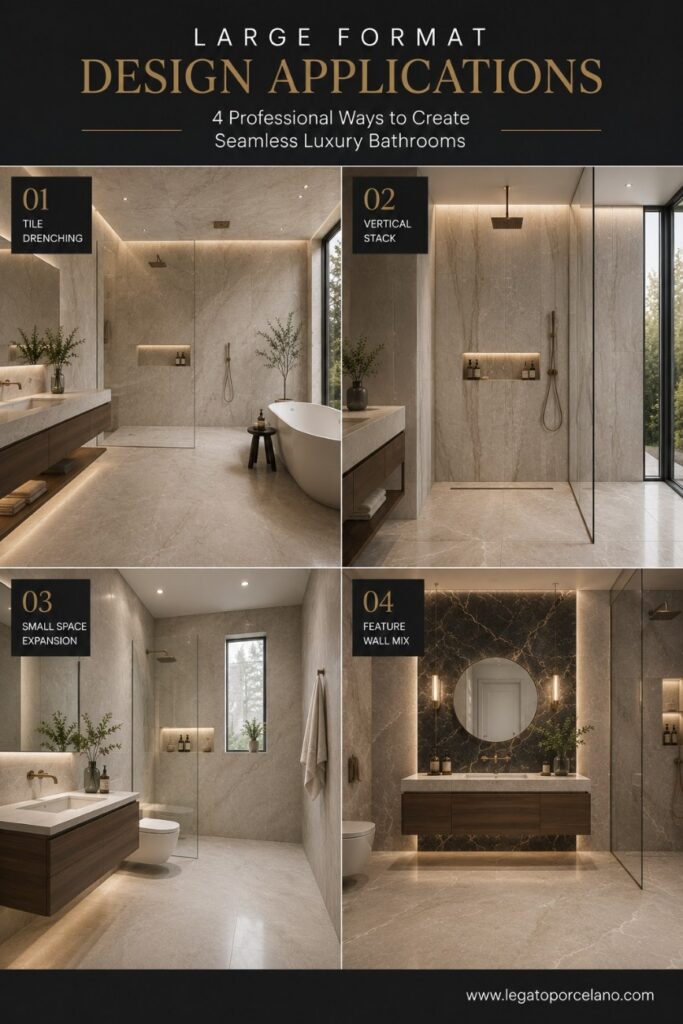
Tile drenching has become one of the most influential bathroom design trends of 2026. The concept involves using the same large-format tile across floors, walls, shower surrounds, and sometimes even ceilings to create a fully continuous environment. As a result, the bathroom feels calmer, larger, and far more architectural.
Vertical Layout for Height and Elevation
Meanwhile, vertically oriented large-format tiles help bathrooms appear taller and more spacious. Formats such as 60×120 cm and 30×120 cm naturally guide the eye upward, creating the illusion of higher ceilings without structural changes.
Research highlights vertical stacked layouts as one of the most effective modern bathroom design strategies for compact spaces. Pairing vertical tiles with aligned grout joints creates a cleaner and more architectural appearance.
Small Bathroom Strategy
Interestingly, small bathrooms often benefit more from large-format tiles than oversized rooms do. Smaller tiles create more grout lines, which visually divide the space and make the room feel busier. Large-format tiles reduce those interruptions and allow the bathroom to read as one continuous surface.
Light-toned porcelain tiles with colour-matched grout are especially effective in bathrooms under 5 m². Consequently, the room feels brighter, wider, and more open despite its compact footprint.
Floor-to-Ceiling in Master Suites and Wet Rooms
For master ensuites and luxury wet rooms, floor-to-ceiling large-format tiles create the strongest spa-style visual impact. Formats such as 80×80 cm and 120×60 cm are commonly used to achieve seamless continuity across the entire space.
This design approach is frequently seen in premium hospitality interiors and modern architectural homes because it delivers a refined, monolithic appearance. However, successful execution depends heavily on proper substrate preparation and precision installation.
→ Internal Links: Small Bathroom Tile Ideas — Space-Maximising Strategies | Spa-Inspired Bathroom Design Guide | Marble Look Bathroom Tiles — Large Format Applications | Matte vs Glossy Finish Guide — Floor Safety for Large Format
5 Professional Selection Criteria for Large Format Bathroom Tiles
1. Specify Rectified Tiles
Rectified tiles are precision-cut after firing to exact, consistent dimensions. For large-format tiles, rectification is not a premium option — it is a functional requirement. Rectified tiles allow the narrowest possible grout joints (1.5–3 mm), dramatically reducing lippage risk and enabling the seamless aesthetic that large format is specified for. Non-rectified large-format tiles are significantly harder to install without visible lippage.
2. Verify DCOF Before Any Floor Specification
Furthermore, large-format floor tiles in bathrooms must meet the ANSI A137.1 minimum DCOF of 0.42 for wet interior floors. Format does not affect slip resistance — finish does. Matte large-format tiles typically meet and exceed this threshold. However, Polished or glossy large-format tiles must be independently DCOF-tested before floor specification in wet zones. Always request the DCOF test data from your supplier.
3. Match Format to Room Scale Proportionally
For example, A 120×120 cm tile in a 4 m² bathroom creates fewer but more visually dominant grout lines and can produce a tiled-slab effect that overwhelms the space. Therefore, Match format to room scale: 60×60 cm or 60×120 cm for bathrooms under 8 m²; 80×80 cm or 120×60 cm for 8–15 m²; full slab formats for wet rooms and statement spaces above 15 m².
4. Plan Grout Colour as a Design Decision
Meanwhile, with large-format tiles, grout lines cover less total area but are individually more prominent than with small-format tiles — each joint spans a greater length. A contrasting grout colour in a large-format floor creates strong geometric lines that define the visual character of the room. A matched or tonal grout creates near-seamless continuity. Decide before purchase, not after installation.
5. Budget for Professional Substrate Preparation
The single most common large-format installation failure is inadequate substrate preparation. Flatness tolerances for tiles over 15 inches are twice as strict as standard (1/8 inch in 10 feet vs 1/4 inch). Budget explicitly for substrate assessment, any required levelling or grinding, and an installer with verified large-format experience. The tile itself is rarely the weak link — the substrate preparation almost always is.
Conclusion:
Large format porcelain tile is not a trend — it is the natural endpoint of a design direction that has been building for a decade. The bathroom that reads as genuinely luxurious, genuinely spa-like, genuinely architectural is almost always defined by surface continuity. Fewer grout lines. More unbroken material. The eye moving freely through the space rather than reading a grid.
The technical requirements are clear and non-negotiable: substrate flatness within 1/8 inch in 10 feet, 95% mortar coverage, rectified tiles, DCOF-verified finishes for wet floors. These are not obstacles — they are the precision that makes the result worth the investment. Get the substrate right, use the right mortar, specify the right format for your room scale, and the result is a bathroom that does not reference luxury — it produces it.
“Scale is the silent dimension of bathroom design. Get the tile format right and everything else in the room becomes easier to resolve.”
| 🏛 | EXPLORE LEGATO PORCELANO Premium large-format porcelain tile collections — 60×60 cm through 120×120 cm — for bathrooms designed to the standard of the finest residential and hospitality interiors. legatoporcelano.com/blog/ |
↑ Porcelain Tiles for Bathroom — Complete Pillar Guide | Explore all Legato Porcelano collections
FAQ’s
Rectified tiles allow tighter grout joints and a cleaner seamless appearance, which is essential in luxury bathroom design. Legato Porcelano large-format collections are precision-finished to support modern minimal grout layouts and architectural continuity.
Yes. Large format tiles reduce grout lines As a result which makes small bathrooms feel visually wider and less cluttered. Light shades with matching grout create the strongest seamless effect.
For most bathrooms, 60×60 cm and 60×120 cm are the most practical and visually balanced sizes. Larger wet rooms can accommodate 80×80 cm or 120×120 cm formats for a more luxurious spa-like finish.
Yes. Large format porcelain tiles require flatter substrates, proper back-buttering, and at least 95% mortar coverage to avoid lippage and hollow spots. Professional installation is strongly recommended.
Matte and satin finishes are generally preferred for bathroom floors because they provide better slip resistance in wet areas. Many premium collections from Legato Porcelano are designed specifically for modern spa-inspired bathrooms with safe, low-maintenance finishes.
No. In fact, they are easier to maintain because fewer grout joints mean less dirt buildup, mould growth, and grout cleaning compared to small-format tiles.
