Brand: Legato Porcelano
Category: Commercial Office Flooring
Reading Time: ~7 Minutes
Introduction
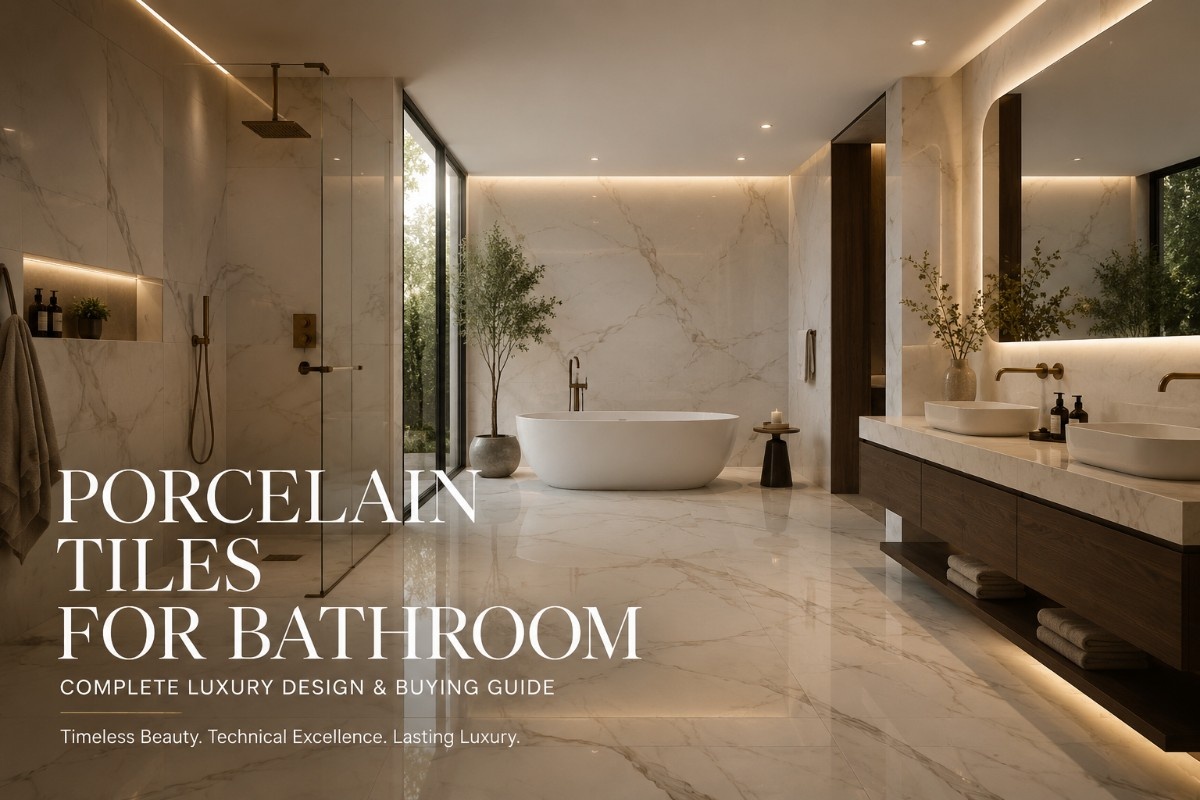
Your bathroom is no longer just a functional room — it is the most personal space in your home, the one that sets the tone for how you start and end every day. In contemporary residential and hospitality design, the bathroom has evolved into a private wellness sanctuary. And at the heart of every exceptional bathroom is the surface beneath your feet and behind your walls.
Porcelain tiles have emerged as the definitive surface material for modern bathroom design — not by accident, but by engineering. They combine technical superiority with design versatility that no other material replicates at scale. Whether you are planning a full renovation or selecting finishes for a new build, this guide covers everything you need to make an informed, design-intelligent decision.
Key Insight:
” Modern bathrooms require surfaces that combine aesthetics with long-term functionality — making porcelain one of the most versatile architectural materials for wet spaces. This guide is your complete reference.”
Why Porcelain Tiles Are the Gold Standard for Modern Bathrooms
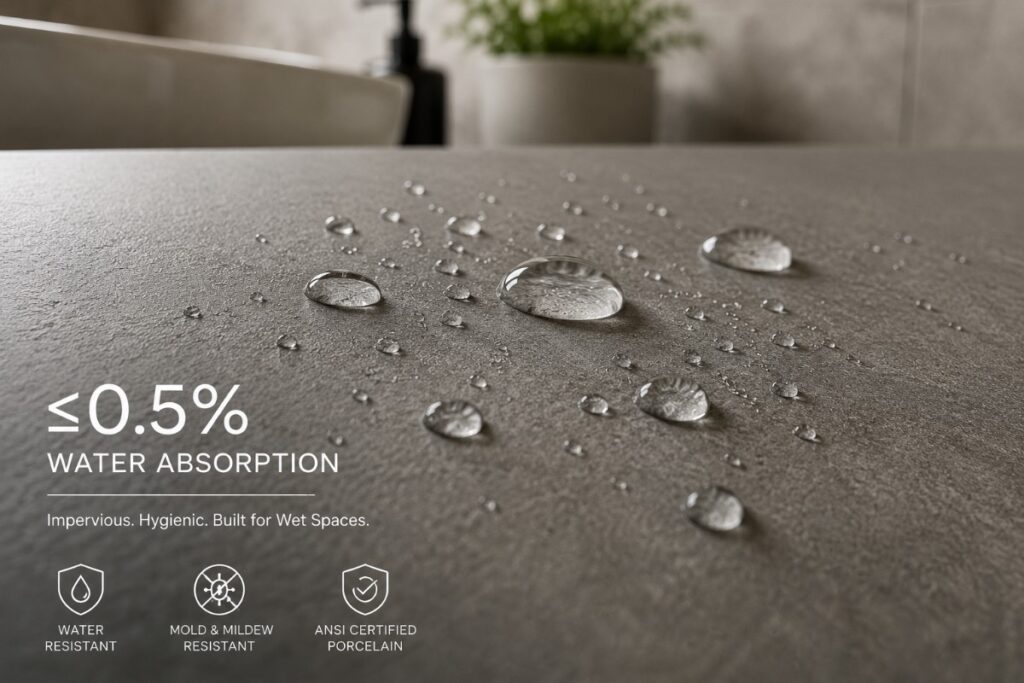
Not all tiles are created equal. The distinction begins at the molecular level. According to the Tile Council of North America (TCNA) and the American National Standards Institute (ANSI), true porcelain tile is defined by a water absorption rate of 0.5% or less, tested under ASTM C373 — a threshold that classifies it as technically “impervious.” This single property explains why porcelain dominates professional bathroom specifications worldwide.
Water Resistance & Moisture Performance
Bathrooms are high-humidity environments by definition. Surfaces are exposed to direct water contact, steam, and condensation daily. Natural materials like stone, wood, and even standard ceramic absorb moisture over time, leading to warping, efflorescence, and microbial growth beneath the surface.
Porcelain’s ≤0.5% water absorption — verified by ASTM C373 and ANSI A137.1 — means water cannot penetrate the tile body in any meaningful quantity. This makes it inherently resistant to mold formation within the tile itself, unlike porous alternatives.
Durability for Daily Bathroom Use
Porcelain is fired at temperatures between 1,200°C and 1,400°C, creating a dense, vitrified body that resists impact, thermal shock, and surface abrasion. In residential bathrooms, this translates to a surface that handles decades of daily use without visible deterioration. High-quality porcelain rated PEI IV–V can withstand heavy foot traffic well beyond domestic requirements.
Slip Resistance — The Safety Standard You Need to Know
In wet bathroom environments, slip resistance is not optional — it is a code requirement and a safety imperative. ANSI A137.1, incorporated into the 2012 International Building Code (IBC), mandates a minimum Dynamic Coefficient of Friction (DCOF) of 0.42 for tiles used in level interior spaces expected to be walked upon when wet.
When specifying bathroom floor tiles, always verify the DCOF value. Textured and matte-finish porcelain tiles typically perform above this threshold, while highly polished glossy surfaces may require placement limitation to walls or dry areas.
Low Maintenance Benefits
Unlike natural stone — which requires annual sealing and pH-specific cleaners — porcelain is non-porous and does not absorb cleaning agents, staining compounds, or bathroom chemicals. Routine maintenance requires nothing more than mild detergent and water.
Luxury Design Flexibility
Modern digital-printing technology allows porcelain to replicate the visual character of Calacatta marble, Venetian stone, natural wood grain, and raw concrete with photographic precision — while retaining all the functional advantages of engineered ceramic. The design palette is effectively unlimited.
“The surface you select for your bathroom is not merely aesthetic — it is the architectural foundation of a space that must perform flawlessly for decades.” — Interior Design & Architecture Principle
Types of Porcelain Tiles for Bathroom Spaces
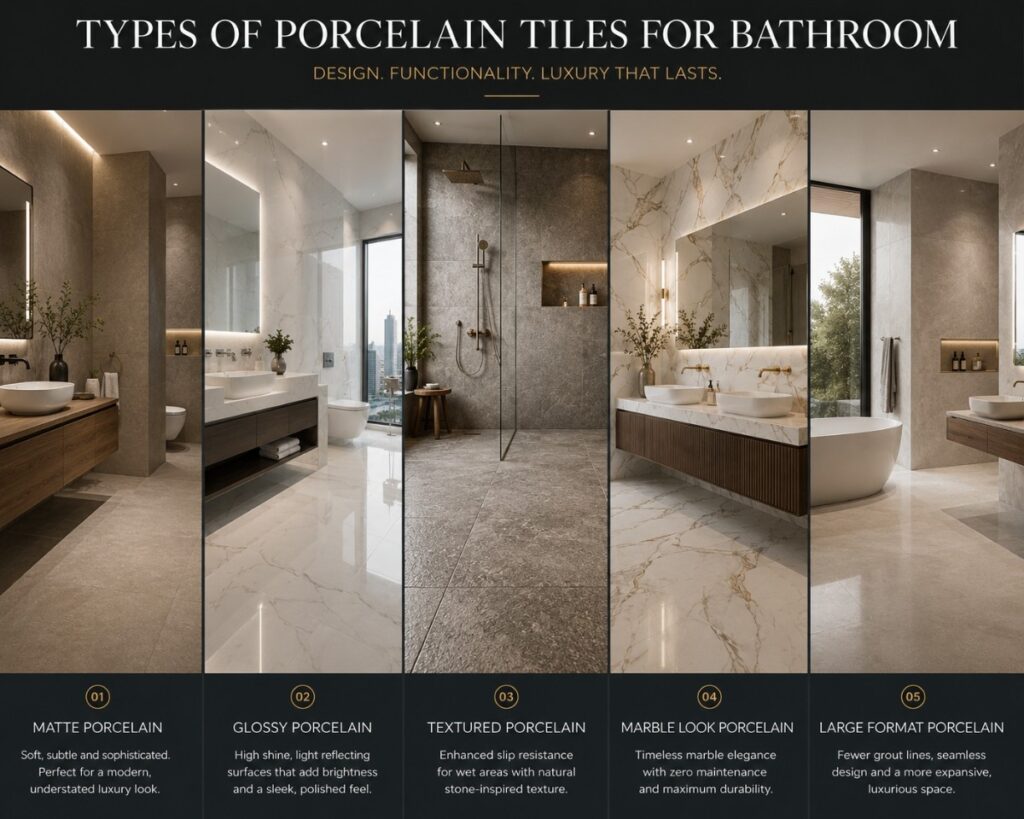
Understanding the differences between porcelain tile types allows you to make purposeful decisions — matching the material’s physical properties to the specific demands of each bathroom surface.
| Tile Type | Best Application | Design Aesthetic | Key Benefit |
|---|---|---|---|
| Matte Porcelain | Floors & walls | Modern Minimalist | Hides water marks, understated luxury |
| Glossy Porcelain | Walls / dry areas | Reflective Luxury | Amplifies light, bold presence |
| Textured Porcelain | Wet floors & shower | Natural & Tactile | Superior slip resistance (DCOF ≥0.42) |
| Marble Look | Full bathroom | Calacatta Elegance | Stone aesthetics, zero sealing |
| Large Format | Open-plan bathrooms | Seamless & Expansive | Fewer grout lines, spa visual |
Matte Porcelain Tiles
Matte surfaces have become the dominant choice in contemporary bathroom design for good reason. They conceal water marks, soap residue, and fingerprints more effectively than glossy alternatives — a practical advantage in a bathroom context. Aesthetically, matte tiles create a sense of grounded, understated luxury that aligns with minimalist and Japandi design movements.
→ Internal Link: Explore matte vs glossy porcelain tiles
Glossy Porcelain Tiles
High-gloss porcelain tiles create visually expansive, light-amplifying surfaces that are ideal for bathroom walls in rooms with limited natural light. The reflective quality adds a sense of depth and hotel-grade luxury. However, high-polish tiles should be verified for DCOF compliance before use on wet floors — many glossy bathroom tiles are intentionally specified for walls only.
Textured & Anti-Skid Porcelain Tiles
Designed specifically for wet zones — shower floors, bathroom floors adjacent to bathtubs, and spa areas — textured porcelain tiles incorporate micro-relief or directional surface patterns that increase friction underfoot. These tiles are the correct choice wherever ANSI A326.3 wet DCOF compliance is mandatory.
Marble Look Porcelain Tiles
Perhaps the most transformative advancement in tile design, marble-look porcelain replicates the veining, variation, and translucency of Calacatta, Carrara, and Statuario marble at a fraction of the cost and with none of the maintenance burden. Natural marble is inherently porous and requires regular sealing; marble-look porcelain requires only periodic cleaning.
→ Internal Link: Discover marble look bathroom tiles
Large Format Porcelain Tiles
Defined broadly as tiles exceeding 60×60 cm (24×24 inches), large-format porcelain creates monolithic visual continuity. Each fewer grout line is a reduction in visual interruption — the bathroom reads as a continuous, unified surface rather than a mosaic of individual pieces. Industry sources and leading bathroom design publications consistently identify large-format tiles as among the top design trends through 2025 and 2026.
→ Internal Link: Large format bathroom tiles — full design guide
Bathroom Wall vs Floor Tiles: What’s the Difference?
Many homeowners treat bathroom wall and floor tiles as interchangeable. They are not. The functional demands of each surface are fundamentally different — and understanding these differences is essential to making the right specification.
Slip Resistance Requirements
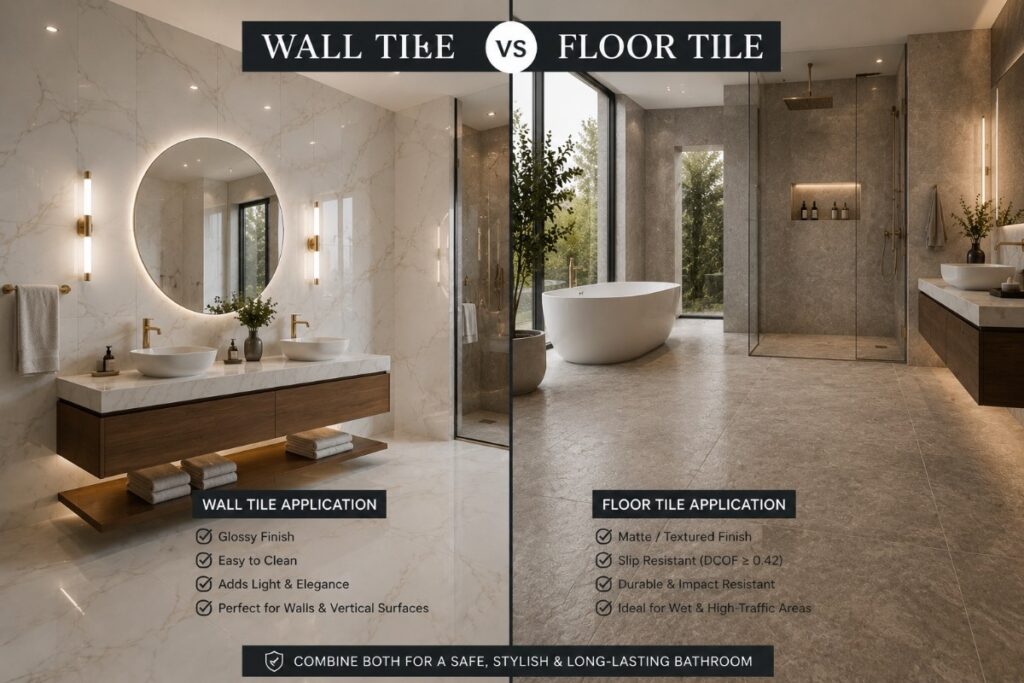
Floor tiles in any space expected to be walked upon when wet must meet a minimum DCOF of 0.42 per ANSI A137.1 and the 2012 International Building Code. This standard does not apply to wall tiles — which are never walked upon. Choosing a floor-rated tile for walls is always acceptable; choosing a wall-only tile for floors may violate code and creates safety liability.
Surface Finish Selection
Glossy and semi-polished finishes are appropriate for vertical wall applications where light reflection and visual drama are desired. For floors, particularly in wet zones, matte, satin, or textured finishes are preferred for both safety (DCOF) and practical reasons — polished floors show every water spot and footprint.
Tile Thickness & Application
Standard bathroom wall tiles range from 6–10 mm thickness. Floor tiles are typically 10–12 mm or more to handle the structural load and impact from foot traffic. Large-format tiles for floor use should be a minimum of 10 mm to prevent flexural failure under load. Always consult your installer regarding substrate preparation requirements for large-format floor tiles.
Best Layout Pairings
Creating visual harmony between wall and floor tiles involves intentional decisions about scale, color, and finish. A common high-performance pairing: matte large-format floor tiles (for safety and visual continuity) with glossy or semi-polished wall tiles in the same tonality (for light amplification and luxury feel). Carrying the same tile from floor to wall is also a contemporary approach that creates a spa-like monolithic environment.
| “The most successful bathroom interiors create visual continuity while balancing safety, texture, and spatial harmony across every surface.” — Architectural Design Principle |
Large Format Porcelain Tiles: The Luxury Bathroom Standard
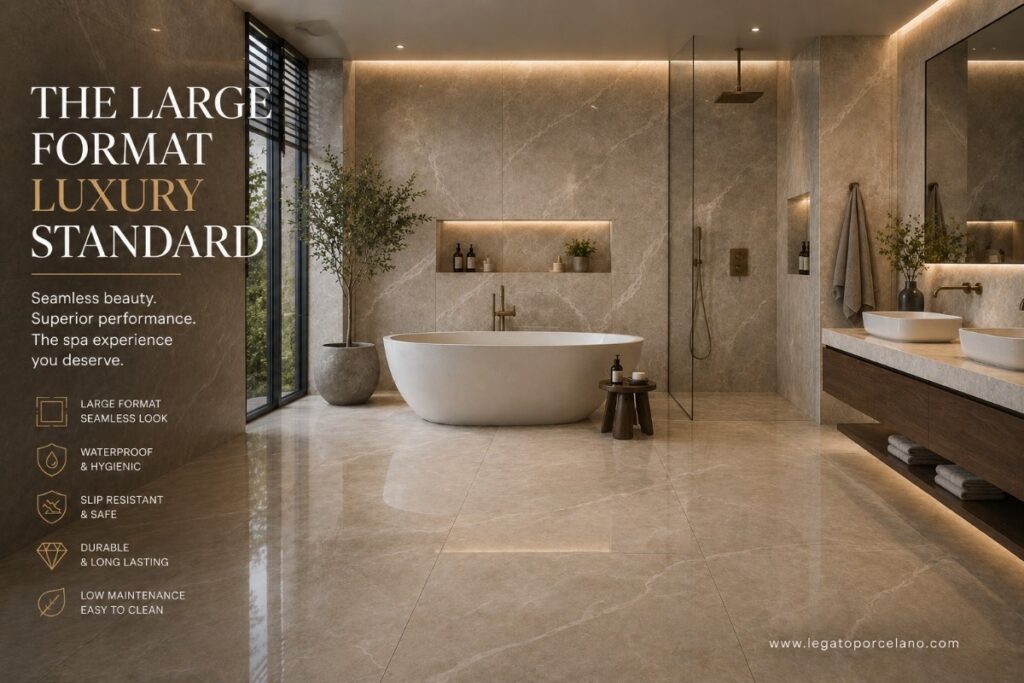
Large-format porcelain tiles — spanning 60×120 cm, 80×80 cm, 120×120 cm, and beyond — have become the defining element of luxury bathroom design in 2025 and 2026. According to leading design industry sources including Porcelanosa and Perry Homes design reports, large-format tile continues to dominate professional bathroom specifications precisely because it delivers a hotel-grade, spa-inspired result that smaller tiles simply cannot replicate.
Why Large Format Feels More Luxurious
It is not subjective perception — it is geometry. More tiles in a space means more grout lines, and grout lines function as visual interruptions. Reduce the number of grout lines, and the eye perceives continuous, unbroken surface — which reads as more expensive, more refined, and more considered. The psychological effect is immediate and consistent across observers.
Minimal Grout Line Aesthetics
With rectified (precision-cut) large-format porcelain, grout joints can be reduced to as little as 1.5–3 mm. Combined with grout matched or harmonized to the tile color, the result approaches a seamless, monolithic surface — the same visual quality found in high-end hotel and resort bathrooms globally.
Seamless Spa-Inspired Interiors
The most aspirational bathroom environments — spa retreats, five-star hotel bathrooms, architectural showhouses — are defined by material continuity and absence of visual noise. Large-format porcelain applied floor-to-ceiling, or from shower wall to bathroom floor, creates precisely this effect. Industry trend reports from Apavisa and Archiproducts confirm large-format tiles as the dominant 2025–2026 specification for premium residential bathrooms.
External Reference: Apavisa — Bathroom Trends 2025 | Porcelanosa — 2025 Bathroom Renovation Trends
Small Bathroom Space Illusion
One of the most practically valuable properties of large-format tiles: they visually expand smaller spaces. Fewer grout lines mean fewer horizontal and vertical divisions that the eye registers as boundaries. A small bathroom tiled in large-format, rectified porcelain will consistently appear larger than the same space tiled with smaller formats — a measurable psychological phenomenon architects leverage routinely.
→ Internal Link: Small bathroom tile ideas — space-expanding strategies
Marble Look Porcelain Tiles for Elegant Bathroom Design
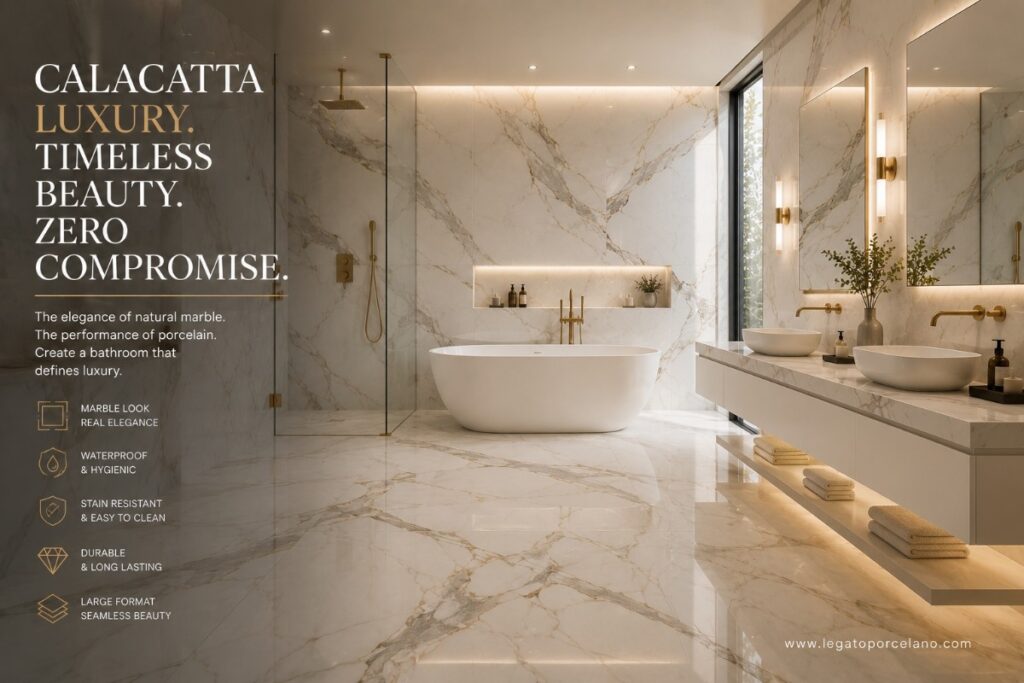
For centuries, marble has been architecture’s ultimate luxury signifier — from the Taj Mahal to Roman baths, from Renaissance palaces to contemporary five-star hotels. The challenge has always been cost, fragility, and maintenance. Marble-look porcelain resolves all three without compromising the visual impact.
Calacatta and Carrara: Luxury Without the Liability
Calacatta marble — quarried exclusively from the Apuan Alps in Italy — commands prices of $150–$300+ per square foot installed, requires annual sealing, and is susceptible to etching from acidic bathroom products (shampoo, toothpaste, soap residue). Calacatta-look porcelain delivers the same bold grey veining on a warm white ground at a fraction of the cost, with zero sealing requirements and full imperviousness to bathroom chemicals.
Stone Aesthetics Without High Maintenance
Natural marble requires pH-neutral cleaning products, immediate response to acidic spills, and professional resealing on an annual basis. Marble-look porcelain is non-porous: it resists staining, requires no sealing, and tolerates standard household cleaning products without surface degradation. The practical maintenance advantage is significant over any multi-decade installation lifecycle.
| VERIFIED FACT: Natural marble is porous and requires regular sealing to prevent staining and etching. Marble-look porcelain is non-porous (≤0.5% water absorption per ANSI A137.1), requires no sealing, and resists the acidic bathroom products that etch natural stone. Source: ANSI / Tile Council of North America. |
Hotel-Style Bathroom Inspiration
The visual vocabulary of premium hotel bathrooms — continuous white marble surfaces, dramatic veined walls, seamless shower enclosures — is replicable with marble-look porcelain at residential scale and budget. Floor-to-ceiling application with matched grout color creates the most convincing hotel-suite effect. Pair with brushed gold or matte black fixtures for contemporary luxury contrast.
Modern White Bathroom Concepts
All-white bathrooms represent the most searched-for and aspirational bathroom aesthetic globally — clean, expansive, timeless. Marble-look porcelain in a Carrara or Bianco tone, applied across floor and walls with minimal grout contrast, creates a light-reflective, serene environment that ages exceptionally well across design trends.
→ Internal Links: Marble look bathroom tiles — complete collection guide
Best Bathroom Tile Sizes for Modern Interiors
Tile size is not merely an aesthetic choice — it directly affects spatial perception, installation complexity, grout maintenance, and design coherence. Understanding how size interacts with bathroom scale is essential to specification excellence.
| QUICK REFERENCE: Small bathrooms → 60×60 cm or larger to visually expand. Luxury bathrooms → 80×80 cm, 60×120 cm, or 120×120 cm slabs. Shower walls → vertical large-format for ceiling-height illusion. Modern minimalist → seamless continuous surface with matched grout. |
Small Bathroom Tile Sizing Strategy
A widely misunderstood design principle: small rooms benefit from larger tiles, not smaller ones. Smaller tiles create more grout lines, which act as visual grid markers that emphasize the room’s boundaries. Larger tiles — particularly 60×60 cm and above — reduce these markers and allow the eye to read the space more openly. For a bathroom under 5 square metres, 60×60 cm is the recommended minimum for floor application.
Large Format Applications
For master bathrooms, spa bathrooms, and open-plan wet rooms of 8 square metres and above, tiles in the 80×80 cm, 60×120 cm, and 120×120 cm formats create the most architecturally resolved result. These formats require careful substrate preparation (minimum S3 flatness tolerance), proper lippage control during installation, and adhesive coverage of 95–100% for structural integrity.
Floor-to-Ceiling Layouts
Extending the same tile from floor to ceiling — particularly in narrow bathrooms or shower enclosures — visually heightens the space. This technique, combined with vertical tile layout (portrait orientation on walls), directs the eye upward and makes the ceiling feel more distant. The result: a bathroom that reads significantly larger and more refined than its physical dimensions.
Grout Line Optimization
For large-format rectified porcelain, grout joints of 1.5–3 mm are achievable and recommended by most installation standards. Use epoxy grout for shower areas and other continuously wet zones — it is non-porous, requires no sealing, and resists discoloration over time. For aesthetic continuity, select grout that harmonizes with the tile body rather than contrasting with it.
Modern Bathroom Design Trends Using Porcelain Tiles (2025–2026)
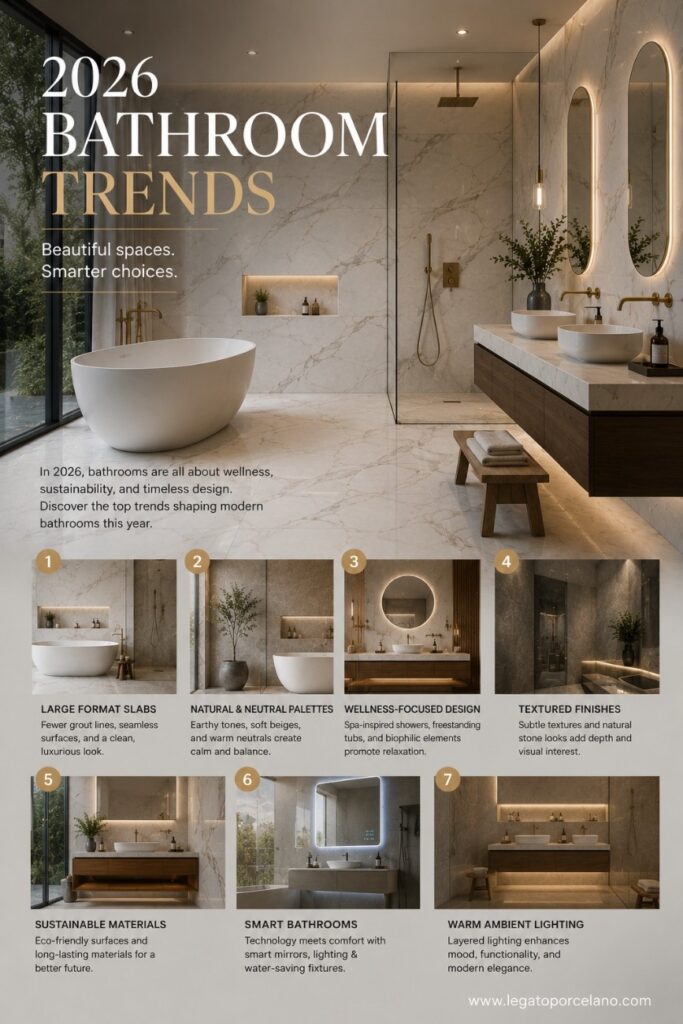
The bathroom design landscape in 2025 and 2026 is defined by a departure from cold, purely minimalist interiors toward warmer, more textural, wellness-oriented environments. Porcelain tile — with its expanding range of formats, finishes, and colorways — sits at the center of this evolution.
Minimalist Bathroom Spaces
Influenced by Japanese Wabi-Sabi and Scandinavian design, minimalist bathrooms prioritize surface quality over decorative excess. Matte large-format porcelain in warm grey, stone, or off-white tones forms the foundation. Hardware is reduced to essential elements; grout lines are minimized; and the material itself carries the aesthetic weight.
Spa-Inspired Interiors
The most aspirational bathroom category. Characterized by continuous stone-look surfaces, ambient indirect lighting, deep-soaking tubs, and an absence of visual clutter. Large-format porcelain in travertine-look, limestone-look, or warm sandstone finishes creates the textural warmth associated with destination spas. Paired with rain shower systems and floor heating, the result is residential architecture at its most refined.
Natural Stone Looks
Textures that reference limestone, slate, travertine, and sandstone continue to dominate professional specifications. According to design trend reporting from Archiproducts (Cersaie 2024 coverage) and Perry Homes 2026 bathroom trend analysis, earth-inspired palettes — soft beige, taupe, clay, and muted terracotta — are displacing cool grey as the dominant residential bathroom colorway.
Warm Neutral Color Palettes
Cool bathroom aesthetics — dominated by white and grey — are giving way to warmer, more enveloping color environments. Cream, sand, warm taupe, clay, and soft terracotta are appearing in both floor and wall specifications. These tones create a psychologically warmer environment that enhances the bathroom’s function as a relaxation and restoration space.
Contemporary Floating Vanity Concepts
Floor-to-wall continuous porcelain surfaces pair most effectively with wall-hung, floating vanities — a combination that exposes more floor surface, amplifies the sense of space, and creates the uninterrupted visual flow that defines premium bathroom design. The floor tile becomes a visual feature rather than a background.
→ Internal Links: Spa-inspired bathroom designs | Modern bathroom tile ideas | Luxury bathroom trends
Bathroom Tile Color Combinations That Feel Luxurious
Color is among the most consequential decisions in bathroom design. The right palette can make a small bathroom feel expansive, a plain bathroom feel elevated, and a luxury bathroom feel timeless. Below are four of the highest-performing combinations in current professional practice.
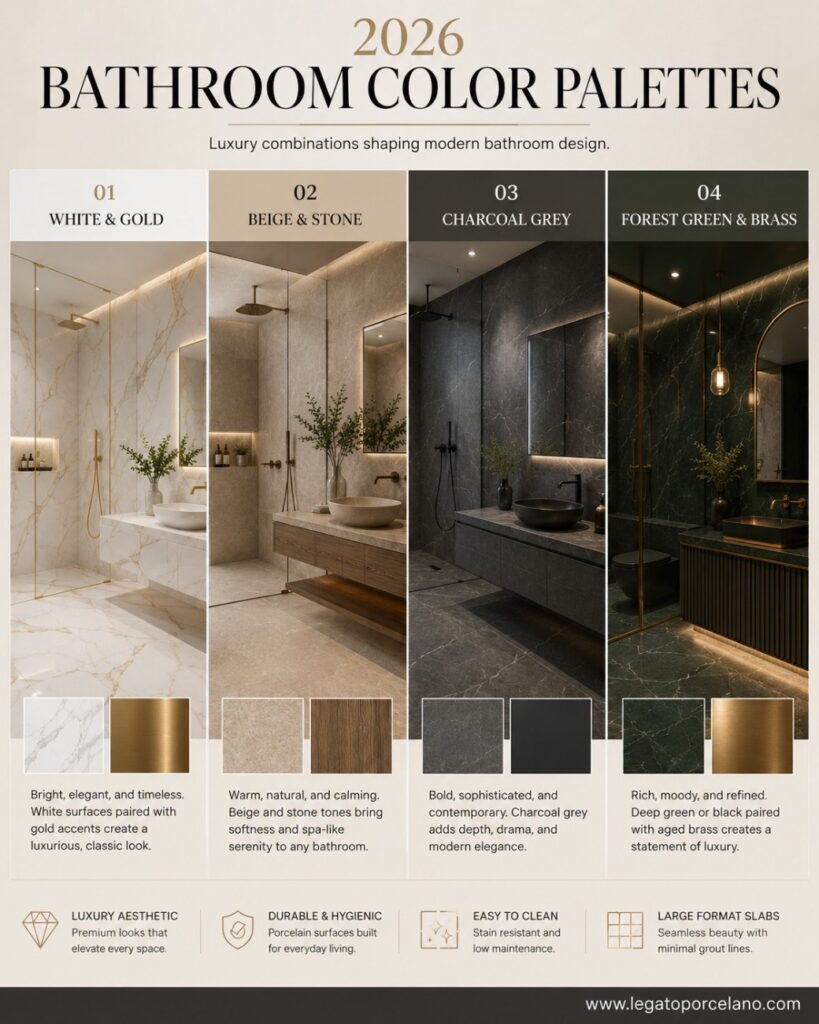
White & Gold — Timeless Prestige
The most enduringly aspirational bathroom combination: white Calacatta or Bianco-look porcelain tiles with brushed or antique gold hardware and accessories. Gold accents — faucets, towel rails, mirror frames — create warmth against the cool white surface without visual clutter. This palette photographs exceptionally well and has direct resonance with luxury hotel and residential design worldwide.
Beige & Stone Tones — Warm Contemporary
Warm beige, sandstone, and travertine-look porcelain tiles create bathrooms that feel genuinely inviting rather than clinically white. This palette is particularly effective in bathrooms with natural light — the warm tones shift beautifully across different light conditions throughout the day. Pair with brushed nickel or warm bronze fixtures and organic materials (stone basin, linen towels) for maximum effect.
Grey Minimalist Palettes
Cool to mid-tone grey remains the foundational tone of modernist bathroom design. Its neutrality allows fixtures, lighting, and accessories to carry the design narrative. For a 2025-contemporary take, pair charcoal grey large-format floor tiles with lighter wall tiles in the same family — the tonal variation creates depth without color conflict.
Dark Luxury Bathroom Themes
Deep forest greens, Nero Marquina-look black porcelain, and slate-dark surfaces create bathrooms with genuine drama and nocturnal luxury. This approach — increasingly seen in high-end residential and boutique hotel design — requires thoughtful lighting design but delivers an unmatched sense of retreat-like intimacy. Pair with aged brass or polished chrome for the most sophisticated contrast.
Common Bathroom Tile Mistakes to Avoid
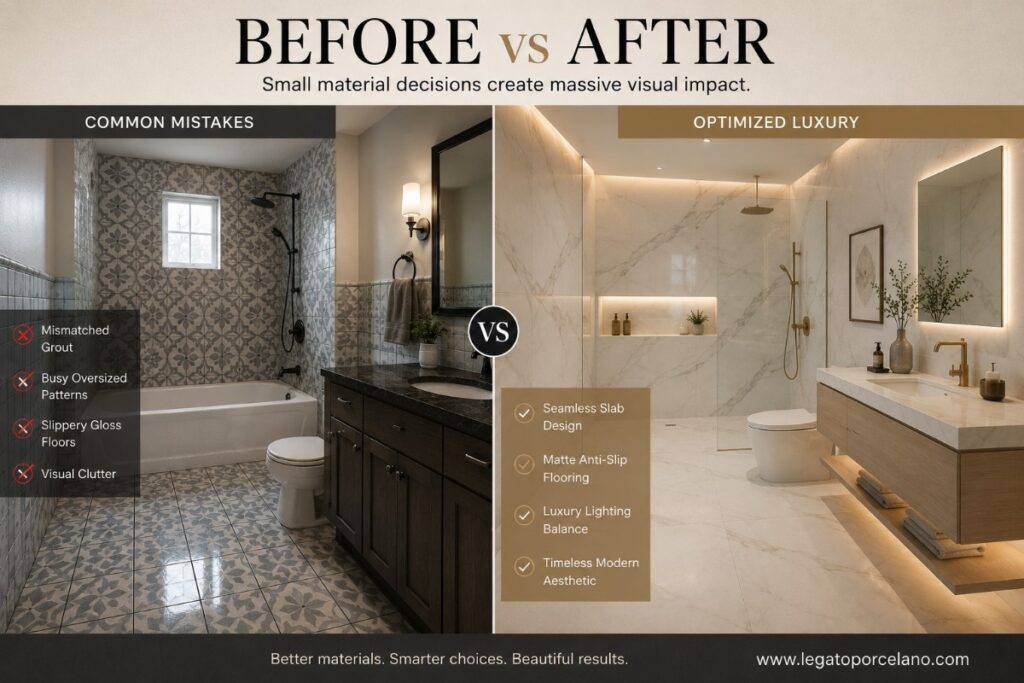
Choosing Slippery Flooring
High-gloss floor tiles in wet zones are the most consistently consequential specification error in bathroom design — both aesthetically and legally. Any tile used on a floor surface in a wet interior space must meet the ANSI A137.1 minimum DCOF of 0.42, measured per ANSI A326.3. Always request DCOF test data from your tile supplier before specifying floor tiles for bathroom use.
Overusing Small Tiles
Mosaic tiles and small-format tiles have a place in bathroom design — as feature walls, shower niche detailing, and accent applications. Using them as the primary floor or wall tile in any bathroom larger than 3 square metres creates visual fragmentation and significantly increases grout maintenance requirements over the installation’s lifetime.
Ignoring Lighting Conditions
Tile surface appearance changes substantially under different light conditions. Matte tiles in natural light present differently than under warm artificial lighting. Glossy tiles under certain artificial light sources can show reflections unintentionally. Always review tile samples in the actual room or under closely matching light conditions before committing to a specification.
Poor Color Coordination
Mismatched grout color is among the most common post-installation regrets. Grout joints cover 5–15% of the floor or wall surface — their color is a significant design variable, not an afterthought. For contemporary seamless looks, specify grout that closely matches the tile body. For intentional contrast (as in classic checkerboard applications), the contrast must be deliberate and consistent.
Excessive Grout Lines
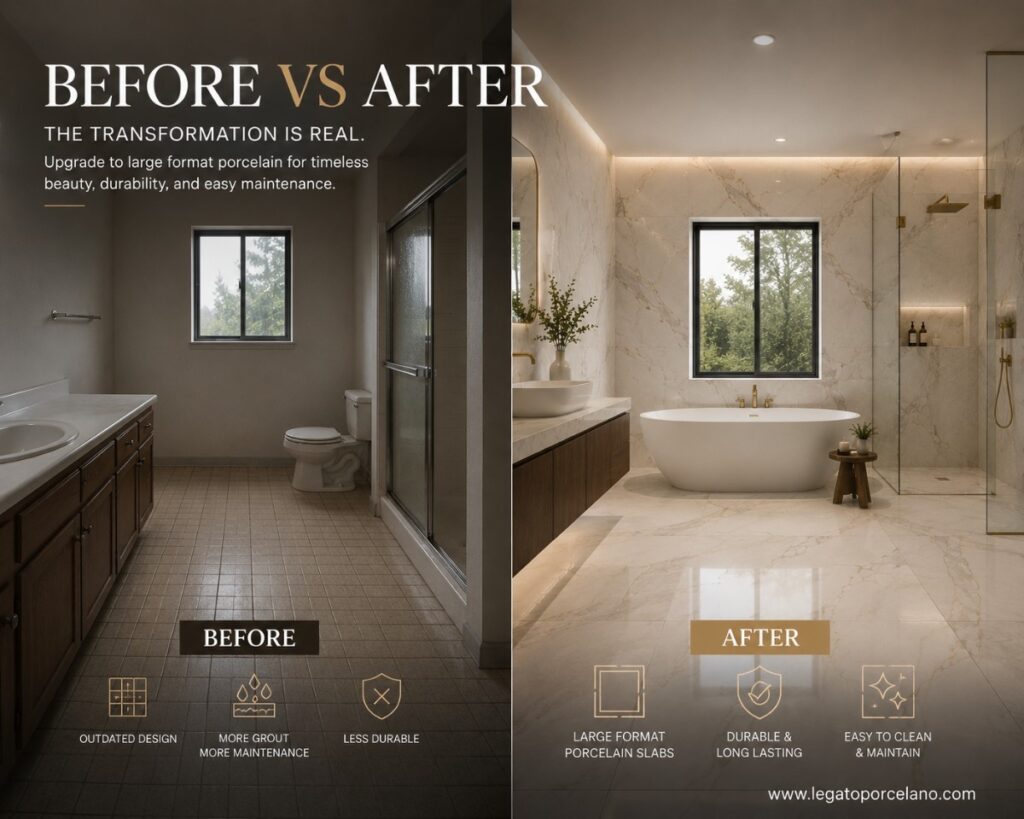
Excessive grout lines from small-format tiles are not merely a visual issue — they are a hygiene and maintenance issue. More grout surface means more area for mold, mildew, and discoloration over time. Maximizing tile size relative to room scale and minimizing grout joint width are the two most effective strategies for long-term bathroom maintenance reduction.
| DESIGN PRINCIPLE: Luxury bathroom design is most consistently defined by restraint, material continuity, and the deliberate reduction of visual noise — not by decoration. The highest-performing bathrooms are built around one or two exceptional surfaces, specified with precision. |
Maintenance & Cleaning Guide for Porcelain Bathroom Tiles
One of the most compelling arguments for porcelain in bathroom environments is maintenance simplicity. Understanding the correct care practices — and what not to do — will protect your installation’s appearance across decades.
Daily Cleaning Practices
For routine daily cleaning, a microfibre cloth or soft mop with warm water is sufficient for porcelain tile surfaces. A mild pH-neutral detergent can be added for more thorough cleaning. Avoid abrasive cleaning pads, which can scratch polished surfaces, and alkaline or acidic concentrated cleaners, which can damage grout over time.
Hard Water Stain Prevention
In hard water areas, mineral deposits (calcium and magnesium scale) can develop on glossy tile surfaces and glass shower enclosures over time. Regular wiping of surfaces after bathing is the most effective preventative measure. White vinegar diluted 1:10 with water is effective for removing light mineral deposits from porcelain without surface damage — though avoid use on unsealed natural stone if any is present nearby.
Grout Maintenance
Epoxy grout — the correct choice for continuously wet zones — is inherently non-porous and requires no sealing. Standard cement grout in bathrooms should be sealed at installation and resealed every 12–18 months depending on usage intensity and cleaning frequency. Use a grout sealer appropriate for the grout type. Discolored or damaged grout should be regrouted promptly to prevent moisture ingress beneath tiles.
External Reference: EPA Indoor Air Quality — Moisture and Mold Resources
Matte vs Glossy Surface Care
Matte surfaces require less frequent cleaning for visual maintenance (water marks and fingerprints are less visible) but may require slightly more effort to restore deep cleanliness given their micro-textured surface. Glossy surfaces are easy to wipe clean but require more frequent attention to maintain their reflective appearance. In both cases, porcelain’s non-porous body means surface-level cleaning is always sufficient — there is no subsurface absorption to address.
Conclusion: The Case for Porcelain in Your Bathroom
The decision to use porcelain tiles in your bathroom is, at its core, a decision to invest in surface quality that performs as well as it looks. No other material offers the same combination of imperviousness to moisture, design versatility across formats and aesthetics, long-term maintenance simplicity, and architectural flexibility.
Whether you are drawn to the seamless expansiveness of large-format tiles, the timeless elegance of marble-look porcelain, the understated refinement of matte surfaces, or the dramatic impact of dark luxury tones — the right porcelain tile exists for your vision. The parameters are clear: match finish to application (matte/textured for floors, any finish for walls in dry zones), verify DCOF compliance for all floor specifications, and select format relative to room scale.
A well-specified bathroom is not re-tiled every decade. It is designed once, with the right knowledge and the right material — and it lives with you for the lifetime of the home.
| “Design is not what it looks like. Design is how it works — and in a bathroom, how it works for you, every single day.” |
| EXPLORE LEGATO PORCELANO | Discover premium porcelain surfaces inspired by contemporary architecture and modern luxury living at legatoporcelano.com — bathroom tile collections that combine timeless aesthetics with refined, verified performance. |
→ Explore the Legato Porcelano bathroom collection | Designed for the discerning specifier.
FAQ’S
Yes, porcelain tiles are highly water-resistant, durable, and ideal for both bathroom walls and wet floor areas. They also offer long-term performance with minimal maintenance.
High-quality porcelain surfaces from Legato Porcelano require only regular cleaning with mild detergent and water, with no sealing needed like natural stone.
Matte and textured finishes are best for bathroom floors because they provide better slip resistance, while glossy finishes work beautifully on walls for a brighter luxury look.
Legato Porcelano collections combine Italian-inspired aesthetics with durable porcelain technology, making them suitable for contemporary residential and hospitality bathrooms.
Yes, large-format tiles reduce grout lines and create a seamless visual flow, making even compact bathrooms appear more spacious and premium.
Marble-look porcelain offers the elegance of natural marble without the high maintenance, sealing, or staining issues, making it a practical luxury solution for modern bathrooms.
