
Author: Legato Porcelano Editorial Team
Reading Time: 11 minutes
Category: Commercial Office Flooring Authority
Quick Answer:
Porcelain tiles are the most specified commercial office flooring material globally because they meet ASTM C373’s ≤0.5% water absorption standard, achieve PEI Grade 4–5 for heavy commercial traffic, last 50+ years with standard maintenance, and are now available in the full luxury design vocabulary — marble, concrete, wood, and stone looks — at architectural scale. For modern workspaces in 2026, nothing else delivers this combination at commercial grade.
Why Porcelain Tiles Win the Office Flooring Decision
Every office flooring decision eventually arrives at the same place. The designer has presented the options. The facility manager has run the lifecycle numbers. The architect has reviewed the technical specifications. And porcelain tile — not because it was the first suggestion or the easiest choice, but because it is the only material that simultaneously satisfies every requirement on the list — is what remains.
It is not sentiment. It is physics, economics, and design intelligence converging at the same material.
Porcelain tile is defined by a performance threshold, not a marketing label. According to ANSI A137.1:2022, a tile qualifies as porcelain only when it achieves a water absorption rate of 0.5% or less, verified under ASTM C373 and independently certified by the Porcelain Tile Certification Agency (PTCA). This imperviousness — achieved through firing at 1,200°C to 1,400°C — is the technical root of every practical advantage the material delivers in commercial environments.
In the context of a modern workspace, this means one thing above everything else: the floor performs exactly as specified, on day one and on year twenty-five, without extraordinary intervention. Coffee spills, chemical cleaners, daily foot traffic from hundreds of employees, rolling furniture loads — none of it penetrates the tile body. Nothing degrades from the inside out.
No other flooring material at commercial scale makes that claim and backs it with independently verified technical data.
🔗 Internal: Explore Legato Porcelano Collections
Design: Luxury Office Looks That Hold Up {#design}
The modern office is not a functional container. It is a spatial argument for what an organization believes about itself — and the floor is the largest surface making that argument every day.
Porcelain tile in 2026 delivers the full luxury design vocabulary of commercial architecture. The manufacturing capability — high-definition inkjet printing at 360+ DPI, Embossed in Register (EIR) surface texturing, large-format rectified calibration — means that every natural material reference an architect or designer might reach for is now available in a format that out-performs the original in a commercial setting.
The three designs driving premium office specification right now:
Marble-Look Porcelain dominates formal client-facing environments. Calacatta, Carrara, Statuario — the full heritage of European luxury stone, delivered without marble’s Mohs 3–4 hardness vulnerability, its susceptibility to etching from cleaning chemicals, or the sourcing inconsistency that makes specifying natural marble across a 10,000 sqft floor plan a logistical risk. In porcelain: consistent, durable, permanently non-porous.
Concrete-Look Porcelain is the specification language of the innovation economy. Technology companies, design studios, architecture firms — spaces where the aesthetic of thoughtful industrial restraint communicates cultural positioning. In porcelain: delivered without the structural subfloor requirements, resealing schedule, or cracking risk of actual polished concrete.
Large-Format Seamless Tiles — 60×120cm, 80×160cm, full slab formats — transform how space reads. Fewer grout lines mean a surface, not a pattern. The human visual system processes an uninterrupted floor plane differently: the space reads as larger, more resolved, more intentional. In open-plan offices, entrance lobbies, and formal corridors, this is not aesthetic preference. It is spatial psychology.
“In commercial interiors, the surface is part of the brand message before anyone speaks.”
Commercial Decision: Durability, Cost & Maintenance
The business case for porcelain tile is the most straightforward in commercial flooring. It requires only one question: what does the floor cost per year of service life?
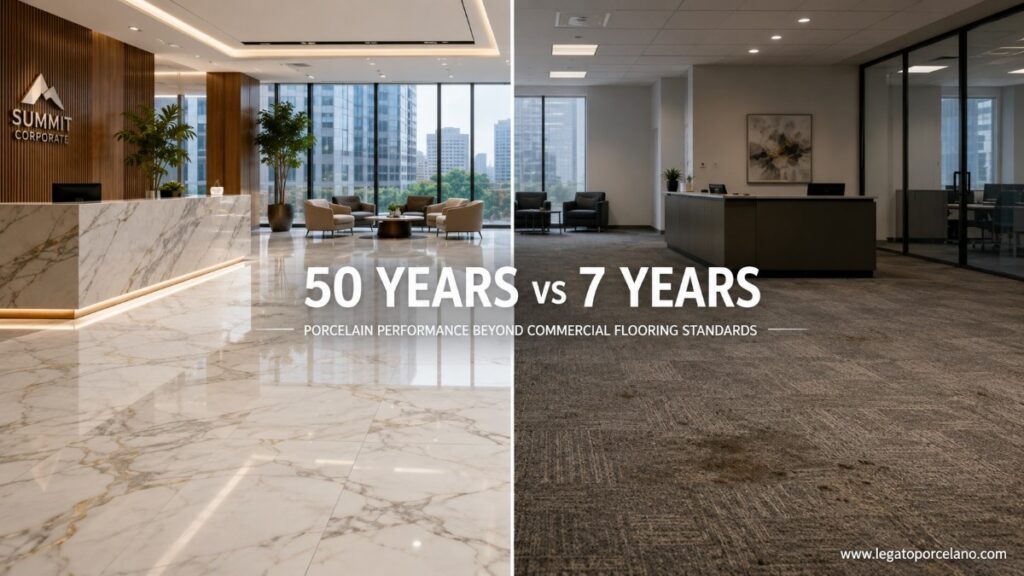
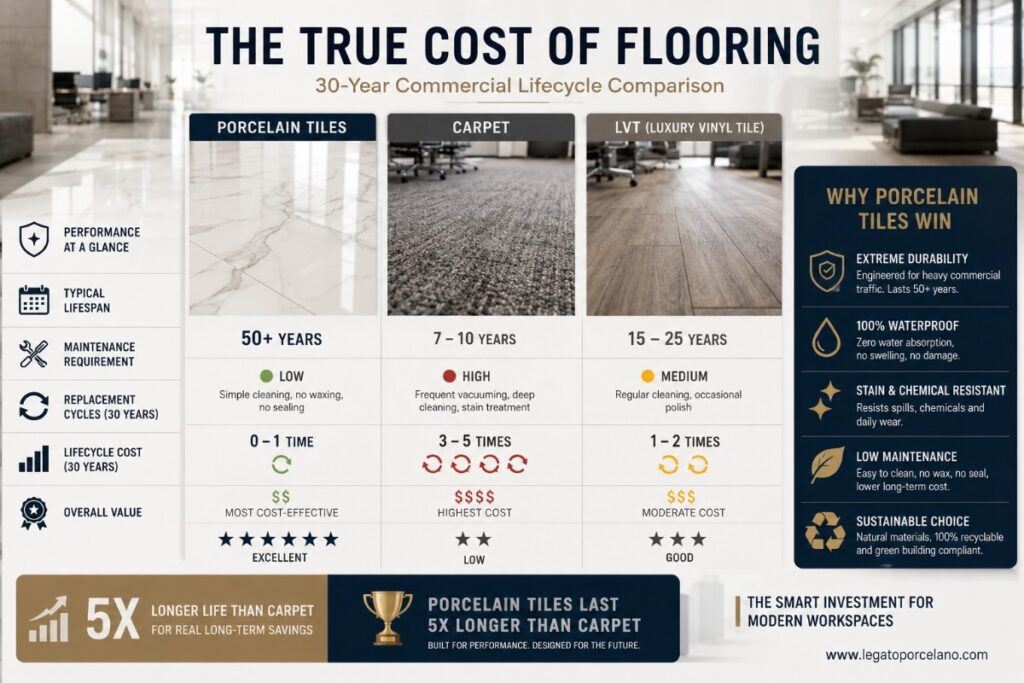
A properly specified porcelain tile floor, installed to TCNA standards, lasts 50 years or more in commercial office conditions. Commercial carpet in equivalent high-traffic environments requires replacement every 7–10 years. Luxury vinyl tile (LVT): 15–25 years. The cost differential across a 30-year building operational life is not marginal. It is structural.
The PEI system tells you exactly what grade to specify:
| PEI Grade | Environment | Office Application |
|---|---|---|
| PEI 3 | Light commercial | Small private offices |
| PEI 4 | Moderate commercial | Corridors, lobbies, open-plan floors |
| PEI 5 | Heavy commercial | High-volume entrances, retail-adjacent zones |
For most corporate office environments, PEI 4 is the minimum specification. Any tile below this will show measurable surface wear within standard commercial conditions — regardless of its appearance in a showroom.
Breaking strength under ASTM C648 requires a minimum of 275 lbf average (250 lbf minimum) for porcelain floor tiles per ANSI A137.1. Commercial-grade porcelain from premium manufacturers exceeds this standard significantly, with some full-body products achieving compressive strengths above 20,000 psi.
Maintenance is the hidden commercial advantage. Porcelain’s non-porous surface requires only pH-neutral cleaning. facing issues into:
- stripping
- waxing
- sealing cycles
- specialized chemistry
For a facility manager responsible for 50,000 square feet of commercial office, this simplicity has direct and measurable budget consequences year over year.
“Porcelain tiles are the most resilient variety — highly suited to office environments with high movement.”
— CDC Distributors, Commercial Flooring Guide
Architect & Designer Authority: Specification Intelligence
Architects return to porcelain tile across project after project not from habit, but because it is the only commercial flooring material that provides legally defensible, independently verified specification language.
When a specification reads: GVT porcelain tile, PEI Grade 4 minimum, water absorption ≤0.5% per ASTM C373, DCOF ≥0.42 wet per ANSI A326.3, breaking strength ≥275 lbf per ASTM C648 — every contractor submitting for that project must demonstrate compliance with documented test data. There is no ambiguity. No substitution game. No post-installation dispute about whether performance was delivered.
This specification precision is unique to porcelain tile among commercial flooring categories. It is why the material dominates institutional, corporate, and government project specification in every developed market.
GVT vs. PGVT: The specification decision that matters:
GVT (Glazed Vitrified Tile) — the commercial default for floor applications. Available in matte, satin matte, lapato, and textured finishes. Superior traction performance. Full design vocabulary. Suitable for all commercial traffic zones.
PGVT (Polished Glazed Vitrified Tile) — the premium choice for formal, lower-traffic feature areas. Mirror-finish surface reads as unambiguously luxury. Requires DCOF verification for wet areas. Higher maintenance frequency in high-traffic zones.
The finish specification guide for commercial offices:
| Zone | Recommended Finish | Reason |
|---|---|---|
| Open-plan floors | GVT Matte / Satin Matte | Traffic resilience, slip safety, mark resistance |
| Building entrance | GVT Textured | Moisture ingress, slip resistance mandatory |
| Formal reception | GVT Satin / Lapato | Premium read + practical cleaning |
| Boardroom | GVT Satin Matte | Design precision + daily maintenance |
| Feature walls | PGVT High Polish | Maximum visual impact, zero traffic load |
| Executive lobby | GVT or PGVT Lapato | Prestige + performance balance |
📌 [Image: A detailed architectural drawing or specification sheet — annotated floor plan showing tile zones by finish type. Use as a professional-audience visual. Place after the specification table.]
Technical Deep Dive: Material Expertise
Water absorption (ASTM C373):
The 0.5% porcelain threshold is not a quality claim — it is a material classification under ANSI A137.1:2022, enforced by the TCNA’s PTCA certification program. Products marketed as porcelain that do not meet this standard through independent testing are misclassified, and the commercial market contains them. Always request PTCA certification or batch-specific ASTM C373 test reports.
PEI abrasion resistance (EN ISO 10545-7):
Tested by subjecting glazed tile surfaces to an abrasive medium under controlled load and rotation. The resulting wear classification (PEI 1–5) is the only standardized measure of surface durability for commercial traffic. PEI Grade 4 minimum for office floors.
Breaking strength (ASTM C648):
A three-point load test measuring force required to fracture the tile body. ANSI A137.1 requires 275 lbf average for porcelain. This tests the tile in isolation — subfloor preparation quality determines real-world performance. A tile with 275 lbf breaking strength installed over a poorly prepared substrate will fail. The standard is a material floor, not a system guarantee.
Dynamic Coefficient of Friction — DCOF (ANSI A326.3):
The current U.S. slip resistance standard for commercial floors. Minimum DCOF ≥0.42 wet for interior floors where water may be present. This is a safety compliance threshold. Verify per-product test data, not finish category generalizations.
Dimensional tolerances (ANSI A137.1 — C485, C499, C502):
Calibration (size), warpage (flatness), and wedging (squareness) affect installation precision and long-term floor performance as significantly as tile strength. Rectified tiles — mechanically finished after firing — achieve tighter dimensional tolerances, enabling narrower grout joints and more precise large-format layouts.
Office Flooring Trends 2026
Three documented shifts are reshaping commercial office flooring specification in 2026. None of them are trends in the casual sense. They are material consequences of broader changes in how organizations think about workspace.
The warm neutral shift.
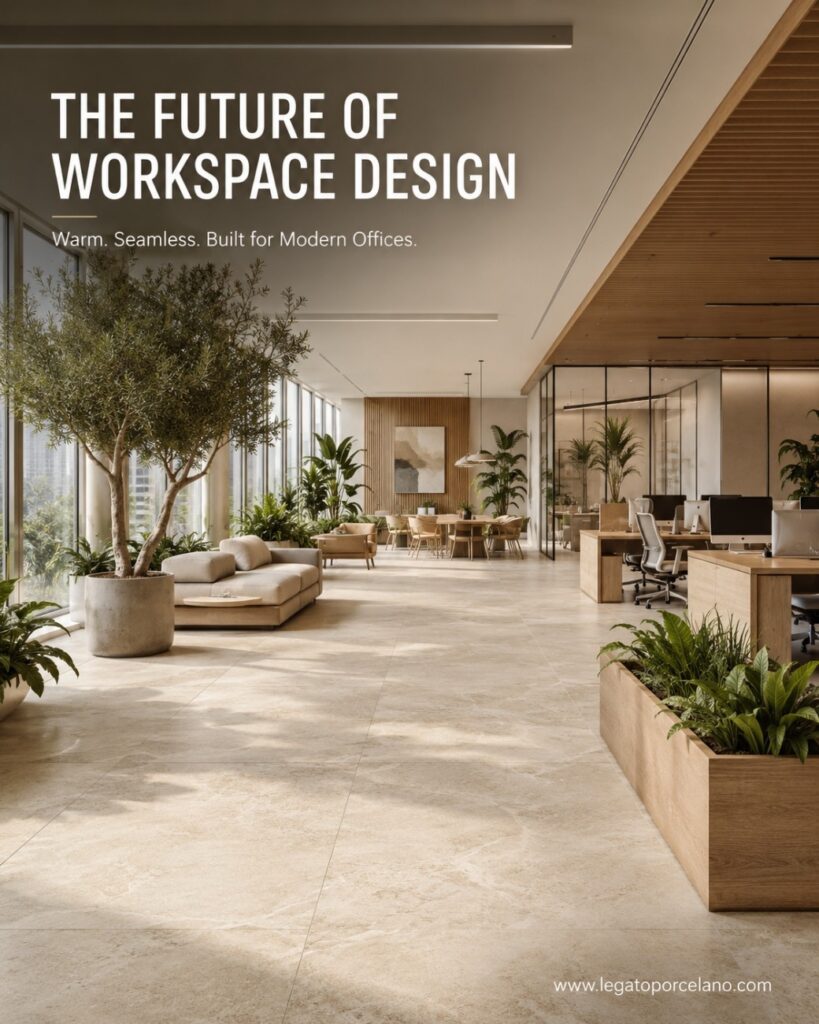
Cool grey-white palettes that defined corporate interiors from 2015–2023 are being replaced — not gradually, but decisively — by warm beige, taupe, greige, and warm stone tones. Multiple commercial design authorities have confirmed this in their 2026 reporting. The mechanism is not fashion: peer-reviewed research in environmental psychology shows warm-toned, natural-material-referencing surfaces correlate with lower reported stress and higher perceived restorativeness among office workers. The palette change is evidence-based, not editorial.
Biophilic material specification.
A 2024 study published in Frontiers in Psychology(NCBI), examining greened office environments, found that natural-material references in workspaces are associated with measurable restorative attention effects consistent with Attention Restoration Theory. Stone-look, travertine-look, and wood-look porcelain tiles are now specified as biophilic design interventions, not just aesthetic choices. The visual cortex processes high-quality natural-look surfaces through the same pathways as actual natural materials.
Sustainability as procurement baseline. Environmental Product Declarations (EPDs), GREENGUARD certification, and Health Product Declarations (HPDs) are now required — not preferred — in major commercial office specifications.
Porcelain tile’s case: natural raw materials (clay, feldspar, silica, sand), zero VOC emission during occupancy, and a 50+ year service life that eliminates two to three full replacement cycles compared to alternative flooring systems. Fewer replacement cycles means less construction waste, less transportation energy, and less embodied carbon over a building’s operational life.
“Sustainability is no longer a differentiator. In 2026, it is a baseline procurement requirement.”
— Stonhard Commercial Flooring Trends Report, 2026
Export Quality & Why the Manufacturer Matters
The porcelain tile market contains a spectrum from genuinely commercial-grade products to materials that carry the marketing language of premium without the manufacturing standards that make it true. For architects specifying across international projects, and for global buyers sourcing commercial quantities, understanding what separates these categories is not a detail — it is project risk management.
What commercial-grade manufacturing actually requires:
Pressing pressure that achieves the body density necessary for ≤0.5% water absorption. Kiln temperature control precise enough to produce consistent color, dimensional stability, and structural density across every production batch. High-definition surface printing (360+ DPI) that creates the visual depth distinguishing premium from entry-level design. Calibration tolerances (per ANSI A137.1 C485, C499, C502) that allow large-format installation without lippage or layout compromise.
What global buyers verify before committing:
PTCA or equivalent independent certification for water absorption. Batch-specific PEI and DCOF test reports (not product-level averages). ISO 9001:2015 quality management certification. Dimensional calibration records across production batches. CE marking for European markets. SGS or equivalent third-party testing documentation for premium commercial specifications.
The batch consistency issue is where lower-tier manufacturers consistently create project-level problems. A tile that matches the sample perfectly can arrive on site with visible shade variation from a different production batch. Premium manufacturers control this through documented shade matching systems, batch labeling, and supply agreements that allow large commercial orders to be fulfilled from consistent production runs.
“Quality is not just a promise — it is a standard. Every batch undergoes testing to ensure customers receive tiles that deliver long-term durability.”
Why Legato Porcelano
Legato Porcelano is India’s leading GVT/PGVT porcelain slab manufacturer and exporter, offering 1,000+ designs across 12+ sizes, exporting to 30+ countries from Morbi, Gujarat.
The Morbi advantage is real and specific: the region’s manufacturing infrastructure — advanced Italian and Spanish machinery, a highly skilled specialist workforce, raw material supply chains optimized over decades, and a global logistics ecosystem — produces the conditions where commercial-grade quality and internationally competitive pricing coexist. Among the many brands present in Morbi, Legato Porcelano has earned a distinctive reputation as one of the most trusted, progressive, and globally recognized tile manufacturers, with a vision built on excellence, creativity, and next-generation manufacturing standards.
For commercial office projects specifically, Legato Porcelano provides:
Manufacturing precision using advanced technology imported from Italy and Spain — the same equipment base that defines European premium manufacturing standards. This directly controls the pressing pressure, kiln temperature profile, printing resolution, and calibration precision that determine whether a tile performs at commercial grade.
Design depth across the complete commercial vocabulary: marble-look in multiple colorways, concrete-look in multiple matte finishes, large slab formats for feature applications, GVT textured surfaces for entrance and wet-area specification, and PGVT polished finishes for formal feature applications. Legato Porcelano is dedicated to incorporating the latest trends and technologies into its product line — from sleek, minimalist designs to bold, statement-making patterns — ensuring tiles that are not only visually stunning but also highly durable and low-maintenance.
Global supply reliability across 30+ countries including the USA, Canada, UK, Germany, France, Italy, Australia, and markets across the Middle East, Eastern Europe, and Asia-Pacific. Legato Porcelano ensures that Indian tiles meet and exceed global quality benchmarks, making them competitive with top European manufacturers.
Single-source capability for large commercial projects — consistent design, consistent calibration, consistent supply across the production volume that corporate campus and multi-floor office fit-outs require.
The floor that architects specify, designers detail, and businesses invest in should last longer than any of those relationships. Legato Porcelano manufactures it to.
Conclusion
Porcelain tiles have become the leading choice for modern office flooring because they combine durability, low maintenance, and premium design in one commercial-grade solution. From large-format seamless aesthetics to long-term performance under heavy traffic, they meet both functional and architectural demands of today’s workspaces.
For businesses, architects, and designers seeking reliable export-quality GVT and PGVT solutions, Legato Porcelano offers the design innovation, manufacturing precision, and global-quality standards required for modern commercial projects.
FAQs
Porcelain tiles offer high durability, low water absorption, scratch resistance, and long-term performance in heavy commercial traffic areas. They also require minimal maintenance compared to carpet or vinyl flooring.
Matte and satin-finish GVT tiles are ideal for most office environments because they provide better slip resistance, reduced visible wear, and easier daily cleaning in high-traffic areas.
Yes, large-format tiles create a seamless and premium visual effect with fewer grout lines, making office spaces appear larger, cleaner, and more sophisticated.
Legato Porcelano is trusted for commercial office flooring because of its export-quality GVT and PGVT tiles, advanced manufacturing precision, and globally recognized design standards. .
A properly installed commercial porcelain tile floor can last 50+ years with standard maintenance, making it one of the most cost-effective flooring investments over time.
