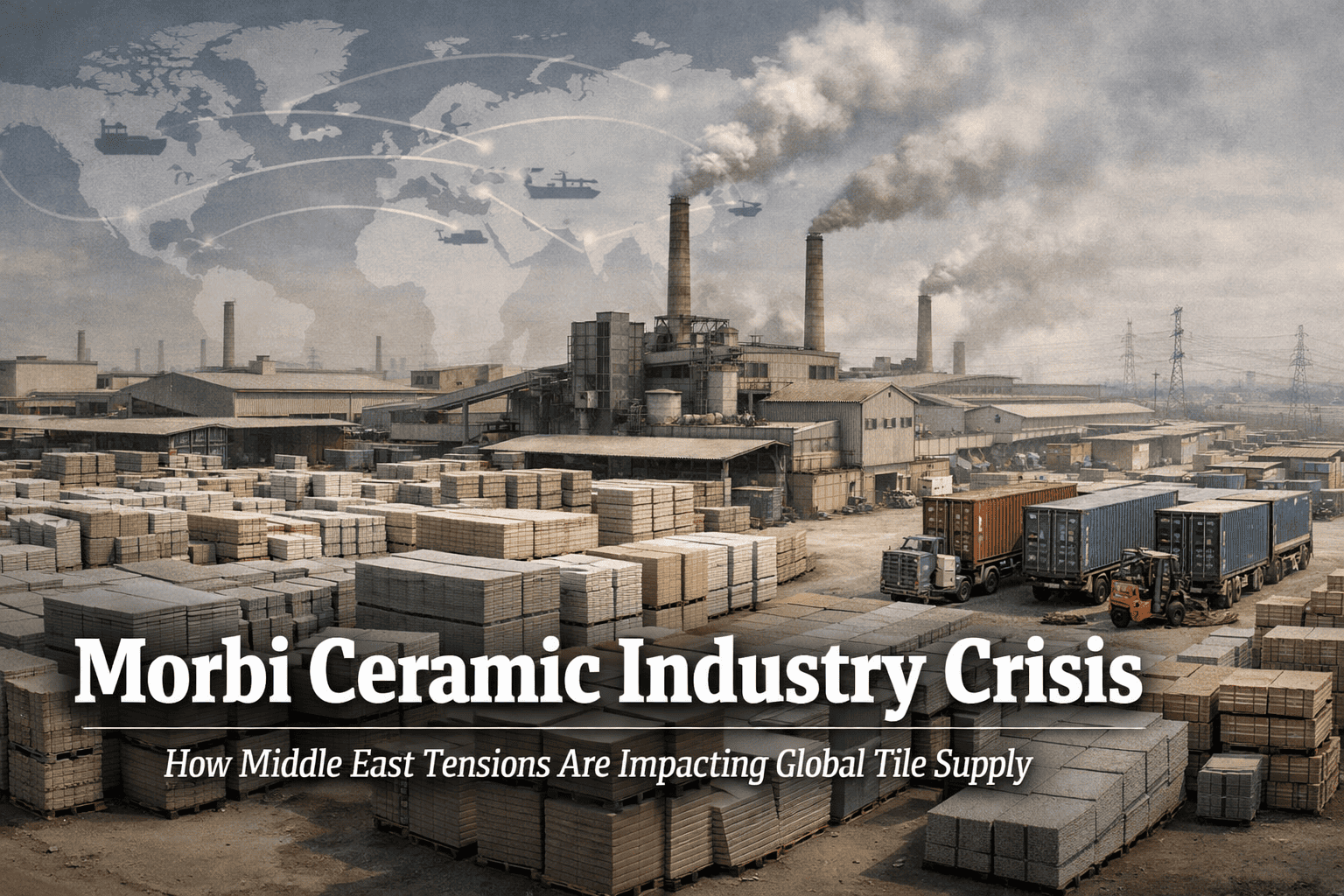
Morbi, a city in Gujarat, has spent decades building a reputation as the ceramic capital of India — and it has earned it.The region accounts for over 80% of India’s ceramic tile production and ships to more than 130+ countries, which makes it a genuinely critical node in the global tile supply chain,
That position is now under serious pressure. A combination of fuel supply disruptions tied to Middle East geopolitical tensions, rising energy costs, tightening environmental regulations, and softening in some export markets has pushed hundreds of factories to slow production or shut down entirely. Reports put the number of temporarily closed units at over 200, with several hundred more at risk if conditions don’t improve.
This piece covers what’s actually happening, why it’s happening, who it affects, and what the realistic near and long-term outlook looks like — for manufacturers, workers, and the international buyers who depend on Morbi’s output.
What Makes Morbi So Important
To understand why the current crisis matters, you need to understand what Morbi actually represents. This isn’t a regional manufacturing story — it’s a global supply chain story.
The scale of the Morbi cluster is significant:
- Over 800 ceramic tile factories operate within the region
- Annual turnover across the cluster runs to approximately ₹50,000 crore
- Ceramic products from Morbi reach more than 150 countries worldwide
- Direct and indirect employment linked to the industry runs to nearly 9 lakh people
India is currently the second-largest producer of ceramic tiles globally, after China. According to the India Brand Equity Foundation (IBEF), the country exported ceramic tiles industry reached a market value of Rs. 62,000 crore (US$ 6.99 billion) in FY24, with a significant share produced in the Morbi ceramic cluster.
Several geographic and industrial advantages built Morbi into this position: proximity to Mundra and Kandla ports keeps export logistics costs competitive; access to raw materials and a concentrated pool of skilled labour reduces production friction; and the cluster effect — hundreds of manufacturers, suppliers, and service providers in close proximity — drives down costs that would be higher for isolated factories.
The result is that India has become the second-largest ceramic tile producer in the world, and Morbi is where most of that production happens.
What Is Currently Happening in Morbi
The disruption has been building since early 2026, driven primarily by the effect of Middle East tensions on fuel supply chains. The situation on the ground, based on current reporting:
- According to the Print Economy Around 200 ceramic factories have stopped operations temporarily
- According to Mint An estimated 300–400 additional factories could shut down if fuel shortages continue
- Some units have already cut production as propane supplies have been interrupted
The downstream effects are already visible in export timelines. International buyers who placed orders with Morbi manufacturers are seeing delays, and some are beginning to explore alternative sourcing as a contingency. This matters not just for individual transactions but for global construction supply chains that have been built around reliable Indian tile availability.
What Is Driving the Crisis
1. Fuel Supply Disruption
This is the immediate trigger. Ceramic tile manufacturing is energy-intensive — kilns need to reach and maintain temperatures above 1200°C, and they run continuously. The fuel of choice for most Morbi factories is propane or natural gas, much of which is imported or dependent on supply routes through the Middle East.
Geopolitical tensions in the region since early 2026 have disrupted fuel shipments to India. The practical consequences for Morbi have been direct: propane deliveries to factories have been interrupted, kilns have had to be shut down, and export shipments that depend on continuous production have slowed or stopped.
The economics of kiln operation leave manufacturers with little flexibility when fuel supply drops. A kiln that can’t run at capacity doesn’t run at a useful partial capacity — it either operates or it doesn’t. So fuel disruptions translate almost immediately into production stoppages rather than just reduced output.
2. Rising Energy Costs
Energy prices have been climbing for Morbi manufacturers over several years, and the current supply disruption has accelerated that pressure. Industry data shows that energy represents a significant share of total manufacturing cost for ceramic tiles — estimates vary, but figures of 30–40% are common. When that cost increases sharply, the margin structure for small and mid-size manufacturers breaks down quickly
The manufacturers most exposed are the smaller units that don’t have the scale to absorb cost increases through volume or negotiate better supply terms. Many of the 200+ shuttered factories fall into this category — they’ve effectively been priced out of production until the cost environment improves.
3. Environmental Regulations and the Fuel Transition
Layered on top of the supply and cost issues is a regulatory transition that was already underway before the current crisis. Gujarat authorities have been phasing out coal gasifiers — previously the dominant fuel technology in Morbi — due to pollution concerns, requiring factories to shift to piped natural gas (PNG) or other cleaner alternatives.
The transition itself is directionally the right policy. But the timing and pace have created real financial pressure. Factories that invested in the switchover incurred significant capital costs. Those that didn’t were penalised for continuing to use banned technologies. Either way, the regulatory environment added cost at a time when external pressures were already tightening margins. Several units that might have survived the fuel supply shock in a normal cost environment couldn’t absorb the combination.
4. Export Market Headwinds
According to the India Brand Equity Foundation (IBEF), India’s ceramic tile exports reached 590 million square metres in FY24, generating over ₹20,000 crore in export revenue — a number that reflects how much Morbi’s economic health depends on international demand holding up.
That demand is under pressure from several directions simultaneously. Freight cost volatility has eroded the price advantage that Indian manufacturers hold over competitors. Demand in some key markets has softened. And the competitive landscape hasn’t stood still — China, Turkey, Spain, and Italy all continue to invest in their own ceramic manufacturing sectors and compete directly with Indian exporters in overlapping markets.
None of these factors alone would constitute a crisis. Together, at the same time as the fuel situation, they’re compressing margins from multiple directions.
Impact of the Crisis
On Manufacturers
The most immediate impact is on factory operations. Manufacturers are dealing with production stoppages, reduced order books, higher input costs, and in some cases the need to break or delay supply contracts with international buyers. Some companies are actively exploring alternative fuel sources and operational workarounds — running kilns on alternative gas mixes, reducing batch sizes, or sequencing production more carefully around available fuel. (Reuters)
The manufacturers best positioned to weather this are those with stronger balance sheets, longer-standing export relationships, and the operational flexibility to adjust production schedules. Smaller units with tighter margins and less diversified customer bases are more exposed.
On Employment
The employment picture is the most serious human dimension of this crisis. The Morbi ceramic cluster supports nearly 9 lakh workers — not just factory floor workers but logistics operators, packaging suppliers, freight forwarders, and the wider service economy that depends on the cluster’s activity. Extended factory shutdowns put all of that at risk. According to news artical
Many manufacturers are making efforts to retain their workforces through temporary shutdowns — providing accommodation and food, keeping core teams on reduced hours rather than laying off entirely. That’s a short-term measure. If the disruption extends for months rather than weeks, the labour market consequences will be harder to manage.
On Global Tile Supply
For international buyers, the Morbi disruption creates a supply uncertainty that’s worth planning for. The markets most exposed are those that have concentrated their tile sourcing heavily on Indian suppliers — particularly in the US, Europe, Middle East, and Africa, where Morbi-manufactured tiles have significant market share.
The practical effects: some orders are being delayed, lead times are extending, and pricing pressure may emerge as available supply tightens relative to demand. Buyers who have existing orders with affected manufacturers should be proactively checking on production status. Those planning future procurement should factor in the possibility of longer lead times or the need to work with alternative suppliers while the situation resolves.
Future Outlook for the Morbi Ceramic Industry
The short-term picture is genuinely uncertain — the duration and severity of the fuel supply disruption depends on geopolitical developments that are difficult to forecast. But the medium and long-term outlook for Morbi is more stable than the current headlines suggest, for several reasons.
Global tile demand is structurally growing
Urbanisation in emerging markets, ongoing infrastructure investment in South and Southeast Asia, Africa, and the Middle East, and steady residential construction activity in established markets all point to sustained long-term demand for ceramic tiles. Morbi will be a significant beneficiary of that growth once the current disruptions stabilise.
The cluster’s industrial depth is a genuine advantage
Morbi’s dense ecosystem — raw material suppliers, equipment manufacturers, packaging, logistics, skilled labour — means it can adapt and recover faster than more fragmented manufacturing regions. The infrastructure built over decades doesn’t disappear during a temporary crisis; it’s available to restart when conditions allow.
Export market diversification is underway
Indian ceramic manufacturers were already expanding into Africa, Latin America, and Southeast Asia before the current crisis — markets where demand is growing and where Indian pricing and product range are competitive. That diversification reduces dependence on any single export region and spreads the risk of localised demand softness.
Energy transition investment is accelerating
The current fuel crisis has, if anything, accelerated manufacturers’ interest in energy alternatives. Investment in more fuel-efficient kiln technologies, solar-assisted processes, and alternative gas sources was happening before 2026 — the current situation is pushing that transition faster. Manufacturers that complete the switch to more stable, domestically available energy sources will emerge from this crisis in a structurally stronger position.
What This Means for Tile Buyers and Construction Companies
If you’re an architect, developer, or importer who relies on Morbi-sourced tiles, the current situation warrants attention but not panic. Here’s the practical picture:
- Check the status of existing orders directly with your supplier — don’t assume production is running normally if you haven’t confirmed recently
- Build more lead time into upcoming procurement planning than you normally would
- Consider whether your sourcing is concentrated enough with affected suppliers that you need a contingency plan
- For new projects where tile specification is still flexible, factor supply certainty into material selection alongside the usual cost and design criteria
Working with manufacturers that have demonstrated production stability, strong export infrastructure, and the operational scale to manage supply disruptions reduces exposure to these risks.
Companies such as Legato Porcelano focus on high-quality porcelain tile manufacturing and maintaining reliable global supply standards — worth considering for buyers evaluating their sourcing options during this period.
Conclusion
The Morbi ceramic industry is going through a genuinely difficult period. The fuel supply disruption triggered by Middle East tensions is the acute problem, but it’s landed on an industry already dealing with rising energy costs, a mandatory regulatory transition, and competitive pressure in export markets. The combination has been enough to shut down hundreds of factories and put at risk the livelihoods of hundreds of thousands of workers.
What it hasn’t done is fundamentally alter Morbi’s structural position in the global tile industry. The manufacturing infrastructure, the labour pool, the logistics connections, and the export relationships are all still there. When fuel supply stabilises — and it will — the cluster has everything it needs to return to full capacity.
For international buyers and the broader construction industry, the most useful response is clear-eyed planning: understand which parts of your supply chain are exposed, maintain direct communication with your suppliers, and treat this as a signal to build some redundancy into sourcing rather than assuming single-source concentration will always work. The long-term fundamentals for Indian ceramic manufacturing remain strong.
FAQ’s
What is the Morbi ceramic industry and why is it important?
The Morbi ceramic industry in Gujarat is one of the largest tile manufacturing clusters in the world. It produces more than 80% of India’s ceramic tiles and exports products to over 130 countries, making it a key contributor to the global tile supply chain.
How do Middle East tensions affect the Morbi ceramic industry?
Middle East conflicts disrupt the supply of propane and natural gas used in ceramic kilns. Since ceramic tile production relies heavily on stable fuel supply, shortages can increase costs, reduce production capacity, and even force factories to shut down.
Why is fuel important in ceramic tile manufacturing?
Fuel is essential for firing ceramic tiles in high-temperature kilns. Energy costs often account for 30–40% of production costs in tile manufacturing, so disruptions in fuel supply significantly affect industry profitability.
How many ceramic factories operate in Morbi?
Morbi has more than 800 ceramic manufacturing units producing tiles, sanitaryware, and vitrified products, employing hundreds of thousands of workers and exporting worldwide.
Can Middle East conflicts affect global tile supply?
Yes. Since Morbi is one of the largest tile manufacturing hubs globally, disruptions in production can impact international supply chains and export markets across Asia, Africa, Europe, and the Middle East.
What solutions can help the Morbi ceramic industry during fuel crises?
Possible solutions include diversifying fuel sources, adopting alternative energy technologies, improving energy efficiency in kilns, and strengthening supply chain resilience to reduce dependency on imported fuel.